Reading & Literacy Interactive

Book Bans Over the Years, in Charts

By Eesha Pendharkar — April 28, 2023 2 min read
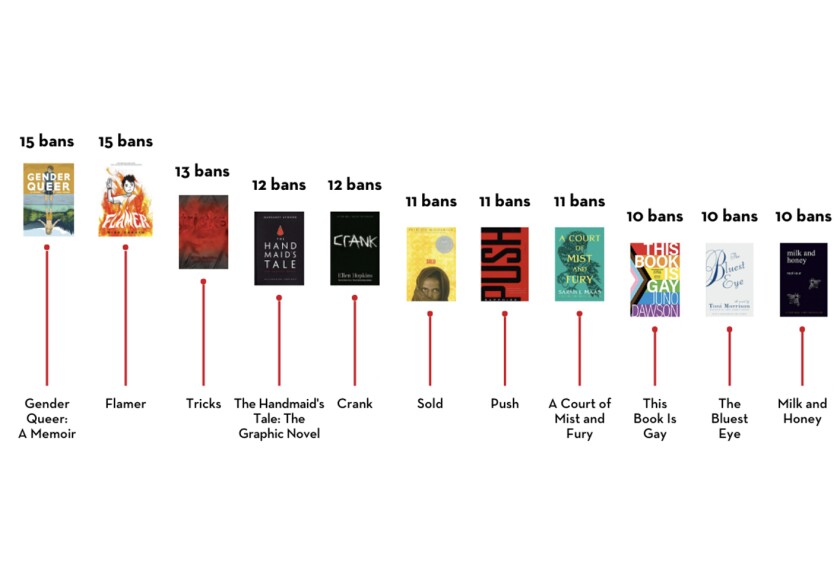
The most banned books from the fall of 2022, according to PEN America.
  • Save to favorites
  • Print

Book bans have escalated for 18 months now, hitting an all-time high in December 2022.

Since June 2021, PEN America, a free speech advocacy organization that tracks bans, has recorded more than 4,000 book challenges and bans in school districts.

The actual number is estimated to be even higher because PEN America relies on media reports, publicly available documents, and school district meeting minutes to track bans.

Book bans have impacted a wide range of topics, from titles about LGBTQ+ characters, to books on sexual health, to books featuring themes of race and racism.

Here’s a visual representation of book bans, from June 2021 to December 2022, based on PEN America data:

How many books have been banned?

Book bans reached an all-time high during the fall of 2022. But since 2021, PEN America has tracked more than 1,000 instances of book challenges and bans during each six-month period.

What is the No. 1 most banned book?

Gender Queer: A Memoir by Maia Kobabe, is the most banned book over the last 18 months. The graphic memoir both written and illustrated by Kobabe chronicles the author’s life from adolescence to adulthood, detailing their experiences with their gender and sexual identity.

It has been banned 56 times in 18 months.

What is the No. 1 reason books get banned?

Books are frequently challenged for having inappropriate or sexual content, according to PEN America. In 2021 and the first half of 2022, more than 41 percent of banned books were about LGBTQ+ characters or stories. That changed in the latter part of 2022, with most banned books being about sexual experiences, violence, or sexual health.

However, many books about gender and sexual identity that chronicle LGBTQ+ experiences fall under these categories too.

Where do books get removed from?

Books predominantly get removed from school libraries, with only a small percentage of book bans impacting classrooms specifically. Most books are removed pending investigation, meaning that a book is removed whenever there’s a challenge for review.

Many of these books are removed from student access before due process of any kind is carried out, according to PEN America. In some cases, books can also be removed without challenges for review. These books often end up being unavailable for weeks or months.

Where are book bans happening?

Most book bans are happening in Texas and Florida, according to PEN America. Over the past year, Texas has seen more than 1,200 book challenges, and Florida more than 900. In some cases, state laws are responsible for causing districts to remove books to err on the side of caution, the report found. In other cases, districts are removing hundreds of titles for review.

Book bans have been recorded in at least 32 states.

Related Tags:

Events

This content is provided by our sponsor. It is not written by and does not necessarily reflect the views of Education Week's editorial staff.
Sponsor
Artificial Intelligence Webinar
Managing AI in Schools: Practical Strategies for Districts
How should districts govern AI in schools? Learn practical strategies for policies, safety, transparency, and responsible adoption.
Content provided by Lightspeed Systems
This content is provided by our sponsor. It is not written by and does not necessarily reflect the views of Education Week's editorial staff.
Sponsor
Student Absenteeism Webinar
Turning Attendance Data Into Family Action
This California district cut chronic absenteeism in half. Learn how they used insight and early action to reach families and change outcomes.
Content provided by SchoolStatus
This content is provided by our sponsor. It is not written by and does not necessarily reflect the views of Education Week's editorial staff.
Sponsor
College & Workforce Readiness Webinar
Climb: A New Framework for Career Readiness in the Age of AI
Discover practical strategies to redefine career readiness in K–12 and move beyond credentials to develop true capability and character.
Content provided by Pearson

EdWeek Top School Jobs

Teacher Jobs
Search over ten thousand teaching jobs nationwide — elementary, middle, high school and more.
View Jobs
Principal Jobs
Find hundreds of jobs for principals, assistant principals, and other school leadership roles.
View Jobs
Administrator Jobs
Over a thousand district-level jobs: superintendents, directors, more.
View Jobs
Support Staff Jobs
Search thousands of jobs, from paraprofessionals to counselors and more.
View Jobs

Read Next

Reading & Literacy Spotlight Spotlight on Creating an Authentic Reading Culture
Create a culture of literacy: abundant books, explicit skills, daily reading, and real engagement that turns students into lifelong readers.
Reading & Literacy Phonics Is Crucial. But How Much Is Too Much?
An influential researcher in the science of reading movement is warns schools may be "overteaching" the skill.
6 min read
Kassandra Geyer teaches phonics to her Intervention class for struggling students on Nov. 8, 2024 at Horizon Elementary School in Port Orange, Fla.
A teacher teaches phonics to her intervention class for struggling students on Nov. 8, 2024 at an elementary school in Port Orange, Fla. Research points definitively to phonics as a key part of learning to read—but not how much phonics instruction, or for how long, students should ideally receive.
Zack Wittman for Education Week
Reading & Literacy Opinion Has Our Zeal for the Science of Reading Created a Cycle of Confusion?
I’m an Orton-Gillingham-certified teacher. Here’s why the spread of new programs troubles me.
Stacy Davies
3 min read
Information overload concept
Education Week + Getty
Reading & Literacy Opinion How Graphic Novels Can Bring Joy to Reading Instruction
Here's how teachers are using comic books and nonfiction graphic novels in literacy instruction.
6 min read
Conceptual illustration of classroom conversations and fragmented education elements coming together to form a cohesive picture of a book of classroom knowledge.
Sonia Pulido for Education Week