

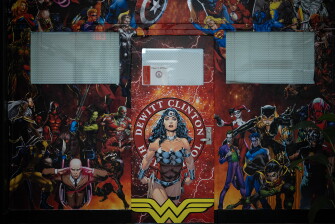
At 15, Jeremy Vargas might seem too young for even the most mundane of summer jobs. But the rising sophomore at DeWitt Clinton High School, a public school in the Bronx neighborhood of New York, secured an on-campus internship that allows him to apply art skills he learned in classes to create everything from T-shirt designs to door wraps. He’s working 25 hours a week this summer, and will scale back to upwards of 12 hours when school’s back in session.
Word of Jeremy’s talent, and that of other DeWitt Clinton student interns, has gotten out. A handful of nearby New York City public schools have reached out to Jeffery Stephens-Prince, the work-based learning coordinator at the school, to arrange for the interns, hand-picked from the school’s Visual and Commercial Arts pathway, to create unique designs for branding purposes. The students earn minimum wage.
“Everything that we train the students to do, every internship they get, is based on them supplementing a skill within our school’s career pathways,” said Stephens-Prince, who, in addition to coordinating work-based learning, teaches robotics at DeWitt Clinton.
It sounds like the stuff of a highly effective high school. And compared to just 10 years ago, Dewitt Clinton is indeed successful.
This past school year, its graduation rate reached 95%. And the chronic absenteeism rate—which has long been a challenge for the high-poverty school—fell to under 26%.
That’s a far cry from the 2015-16 school year, when the graduation rate had bottomed out at 48%, 44% of students were chronically absent, the school was under the threat of state takeover, and two principals had come and gone by the middle of the year.
Pierre Orbe, who began his tenure as principal at DeWitt Clinton in February of 2017 after serving as an assistant principal for a decade elsewhere in the city, had asked to be placed in New York City’s most troubled school. He got his wish.
“The building was plagued by disorder, chronic absenteeism, and widespread staff dysfunction. Many teachers had lost faith in the leadership structure, and students—particularly those with the highest needs—were falling through the cracks,” said Orbe, who was named the 2025 New York State High School Principal of the Year.
This fall, Orbe will start his 9th year at DeWitt Clinton, where 87% of its estimated 1,050 students come from economically disadvantaged backgrounds, and students of color make up 98% of enrollment.
“A lot had to happen to move this school from the brink of closure to one of the most promising turnaround stories in the city,” Orbe said.
Central to that change involved creating a learning environment that inspired students to show up for school, gain applicable skills, and feel confident that they were prepared for next steps. But before making any significant changes, Orbe went on what he calls a “listening tour” of sorts to find out what students felt their school lacked, and what needed to change.
Orbe’s first task: a listening tour
Initially, the student body was less than hospitable to Orbe’s presence, and he understood why. “Students saw leaders coming in and out of here, so they were like: Who are you?”
Orbe was undeterred. He surveyed students about the kinds of clubs, courses, and programs they wanted. The students eventually opened up, voicing their displeasure with how things had been going and revealing very clearly what they wanted.
“They were like, ‘We need to work. Our families need our help. I need a career that hopefully can help me work sooner than later,’” Orbe said.
The students also indicated that they wanted not just any work, but meaningful work and a pathway to getting ahead, Orbe said.
“What we heard loud and clear was that they wanted college credits, certifications, and internships,” he said. “That became our promise: CCI—college credits, certifications, and internships.”
DeWitt Clinton students’ desire for practical, work-based opportunities aligns with the interests of students across the country. In a 2022 national survey of more than 1,000 high school students by the College Savings Foundation, a majority of respondents expressed a desire for “more pragmatic education options.”
Personalizing learning through pathways of interest
It was important to Orbe that the school develop career pathways that reflected student interests and industry demand. Prior to his arrival, the school offered electives but no formal pathway sequences, certifications, or college-aligned opportunities.
The school now offers seven formal career pathways: visual and commercial arts, health/nursing, computer science, dance, digital music/music production, agriculture, and business. The school’s early college program, the MACY Honors program, provides an additional five pathways: engineering/robotics, vocal and band music, visual arts, biomedical science, and business.

Internships are a vital part of these pathways, and the school has worked to establish local industry partnerships that accept student interns year-round. Current partnerships include Hearst Media, Mt. Sinai Health System, the Hip Hop Museum in the Bronx, the New York Botanical Garden, and real estate brokerages across the city.
Orbe said he makes a point to check in routinely with students to find out what career pathways they’d like to see added. While the school can’t always create full-fledge pathways based on every student’s interest, it works hard to accommodate them.
“We evolve all the time,” Orbe said. “Last year, we introduced tattooing as a vocational program at the school. We introduced real estate. This year, plumbing and electrical. These are after-school programs because I can’t fit them into the day.”
Successful completion of these pathways requires taking nine related elective credits, plus a career and financial management course; earning an industry certification; completing a paid internship that’s a minimum of 54 hours in length; developing a digital portfolio; and completing a capstone project.
The payoff is worth the effort: completing the pathways can increase both students’ job prospects as well as college and career readiness. An increasing body of research bears this out.
A 2022 report by the CTE Research Network found that participation in career and technical education led to improved high school grades, attendance, and graduation rates; and a greater likelihood of attending community college (as opposed to not enrolling in any college). Students from underrepresented racial and ethnic groups and/or low-income backgrounds reaped the most benefits, according to researchers.
But funding these student career pathways and paid work opportunities is expensive.
In 2022, the school applied for and received a Future Ready NYC grant, an initiative of New York City Schools that provides resources for career-connected learning with the goal of long-term economic security. This grant makes internships up to 80 hours possible for all students in the school’s computer science and nursing pathways.
The school self-funds up to 150 additional internships for students in other pathways. And New York City’s Summer Youth Employment Program funds summer work—some tied to students’ career interests—for approximately 200 of the school’s 11th and 12th graders.
Skills builds student confidence
The majority of DeWitt Clinton students enroll in a career pathway during their four years in high school, and about 94% of the school’s students graduate having completed a pathway.
Nursing and computer science see some of the biggest enrollment numbers, said Orbe, because they offer direct access to internships within hospitals and local tech companies.
Overall, more than 60% of students find paid employment, mainly affiliated with their respective pathways, during high school.
The background knowledge gained in the classroom, combined with practical work experience in their respective pathways, gives DeWitt Clinton students the confidence to pursue related college majors and careers post-graduation.

Judah Hull, a 2024 DeWitt Clinton graduate, is attending a local college, continuing as a commercial and visual intern at the high school this summer, and, in his spare time, tweaking a superhero he designed, which he hopes to eventually copyright.
Karina Duran, also a recent graduate from the school who is pursuing an arts-related major at a local college, said the hands-on skills experience and paid internship during her time at DeWitt Clinton gave her the confidence to continue her education.
“I never really saw myself going into college, especially not for art,” she said. “I don’t think I would be in college if I didn’t get into the [Visual and Commercial Arts pathway] program.”
Around 70% of this year’s graduating class enrolled in postsecondary institutions—compared to 34% in 2017, when Orbe first arrived at the school.
Further, industry certifications in sought-after fields are helping graduates secure employment. For instance, 30-some students who graduated this year from the school’s nursing pathway earned industry certificates. Each has been offered entry-level positions in the health care industry with hourly wages of about $23 an hour.
Teachers inspiring students
For these programs to exist, the school needed to hire teachers who could lead them.
“We hired teachers who brought these pathways to life,” Orbe said. “Many of our most successful programs—like nursing, dance, and commercial art—are led by educators who come directly from the field. They bring authenticity, up-to-date skills, and networks that immediately benefit our students.”
The commercial art students benefit from having a teacher who owns his own commercial design business and brings real-world projects for kids to work on. The music production teacher has developed music for commercials of big commercial brands, which lends credibility, Orbe said.
“It’s invaluable to even try to measure what it means to have industry-based experience,” he said.
Not only do these industry experts inspire the students, they know what skills they need in order to get practical experience and find relevant work opportunities.

Stephens-Prince is a prime example. He’s now a robotics teacher, but before that, he worked in corporate communications and web design and development. He knows what the industry demands of students.
Teachers with industry experience may also be more likely to treat students as emerging professionals—giving them space to explore and come up with workable solutions to challenges.
Students like Jeremy, the rising 10th grader, respond well to that approach.
“If we have any questions, Mr. Polanco [the commercial arts teacher] is definitely there. But he trusts us to, like, dive deep into the project and just be creative with our own thoughts,” Jeremy said. “If we need feedback or help, he’ll give us advice, but he won’t try to change our project. He gives us creative criticism.”


