College & Workforce Readiness What the Research Says

High School Completions on Par for Black, White Students

By Megan Ruge — January 21, 2020 1 min read
  • Save to favorites
  • Print

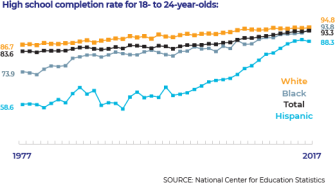
For the first time in 40 years, the percentage of black 18- to 24-year-olds with a high school credential was nearly the same as that of their white peers, data from the National Center for Education Statistics show, but racial gaps remain for earning an on-time diploma.

From 1977 to 2016, white students had a higher “status completion rate” than black students, meaning the percentage of young adults out of high school with a diploma or alternative like a GED. In 2017, that completion gap closed to only 1 percent, measuring 94.8 percent for white students and 93.8 percent for black students. The overall completion rate was 93.3 percent for 2017.
By contrast, the national adjusted cohort graduation rate measures the number of first-time 9th graders who earn a regular high school diploma four years later, accounting for students who transfer in or out, emigrate, or die, in the years between. That rate for 2016-17 was 85 percent, up 6 percentage points since it was first collected in 2010-11. But the cohort graduation rate for white students was 89 percent, versus 78 percent for black students.

A version of this article appeared in the January 22, 2020 edition of Education Week as High School Completions on Par For Black, White Students

Events

Teaching Profession K-12 Essentials Forum Supporting the New K-12 Workforce: What Teachers Need to Stay at School
 Join this free virtual event to discover what teachers say they need to feel supported to stay in classrooms for the long haul.
College & Workforce Readiness K-12 Essentials Forum Career and Technical Education Takes Its Next Big Step
Join this free virtual event to hear creative approaches to modernize CTE programs and navigate the shift away from a near-exclusive focus on "college preparedness."

EdWeek Top School Jobs

Teacher Jobs
Search over ten thousand teaching jobs nationwide — elementary, middle, high school and more.
View Jobs
Principal Jobs
Find hundreds of jobs for principals, assistant principals, and other school leadership roles.
View Jobs
Administrator Jobs
Over a thousand district-level jobs: superintendents, directors, more.
View Jobs
Support Staff Jobs
Search thousands of jobs, from paraprofessionals to counselors and more.
View Jobs

Read Next

College & Workforce Readiness More States Require Personal Finance. But Does It Actually Work?
Personal finance education can influence behavior positively with specific strategies.
5 min read
Photo illustration of a young black female holding her cellphone in one hand and a credit card in the other. Floating around her in the background are a calculator, pie chart, money, credit card, and piggy bank.
Photo collage by Gina Tomko/Education Week + Canva
College & Workforce Readiness Video How a "Reverse Career Fair" Can Launch High Schoolers Into the Real World
It flips the traditional model and allows students to set up booths to display their talents to employers.
1 min read
20260507 ReverseCareerFair EdWeek R5B 5725
Dustin Chambers for Education Week
College & Workforce Readiness Students Want Career Education. More Research Can Improve It, New Report Says
Career education is in demand from students and could be strengthened through research, a coalition says.
4 min read
Adult school student volunteer Starnese Sims, second from right in glasses, sings along with preschool children at Bradley Early Education Center, located on the campus of Maxine Waters Employment Prep Center, in Watts on May 5, 2026 . Adult school student volunteers visit Bradley EEC twice a week for field work as part of a career pathway that will earn them their child development assistant permit. The setup provides the preschool with extra staffing support and allows for collaboration between preschool teachers and adult school staff as students move through the program. The LAUSD early education center is home to the district's first experiment with non-traditional care hours through its expansion this year into evening child care.
A student volunteer sings along with preschool children at Bradley Early Education Center in the Watts neighborhood of Los Angeles on May 5, 2026. Older students visit the center regularly as part of a career pathway that will earn them their child development assistant permit. A coalition of education groups wants greater federal investment in research aimed at strengthening career-connected education that students are increasingly demanding.
Genaro Molina/Los Angeles Times via TNS
College & Workforce Readiness Not All Students Are College-Bound. More Schools Are Paying Attention
The "college for all" rallying cry is quieting down, even at traditional college-prep high schools.
5 min read
Boone Williams, 20, center, talks to other students in the apprentice training program class at the Plumbers and Pipefitters Local Union 572 facility in Nashville, Tenn., on Thursday, Feb. 2, 2023. Williams says eventually he expects to earn far more than friends who took quick jobs after high school. He even thinks he’s better off than some who went to college — he knows too many who dropped out or took on debt for degrees they never used. “In the long run, I’m going to be way more set than any of them,” he says.
Boone Williams, 20, center, talks with students in an apprentice training class at the Plumbers and Pipefitters Local Union 572 facility in Nashville, Tenn., Feb. 2, 2023. Programs like this reflect growing interest in career pathways as more students weigh alternatives to traditional four-year college degrees.
Mark Zaleski/AP
