College & Workforce Readiness What the Research Says

High School Completions on Par for Black, White Students

By Megan Ruge — January 21, 2020 1 min read
  • Save to favorites
  • Print

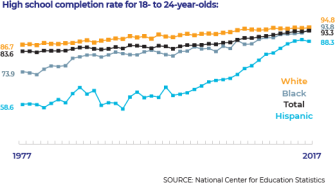
For the first time in 40 years, the percentage of black 18- to 24-year-olds with a high school credential was nearly the same as that of their white peers, data from the National Center for Education Statistics show, but racial gaps remain for earning an on-time diploma.

From 1977 to 2016, white students had a higher “status completion rate” than black students, meaning the percentage of young adults out of high school with a diploma or alternative like a GED. In 2017, that completion gap closed to only 1 percent, measuring 94.8 percent for white students and 93.8 percent for black students. The overall completion rate was 93.3 percent for 2017.
By contrast, the national adjusted cohort graduation rate measures the number of first-time 9th graders who earn a regular high school diploma four years later, accounting for students who transfer in or out, emigrate, or die, in the years between. That rate for 2016-17 was 85 percent, up 6 percentage points since it was first collected in 2010-11. But the cohort graduation rate for white students was 89 percent, versus 78 percent for black students.

A version of this article appeared in the January 22, 2020 edition of Education Week as High School Completions on Par For Black, White Students

Events

Jobs Regional K-12 Virtual Career Fair: DMV
Find teaching jobs and K-12 education jubs at the EdWeek Top School Jobs virtual career fair.
This content is provided by our sponsor. It is not written by and does not necessarily reflect the views of Education Week's editorial staff.
Sponsor
School Climate & Safety Webinar
Cardiac Emergency Response Plans: What Schools Need Now
Sudden cardiac arrest can happen at school. Learn why CERPs matter, what’srequired, and how districts can prepare to save lives.
Content provided by American Heart Association
Teaching Profession Webinar Effective Strategies to Lift and Sustain Teacher Morale: Lessons from Texas
Learn about the state of teacher morale in Texas and strategies that could lift educators' satisfaction there and around the country.

EdWeek Top School Jobs

Teacher Jobs
Search over ten thousand teaching jobs nationwide — elementary, middle, high school and more.
View Jobs
Principal Jobs
Find hundreds of jobs for principals, assistant principals, and other school leadership roles.
View Jobs
Administrator Jobs
Over a thousand district-level jobs: superintendents, directors, more.
View Jobs
Support Staff Jobs
Search thousands of jobs, from paraprofessionals to counselors and more.
View Jobs

Read Next

College & Workforce Readiness How to Bring More Value to Career-Tech Education Programs
Aligning academic goals to the labor market is critical, according to the Education Commission of the States.
5 min read
Keaton Turner, a junior at Warren County High School, welds a during an advanced manufacturing class in McMinnville.
Keaton Turner, a junior at Warren County High School, welds a during an advanced manufacturing class in McMinnville, Tenn., in May of 2017. States and districts need to do a better job connecting career-focused academic lessons with industry goals, speakers at a recent Education Commission of the States forum said.
Joe Buglewicz for Education Week
College & Workforce Readiness Inside One District’s Experiment to Anchor Learning Around Career-Ready Skills
Employers identify skills like creativity and collaboration as key to success in careers.
8 min read
An 8-year-old girl in a purple t-shirt leans over a butcher block counter inside a retrofitted school bus to glue together a map. Behind her, two classmates glue their projects.
Aiden Montanez Castro, 8, Zayne Mendez, 8, and Violet Ward, 8, work on a lesson in making a topographical map of their hometown at Fulton Elementary School in Ephrata, Pa. The Ephrata district refashioned a school bus into a Maker Bus, which parks at each of the district’s elementary schools for hands-on projects. The district has oriented its teaching around projects that allow students to demonstrate skills like empathy and creativity alongside content knowledge.
Scott Lewis for Education Week
College & Workforce Readiness Reports Work-Based Learning in Postsecondary Education: Results of a National Survey
Based on a 2025 survey, this report examines key questions about educator perspectives on work-based learning in postsecondary education.
College & Workforce Readiness Spotlight Spotlight on College and Career Pathways Designed to Serve All Students
CTE is transforming career prep: AI, high-tech training, and real-world learning connect students to in-demand jobs and future-ready skills.
