College & Workforce Readiness Report Roundup

Graduation Requirements

By Catherine Gewertz — August 19, 2014 1 min read
  • Save to favorites
  • Print

Increasing graduation requirements, all by itself, is unlikely to make students better prepared for college or careers in the fields of science, technology, engineering, and mathematics, concludes a new report.

What students need are courses that are truly rigorous and adequate preparation for those courses, according to ACT, the Iowa City, Iowa-based testing company.

The report looks at the aftermath of a 2005 Illinois law that requires high school students to take at least three years of math and two years of science. Examining what happened in nine graduating classes in response to that law, ACT found students’ enrollment patterns didn’t change in math, but the law did prompt more students particularly those in the bottom half to enroll in more science courses. The changes had no effect on how well students did in those subjects on the act college-entrance exam.
A version of this article appeared in the August 20, 2014 edition of Education Week as Graduation Requirements

Events

This content is provided by our sponsor. It is not written by and does not necessarily reflect the views of Education Week's editorial staff.
Sponsor
Personalized Learning Webinar
Differentiation That Delivers: Proven Practices From High-Growth Districts
Make every minute count. Proven strategies from educators and leaders driving real student growth. Save your seat!
Content provided by i-Ready, Curriculum Associates
This content is provided by our sponsor. It is not written by and does not necessarily reflect the views of Education Week's editorial staff.
Sponsor
College & Workforce Readiness Webinar
From Exposure to Experience: Designing Accessible Work-Based Learning
Learn how schools can create meaningful experiences that help every student build skills, connections, and a clearer path to their future.
Content provided by Project Lead The Way
This content is provided by our sponsor. It is not written by and does not necessarily reflect the views of Education Week's editorial staff.
Sponsor
School & District Management Webinar
A Tale of Two School Districts: Forecasting Enrollment
Forecasting enrollment is hard. Here’s how two different districts are navigating times of change with data that considers the whole picture.
Content provided by Zonda Education

EdWeek Top School Jobs

Teacher Jobs
Search over ten thousand teaching jobs nationwide — elementary, middle, high school and more.
View Jobs
Principal Jobs
Find hundreds of jobs for principals, assistant principals, and other school leadership roles.
View Jobs
Administrator Jobs
Over a thousand district-level jobs: superintendents, directors, more.
View Jobs
Support Staff Jobs
Search thousands of jobs, from paraprofessionals to counselors and more.
View Jobs

Read Next

College & Workforce Readiness Q&A Reading, Writing, and Math Skills Are Top Priorities in This CTE Program
How these teachers are connecting the dots between academic and technical skills.
4 min read
Cass Career Center
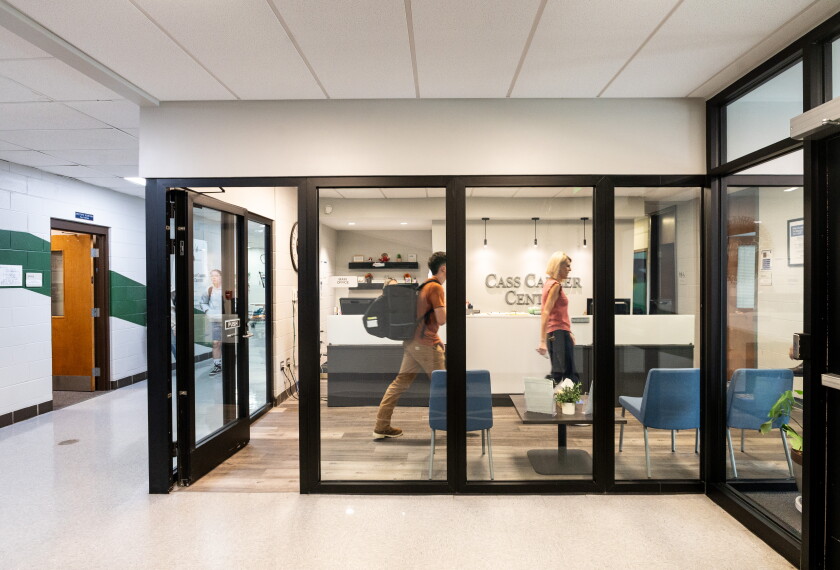
Assistant Director, Nicole Tews, walks a student through the administration office at the Cass Career Center in Harrisonville, Mo., on September 29, 2026. The center has a math and an English teacher who are integrated into students' industry-specific career programs.
Melissa Lukenbaugh for Education Week
College & Workforce Readiness Q&A Dual Enrollment Is Surging. Here's How High Schools Can Get it Right
More than 3 million high school students took a college course last year.
3 min read
Macomb Community College's South Campus in Warren, Mich. off of 12 Mile Road on Oct. 15, 2026.
Macomb Community College's South Campus in Warren, Mich., is shown on Oct. 15, 2026. In Michigan, 16 percent of community college students are high schoolers. Nationwide, dual enrollment now tops 3 million students.
Miles Oates/mlive.com via TNS
College & Workforce Readiness The CTE Program Answering the Question ‘Why Do I Need Math to Be a Firefighter?’
Integrating academic learning into career and technical education comes with challenges.
13 min read
Cass Career Center
Layton Heaper, a senior in the welding program at the Cass Career Center in Harrisonville, Mo., works on a project on Sept. 29, 2026. Through the school's integrated academics program, students learn and apply English and math skills related to future careers.
Melissa Lukenbaugh for Education Week
College & Workforce Readiness As Students Explore Alternatives to College, Are Counselors Ready to Help Them?
A new survey finds growing interest in non-degree pathways post-graduation, but schools are struggling to keep up.
3 min read
Kendall Gray (left) and Gala Davis (right), both guidance counselors, catch up and talk in Davisí office at South Oak Cliff High School in Dallas on March 6, 2025.
Kendall Gray, left, and Gala Davis, both school counselors, talk in Davis' office at South Oak Cliff High School in Dallas on March 6, 2025. A new survey polls school counselors about student career readiness.
Liz Rymarev/The Dallas Morning News via TNS

