Corrected: This story provided incorrect information about the federal funding of projects to beef up history education. In a videotaped message, President Bush announced that he would ask Congress for $100 million over three years to support the ‘We the People’ initiative run by the National Endowment for the Humanities. The money would go toward a variety of projects, including summer training institutes for teachers, an American history essay contest for students, and a National History Bee. Secretary of Education Rod Paige told participants that nearly $100 million in grants under a separate program is available to improve history teaching in schools.
Teachers and parents should harness the power of the personal stories that have crisscrossed time to engage students in the study of history, build their knowledge of historical facts and contexts, and raise their awareness of the value of civic involvement, participants in a White House-sponsored forum on American history, civics, and service said last week.
|
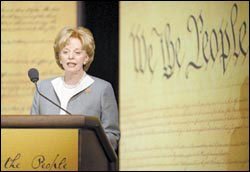
Lynne V. Cheney shares the history of her great-great-grandmother’s journey from Wales to the American West at a White House-sponsored forum on history and civics education. |
The narratives of the nation’s heroes—the well-known as well as the unsung—can draw students into the drama of the republic’s founding and spark their desire to learn more about the events and issues that have shaped the United States, said Lynne V. Cheney, who was among the speakers.
“We need to foster projects and institutions that will lead to greater knowledge and understanding of history, and those focused on teachers ... promise to have a far-reaching impact on historical knowledge,” Mrs. Cheney said. “But we should also try, each of us as individuals, to transmit our national story.”
Mrs. Cheney, the wife of Vice President Dick Cheney, is a senior scholar at the American Enterprise Institute and headed the National Endowment for the Humanities from 1986 to 1993.
Unsung Heroes
Mrs. Cheney shared her own example: the compelling story of her great-great-grandmother, Katurah Vaughn, an immigrant who endured a treacherous and tragic journey from Wales to the American West.
Other speakers, including David McCullough, the Pulitzer Prize-winning author of John Adams and Truman, and the historian Robert Remini, a biographer of Andrew Jackson, cited the stories of behind-the-scenes heroes and the sacrifices and risks they took to secure American democracy.
The forum held here at the National Museum of American History was the first event since President Bush unveiled his “We the People” initiative last fall. The project features an array of programs to improve teaching and learning in American history, including an essay contest, a lecture series, and grants for teachers. The forum was postponed from February because of a snowstorm in Washington.
First lady Laura Bush presented medals and scholarships ranging from $1,000 to $5,000 to six students, the first winners in the essay contest. The participants had been asked to write 1,200-word papers on “The Idea of America.”
Secretary of Education Rod Paige announced at the May 1 event that the president is asking Congress for $100 million for We the People over three years.
The NEH would receive a significant portion of the money to expand its summer institutes that allow teachers to study historical topics in depth.
Experts at the daylong forum lamented the current state of student knowledge in history and civics, citing disappointing results on recent national assessments and surveys.
While some positive developments in history education have occurred over the past decade—including adoptions of state standards in the subject and the increased availability of materials that enable deeper study of history—teachers and students still don’t know enough about the past, said Peter Gibbon, a research associate at Harvard University’s graduate school of education.
Moreover, he contended, popular culture and the growth in “revisionist” history have corrupted students’ views of history and civic duty.
Mrs. Cheney, in fact, was instrumental in nearly scuttling the voluntary national history standards released nearly a decade ago for, in her view, downplaying the contributions of the Founding Fathers and other traditional heroes while overemphasizing the role of women and minorities. A panel of historians, however, deemed that the three-volume set required only some revision. (“Playing Games With History,” Nov. 15, 1995.)
Mr. Gibbon called for expansion of reading materials and resources that characterize the American republic and its history as imperfect, not fundamentally flawed.
Reading such materials could also go a long way toward improving students’ basic skills, according to E.D. Hirsch Jr., the president of the Core Knowledge Foundation, based in Charlottesville, Va.
Mr. Hirsch cited research showing that reading comprehension problems can be traced primarily to students’ lack of background knowledge of subject- area content, not necessarily to inadequate reading skills. The findings, which are outlined in the Spring 2003 issue of American Educator, he said, conflict with the increasing practice in elementary schools of taking time from social studies, science, and the arts to allow more reading and math instruction.
“Reading comprehension depends on privileged knowledge that comes from learning about history and science and other areas,” he said. “If we really want them to read [proficiently], you’ve got to teach them content.”


