

What are the most important ideals that shaped the founding of the United States? And how should we interpret and apply these values today?
The answers to these questions are complex and exist in a constant state of revision and reimagination in this country. They are also the focus of particularly pointed debate right now. And as is frequently the case, Americans’ anxieties and disagreements about them have a way of filtering down to classrooms.
In Texas and Oklahoma, state leaders have argued over the extent to which Christianity formed the basis of the American system of governance. At least 20 states still have laws on the books banning classroom discussion of potentially “divisive” concepts, which experts have said can stymie conversations about historical injustice.
National politics have added new complications. Over the past year, teachers have weighed how to navigate a politically contentious debate about the limits of the president’s executive authority and constitutional interpretation—or whether to even address it at all.
Against that backdrop, teachers are now preparing for the semiquincentennial: the 250th anniversary of the country’s founding. The confluence of this milestone with the current political environment provides an opportunity—and a challenge, teachers said.

“We’ve had a lot of modern examples where students can look at these things in action and assess how well the system is working,” said Kelley Brown, a U.S. history and government teacher at Easthampton High School in Massachusetts.
“What were the original intentions? Do we still see that today? Does that matter?” Brown said. “To me, it provides a very rich environment to discuss the founding ideas.”
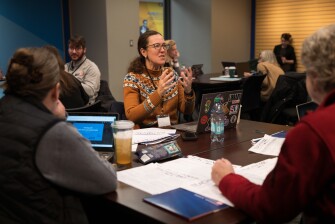
Brown was one of 50 teachers who attended a workshop earlier this month on teaching the 250th at the National Constitution Center in Philadelphia, co-hosted by the California-based Center for Civic Education. There, educators worked together to create lessons on America’s 250th birthday that will be made public this spring for other teachers across the country to use.
“There’s a tension between wanting to celebrate this tremendous accomplishment for our country, for mankind, this brilliant gift of the thoughts that are put together in the [Declaration of Independence] … obviously, something you want to commemorate as a celebration,” said Shannon Salter, a high school civics teacher in Allentown, Pa., who also participated in the workshop.
“But also if you stop at celebration, are we really preparing ourselves for the next 250?”

Teaching the ‘full expanse of history’
More so than in reading or math, social studies teachers tend to have wide latitude over the resources that they use in the classroom. In a 2024 survey of high school history teachers across nine states, at least 81% of educators said they could choose all of the readings and assignments they gave to students.
Most social studies teachers mix and match different resources to make their lessons, said Julie Silverbrook, the vice president of civic education at the National Constitution Center. The goal of the February event was to “capture that, bottle it, and then release it to more teachers.”
During the weekend, teachers heard presentations from some of the civic education organizations that are members of the Civics Renewal Network, a group of 46 nonprofits dedicated to improving civics education. Then, they started work on their own lessons, focused on a set of principles that inspired different pieces of the Declaration of Independence. The materials created will be published later on the Civics Renewal Network website.
Lessons on the social contract, for instance, would aim to get students exploring and debating the questions: How do colonial grievances reflect a broken social contract? Does the government today fulfill its responsibilities to citizens?
“The obligation is to teach the full expanse of history, and to do so in a nonpartisan way,” Silverbrook said.
The February convening, which includes many of the major players in the civics education space, isn’t the only initiative working on lessons and education content for America’s 250th birthday.
In September of last year, the U.S. Department of Education announced the American 250 Civics Education Coalition, a group of 40-plus, mostly conservative organizations that will produce educational programming aimed at “renewing patriotism, strengthening civic knowledge, and advancing a shared understanding of America’s founding principles in schools across the nation.”
The coalition includes Hillsdale College, a private Christian liberal arts school; conservative educational media company PragerU; Turning Point USA, a nonprofit that promotes conservative ideals on college campuses; and Moms for Liberty, a group that has advocated for schools to remove books from their libraries and run conservative school board candidates.
The National Constitution Center and the Center for Civic Education, along with most of the organizations in the Civic Renewal Network aren’t part of the Education Department’s coalition.
When asked about the Education Department’s initiative, Silverbrook said that efforts to teach the 250th are all “tackling it in a slightly different way.”

Tracing founding principles through America’s past and present
For some of the teachers at the National Constitution Center in February, tackling the semiquincentennial meant grounding their lessons in history.
Brown, the Massachusetts teacher, worked with a team of teachers developing a lesson on the principle of equality. They wanted students to examine the philosophical foundations that underpinned its discussion in the Declaration of Independence, and trace how individuals in the fledgling nation used those arguments to push the boundaries of its definition.
In the lesson they’re creating, students will examine arguments from Commonwealth v. Nathaniel Jennison, a 1783 Massachusetts Supreme Court case that determined slavery was incompatible with the state constitution’s guarantees of freedom and equality. They’ll read excerpts from the speeches of Abraham Lincoln, Frederick Douglass, and suffragists, eventually studying Obergefell v. Hodges, the U.S. Supreme Court case that legalized gay marriage in 2015.
Others focused on how one moment in history exemplified a test of certain principles. Brittany Knauer, an 8th grade U.S. history teacher in Montgomery, Texas, worked on a team that focused their lesson on the pursuit of happiness on Loving v. Virginia, the 1967 Supreme Court case that ruled laws banning interracial marriage violated the 14th Amendment’s guarantee of equal protection.

Knauer’s class covers U.S. history through Reconstruction. But she wants her students to understand that the country’s relationship with slavery has had long-term consequences that extend beyond the formal end of the institution, she said.
Both slavery’s legacy and the fight to legalize same-sex marriage could be considered charged topics, especially when the president of the United States claims that cultural institutions are focusing too much on “woke” American history.
But Brown said she doesn’t find it particularly challenging to teach a class on the Constitution in this political environment. The past 10-15 years of Supreme Court cases, especially, have offered many opportunities to discuss the finer points of constitutional law, she said.
“For me, having this course is amazing, because it allows young people and myself to have healthy conversations in a somewhat vitriolic environment,” she said.
Parsing founding documents in theory vs. practice
Still, other teachers who attended the convening said they have had to work hard this past year to square students’ understanding of the founding documents as written with their application in practice.
In Megan Thompson’s crime elective at a high school in the suburbs of Minneapolis, students spent most of this past December learning about the 4th Amendment, which protects against unreasonable search and seizure.
Then, in January, the president ordered thousands of federal Immigration and Customs Enforcement agents to Minneapolis. Students watched as agents without criminal arrest warrants used force to enter residents’ homes, which many legal experts argued was a violation of that amendment’s protections.
They asked her: How does that work?
“I was like, ‘This is a really good question, and it’s a question that judges are probably going to be evaluating,’” said Thompson, who helped facilitate the National Constitution Center event as a member of the group’s Teacher Advisory Board.
Still, it’s not a question that came up in any of the conversations Thompson was part of at the event, she said. Other teachers in attendance said the same—their lessons don’t really grapple with the many ways that experts have argued the Trump administration is reshaping the bounds of executive power.
“This was not a convening about how you teach through difficult political moments,” said Silverbrook, of the NCC.
But how the government derives its power, and how it wields that power, are still very much on Thompson’s students’ minds.
Thompson’s school has a large immigrant population; she’s taught Liberian, Hmong, Ghanaian, Nigerian, and Somali teenagers through the years. Many of her students’ families chose to come to the United States, she said, and can speak to the structures of American government and society that drew them here.
As protests against ICE grew in Minneapolis, Thompson’s classes started asking more questions about their rights. Some students at her school staged walkouts.
“In the context of the 250th, my students are certainly more aware of the things that make you want to revolt, and the things that make you want to stand up and speak out,” she said. “It creates a greater appreciation for the 250th than we could have ever imagined.”


