Reading & Literacy Interactive

Book Bans Over the Years, in Charts

By Eesha Pendharkar — April 28, 2023 2 min read
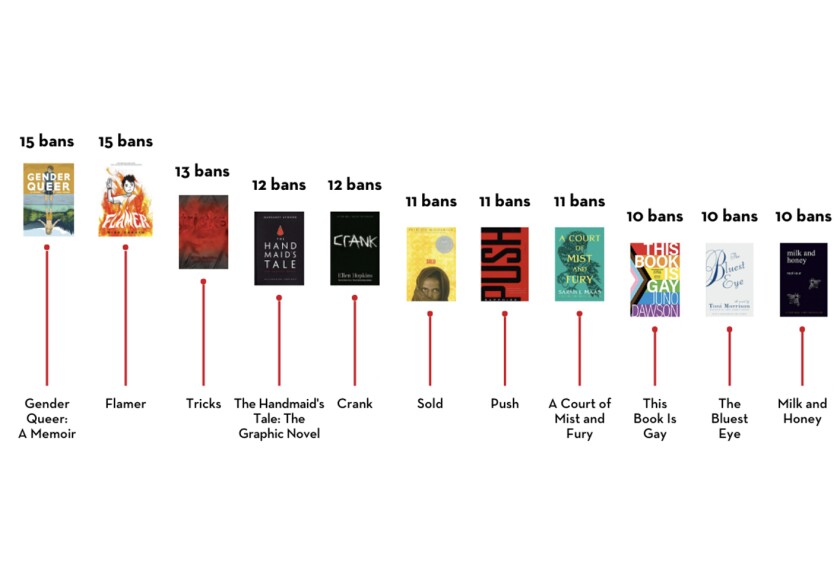
The most banned books from the fall of 2022, according to PEN America.
  • Save to favorites
  • Print

Book bans have escalated for 18 months now, hitting an all-time high in December 2022.

Since June 2021, PEN America, a free speech advocacy organization that tracks bans, has recorded more than 4,000 book challenges and bans in school districts.

The actual number is estimated to be even higher because PEN America relies on media reports, publicly available documents, and school district meeting minutes to track bans.

Book bans have impacted a wide range of topics, from titles about LGBTQ+ characters, to books on sexual health, to books featuring themes of race and racism.

Here’s a visual representation of book bans, from June 2021 to December 2022, based on PEN America data:

How many books have been banned?

Book bans reached an all-time high during the fall of 2022. But since 2021, PEN America has tracked more than 1,000 instances of book challenges and bans during each six-month period.

What is the No. 1 most banned book?

Gender Queer: A Memoir by Maia Kobabe, is the most banned book over the last 18 months. The graphic memoir both written and illustrated by Kobabe chronicles the author’s life from adolescence to adulthood, detailing their experiences with their gender and sexual identity.

It has been banned 56 times in 18 months.

What is the No. 1 reason books get banned?

Books are frequently challenged for having inappropriate or sexual content, according to PEN America. In 2021 and the first half of 2022, more than 41 percent of banned books were about LGBTQ+ characters or stories. That changed in the latter part of 2022, with most banned books being about sexual experiences, violence, or sexual health.

However, many books about gender and sexual identity that chronicle LGBTQ+ experiences fall under these categories too.

Where do books get removed from?

Books predominantly get removed from school libraries, with only a small percentage of book bans impacting classrooms specifically. Most books are removed pending investigation, meaning that a book is removed whenever there’s a challenge for review.

Many of these books are removed from student access before due process of any kind is carried out, according to PEN America. In some cases, books can also be removed without challenges for review. These books often end up being unavailable for weeks or months.

Where are book bans happening?

Most book bans are happening in Texas and Florida, according to PEN America. Over the past year, Texas has seen more than 1,200 book challenges, and Florida more than 900. In some cases, state laws are responsible for causing districts to remove books to err on the side of caution, the report found. In other cases, districts are removing hundreds of titles for review.

Book bans have been recorded in at least 32 states.

Related Tags:

Events

Teaching Profession K-12 Essentials Forum Supporting the New K-12 Workforce: What Teachers Need to Stay at School
 Join this free virtual event to discover what teachers say they need to feel supported to stay in classrooms for the long haul.
College & Workforce Readiness K-12 Essentials Forum Career and Technical Education Takes Its Next Big Step
Join this free virtual event to hear creative approaches to modernize CTE programs and navigate the shift away from a near-exclusive focus on "college preparedness."

EdWeek Top School Jobs

Teacher Jobs
Search over ten thousand teaching jobs nationwide — elementary, middle, high school and more.
View Jobs
Principal Jobs
Find hundreds of jobs for principals, assistant principals, and other school leadership roles.
View Jobs
Administrator Jobs
Over a thousand district-level jobs: superintendents, directors, more.
View Jobs
Support Staff Jobs
Search thousands of jobs, from paraprofessionals to counselors and more.
View Jobs

Read Next

Reading & Literacy Opinion How We Can Turn the Page on This Failed Reading Strategy
We can’t raise new readers on just excerpts. It’s time to bring back whole books.
Carol Jago
3 min read
Image of a book with symbols of brain, ideas, time, conversation, connecting ideas.
Laura Baker/Education Week + Canva
Reading & Literacy Kindergartners' Math and Reading Scores Can Predict Their 3rd Grade Performance
But their academic trajectories aren't set in stone, and early intervention is key, researchers say.
3 min read
Estes Elementary School kindergarten students Evelyn Bolmer, front left; Jase Bellamy, back right; and Eric Guarneros, front right, listen as their teacher Faith Harralson assists Bolmer with a math equation, as they ride pedal desks at school in Owensboro, Ky., Jan. 19, 2016.
Estes Elementary School kindergarten students Evelyn Bolmer, front left; Jase Bellamy, back right; and Eric Guarneros, front right, listen as their teacher Faith Harralson assists Bolmer with a math equation, as they ride pedal desks at school in Owensboro, Ky., Jan. 19, 2016. New research shows students who start kindergarten behind in reading and math are unlikely to catch up by 3rd grade.
Jenny Sevcik/The Messenger-Inquirer via AP
Reading & Literacy Is It Time for Another National Reading Panel?
The panel's 2000 report on reading has influenced policy for years. Now, Congress is calling for an update.
7 min read
readingPanel
A copy of one of the National Reading Panel's work products is shown in this June 17, 2026 photo. The influential report, now more than 25 years old, has long served as a cornerstone of the “science of reading” movement, shaping state legislation, curriculum, and teacher professional development.
Marvin Joseph/Education Week
Reading & Literacy How Should Teachers Select Books for Young Readers? (Hint: It's Not Just Decodability)
Three new studies offer clues about what makes texts easier and harder for young students to read on their own.
5 min read
20250205 AMX US NEWS NEW DATABASE LOOK UP K5 1 PO
An educator at Holcomb Elementary School in Oregon City, Ore. works with students on phonics and phonemic awareness on Feb. 5, 2025. New studies point to the mix of factors teachers should consider when selecting texts for students.
Julia Silverman via TNS