
Special Report
Special Education

5 Tips to Help Students With Disabilities Feel Like They Belong

By Caitlynn Peetz Stephens — April 14, 2024 4 min read
At Ruby Bridges Elementary School in Woodinville, Wash., special education students are fully a part of the general education classrooms. What that looks like in practice is students together in the same space but learning separately – some students are with the teacher, some with aides, and some are on their own with a tablet. Pictured here on April 2, 2024.
  • Save to favorites
  • Print

Creating a school community where students with complex learning or developmental needs feel welcomed and valued takes more than merely including them in classes or clubs, according to a leading researcher on the topic.

Erik Carter, the executive director of Baylor University’s Center for Developmental Disabilities, has developed what he calls the 10 dimensions of belonging, a list of principles that, together, create an environment in which all students—but particularly those with disabilities who have historically been excluded—feel as if they authentically belong.

The principles begin with allowing students with disabilities to be present in the same spaces as their peers, then invited, and ultimately accepted, supported, befriended, needed, and loved.
See Also

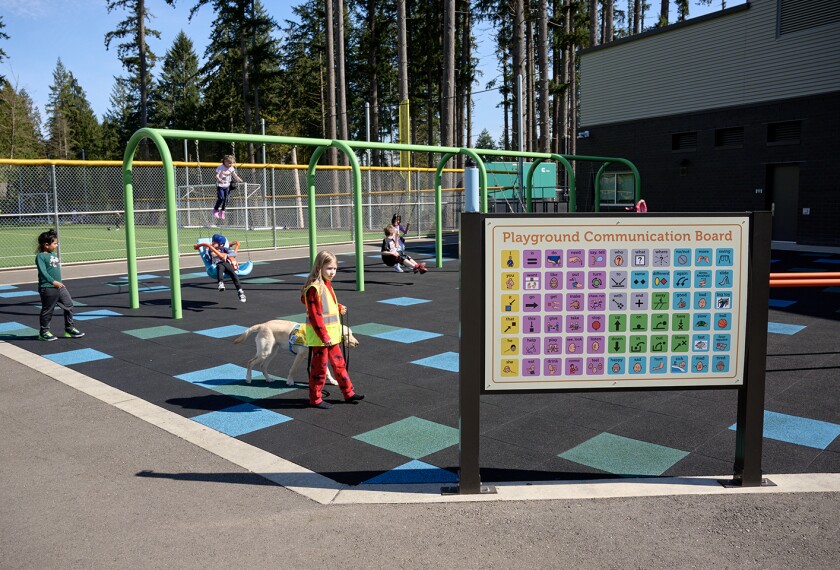
During recess at Ruby Bridges Elementary School in Woodinville, Wash., students have cards with objects and words on them so that all students, including those who cannot speak, can communicate. Pictured here on April 2, 2024.
During recess at Ruby Bridges Elementary School in Woodinville, Wash., students have access to cards with objects and words on them so that all students, including those who do not speak, can communicate. Pictured here, a student who has been taught how to lead and use commands with a campus service dog does so under the supervision of a staff member on April 2, 2024.
Meron Menghistab for Education Week

There are some tangible steps school and district leaders can take today to begin working to create this kind of environment, Carter said. All students stand to benefit, he said.

1. Understand the difference between ‘inclusion’ and ‘belonging’

There is a difference between simply including students with disabilities in classes and activities and deliberately creating a community in which all students feel as if they belong and are valued, Carter said.

Inclusion often refers to students with disabilities “just being present,” he said, whereas belonging is “more about how we see one another and the relationships formed within those activities in which we are present.”

It’s an important distinction, he said, because students who experience a sense of belonging are more excited about and likely to show up for school each day. They’re also more likely to be “primed and ready to learn with other kids in your classrooms or in extracurriculars.”

“Belonging really is inextricably linked to your learning component,” Carter said.

2. Reflect on current practices

School and district leaders should take an honest inventory of how their students experience school.

Rather than “just assuming and declaring that we are a community of belonging” solely because students with disabilities participate in some classes or activities with their peers, Carter said, “we need to be intentional about noticing whether students are actually experiencing a sense of belonging.”

It can be uncomfortable and painful to admit that any group of students may not feel completely valued and welcome, he said, but it’s important to be honest in your observations.

What do kids’ relationships look like? Are programs and services siloed so that students who need additional support are routinely excluded from activities or classes or even portions of them? Do leaders have high expectations for students with disabilities?

Researchers have in recent years “learned a lot more about the practices that lead toward belonging,” Carter said.

Those include things like peer-mediated supports, in which a student who has disabilities may work with a peer who doesn’t have disabilities on lessons or activities, he said. That gives students of all abilities the chance to “come to know each other, work together, and, out of that, perhaps develop some friendships and reciprocal relationships with other kids, which is really at the heart of belonging.”

3. Ask students how they feel

One of the most important steps to assessing and improving students’ sense of belonging is to simply ask them about their experiences in focus groups or one-on-one conversations, Carter said. That exercise should include questions to discover both what students feel is working well and what they enjoy, and how they may feel separated from their peers.

It can be a tricky task if some students with disabilities cannot communicate verbally or in other traditional ways, he said, so it may require a more observational approach, like interpreting their body language when they arrive at school, which can communicate their enthusiasm about attending.

4. Collect data

Anecdotal observations of students are important, but so are data, Carter said.

Some possible data to track, according to Carter, include: the extent to which students with disabilities are participating in general education classrooms or being pulled out for support and the extent to which students with disabilities are taking part in extracurriculars, clubs, and volunteer opportunities.

“There’s a whole set of indicators that schools might pick as helping them track their movement toward more widespread experience of belonging for all students but particularly for students with disabilities,” he said.

5. Make the work a priority

Ultimately, research shows that all students—including those with disabilities—perform better in school when they feel they are valued and belong there, Carter said.

To ensure all students feel that way about school, educators must make it a priority to foster a sense of belonging, he said. School and district leaders must bring the same emphasis that they do to academics, not only ensuring that students are prepared for postsecondary life but that they also feel accepted and valued while they’re in school, Carter said.

“If there’s not a similar commitment and intentionality around belonging, it will always get pushed to the back burner, or we’ll always think we don’t have the time to get to it, which is a disservice to the kids we have a commitment to serve,” Carter said.

See Also

Image of a group of students meeting with their teacher. One student is giving the teacher a high-five.
Laura Baker/Education Week via Canva

Coverage of whole-child approaches to learning is supported in part by a grant from the Chan Zuckerberg Initiative, at www.chanzuckerberg.com. Education Week retains sole editorial control over the content of this coverage.
A version of this article appeared in the April 24, 2024 edition of Education Week as 5 Tips to Help Students With Disabilities Feel Like They Belong

Events

This content is provided by our sponsor. It is not written by and does not necessarily reflect the views of Education Week's editorial staff.
Sponsor
Artificial Intelligence Webinar
Managing AI in Schools: Practical Strategies for Districts
How should districts govern AI in schools? Learn practical strategies for policies, safety, transparency, as well as responsible adoption.
Content provided by Lightspeed Systems
This content is provided by our sponsor. It is not written by and does not necessarily reflect the views of Education Week's editorial staff.
Sponsor
Reading & Literacy Webinar
Unlocking Success for Struggling Adolescent Readers
The Science of Reading transformed K-3 literacy. Now it's time to extend that focus to students in grades 6 through 12.
Content provided by STARI
Jobs Virtual Career Fair for Teachers and K-12 Staff
Find teaching jobs and K-12 education jubs at the EdWeek Top School Jobs virtual career fair.

EdWeek Top School Jobs

Teacher Jobs
Search over ten thousand teaching jobs nationwide — elementary, middle, high school and more.
View Jobs
Principal Jobs
Find hundreds of jobs for principals, assistant principals, and other school leadership roles.
View Jobs
Administrator Jobs
Over a thousand district-level jobs: superintendents, directors, more.
View Jobs
Support Staff Jobs
Search thousands of jobs, from paraprofessionals to counselors and more.
View Jobs

Read Next

Special Education Leader To Learn From How Nashville Dismantled Segregated Classrooms for Students With Disabilities
Nashville overhauled special education to prioritize inclusion, and changed school culture.
8 min read
NASHVILLE, TENNESSEE - JANUARY 14: Debra McAdams, Executive Director, Department of Exceptional Education at Metropolitan Nashville Public Schools visits Isaiah T. Creswell Middle School Of The Arts in Nashville.
Debra McAdams, executive director of the department of exceptional education at Metropolitan Nashville Public Schools, visits Isaiah T. Creswell Middle School of the Arts in Nashville, Tenn., on Jan. 14, 2026.
Brett Carlsen for Education Week
Special Education Q&A Why Inclusive Classrooms Benefit Every Student, Not Just Those With Disabilities
Inclusive practices improve outcomes for all students and require deep system change.
5 min read
NASHVILLE, TENNESSEE - JANUARY 14: Debra McAdams, Executive Director, Department of Exceptional Education at Metropolitan Nashville Public Schools visits Isaiah T. Creswell Middle School Of The Arts in Nashville.
Debra McAdams, executive director of the department of exceptional education at Metropolitan Nashville Public Schools, visits Isaiah T. Creswell Middle School of the Arts in Nashville, Tenn., on Jan. 14, 2026.
Brett Carlsen for Education Week
Special Education 4 Barriers to Giving Students With Disabilities the Tools They Need to Thrive
Assistive technology can help students with disabilities, but schools face challenges using it to its full potential.
5 min read
Kristen Ponce, speech language pathologist, uses Canva and the built in AI software to help her students.
Assistive technologies can be high or low tech, but teachers need help deploying them to match students with disabilities' particular needs. A speech language pathologist in Kansas City, Mo., uses an ed-tech program and its built in AI software to help her students on May 1, 2024.
Doug Barrett for Education Week
Special Education A Missed Opportunity in SEL: Centering Students With Disabilities
Students with learning differences are not always considered in the design or implementation of SEL programs.
7 min read
A “zones of regulation” sign decorates the door of a classroom at Ruby Bridges Elementary School in Woodinville, Wash., on April 2, 2024.
A sign asking children to identify their feelings decorates the door of a classroom at an elementary school in Woodinville, Wash., on April 2, 2024. Experts say schools should design social-emotional-learning curricula and programming with the needs of students with disabilities at the forefront.
Meron Menghistab for Education Week
