

Cheering on the Trump administration’s attempt to dismantle the U.S. Department of Education: Out. Aggressive oversight: In.
Legislation to dramatically expand school choice: Out. Attempts to significantly boost funding for federal K-12 grant programs: In.
That’s the CliffsNotes version of the U-turn educators can expect if Democrats gain control of either chamber of Congress after the Nov. 3 midterm elections—a distinct possibility based on recent polling.

A majority in either chamber would put Democrats in the driver’s seat on the legislative agenda and in a position to hold official hearings on the Trump administration’s dissolution of the Education Department.
To be sure, Democrats are highly unlikely to pick up enough seats, particularly in the U.S. Senate, to pass legislation without Republican support. And President Donald Trump would maintain veto power.
Still, some Democratic allies hope the party will pass legislation that embodies its vision for supporting schools and kids—even knowing it may face Trump’s veto pen.
If they win congressional control, Democrats should take the opportunity to “not just shine the light on the damage done, but what would you do instead if you had the power?” said Randi Weingarten, the president of the American Federation of Teachers, a 1.8 million-member union.
“I want them to do the oversight, but oversight coupled with what their solutions would be,” she said. “Maybe they can do some of this in a bipartisan way, and maybe they can get bills to the president’s desk, whether he vetoes them or not.”
If Democrats take control of one or both chambers of Congress, we will have many more tools at our disposal to protect students and educators from the Trump-Vance administration. Nothing will be off the table.
Some advocates, though, see possibilities for bipartisan cooperation, including on broadening access to early childhood education and childcare, addressing backlash to education technology, career and technical education, and protecting students’ private data as artificial intelligence evolves.
“Divided government can be very productive,” said Lindsay Fryer, who served as a top education aide to former Sen. Lamar Alexander, R-Tenn., when Congress approved the bipartisan Every Students Succeeds Act in 2015. “Each party figures out what their top priorities are, and they come to the table in earnest. And let’s not forget, too, that the Trump administration wants some wins on their way out as well.”
Others simply expect gridlock.
“The status quo will remain, which will be unfortunate,” said Fred Jones, the senior director of policy and advocacy for the Southern Education Foundation, a civil rights organization, which would like to see either party bolster resources for Title I and universal prekindergarten.
Democrats will aim to reverse Trump’s efforts to shrink the Education Department
The 2026 election season highlighted fissures between the Democrats’ more progressive and moderate wings. But the party appears unified in its opposition to the Trump administration’s dismantling of the Education Department.
Lawmakers have pledged to shine a spotlight on problems created by a series of interagency agreements that shifted K-12 programs to the Labor Department, special education to Health and Human Services, and the office for civil rights to the Justice Department.
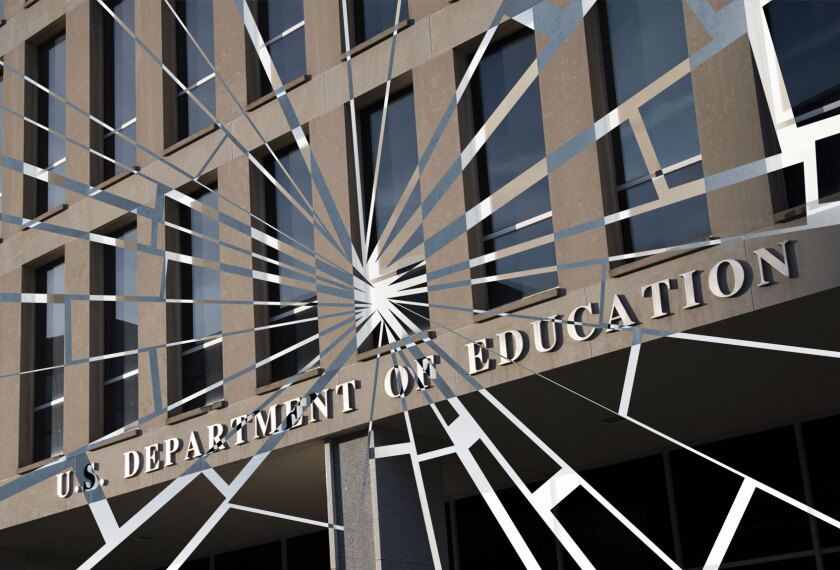
Congressional Republicans have largely supported the moves, which the Trump administration contends have improved efficiency and right-sized the federal role in education, though there has been some pushback from GOP moderates in the Senate.
If Democrats take over the House, “we would be doing oversight on all these interagency agreements, which waste money and are inefficient,” said Rep. Bobby Scott of Virginia, the top Democrat on the House education committee, who would seek the panel’s chairmanship. “Moving K-12 to the Department of Labor? Are you kidding me?”
Rep. Suzanne Bonamici, D-Ore.—who sent a letter to her colleagues Oct. 6 announcing that she’d also seek the committee’s chairmanship—agreed this is an area where the panel needs to dig in.
“One of the first things to do is to get information about what’s happening with these interagency agreements,” she said.
The Trump administration has argued that it’s just sending some of the department’s work to other agencies, “but the effect of them is shutting down the Department of Education,” Bonamici said.
(A third House education committee Democrat, Rep. Jahana Hayes of Connecticut, also plans to seek the chairmanship, Politico reported. Hayes did not respond to Education Week’s request for comment.)
From my point of view, every single Democrat, and I would hope every Republican, wants good schools and just maybe have different ideas about what that means.
On the Senate side, Sen. Bernie Sanders—the Democratic caucus’ ranking member on the Health, Education, Labor, and Pensions Committee—has also drawn attention to the lack of action on civil rights enforcement at the slimmed-down Education Department, which slashed about half its staff last year. (Sanders, of Vermont, did not respond to a request for comment.)
He released a report in April showing that the agency under Trump had not resolved any cases involving sexual harassment, sexual violence, seclusion and restraint, racial harassment, or discriminatory school discipline—despite having 2,700 such cases pending.
(In response, an Education Department spokesperson argued that former President Joe Biden’s team politicized OCR and left a “staggering, 5-digit” case backlog. “We are utilizing every tool at our disposal to resolve the backlog and return common sense to our schools,” the spokesperson said.)

Scott and Bonamici both support working with lawmakers overseeing spending to add language to massive, must-pass funding bills nixing the agreements that sent parts of the Education Department to other agencies.
A freestanding bill returning those offices back to the Education Department would be subject to Trump’s veto, Scott acknowledged—if it could even get through Congress.
But in a budget bill, Trump would “have to decide whether [to] shut down the federal government or bring the people back to the Department of Education,” he said.
Putting language in a funding bill to stop the interagency agreements is something Sens. Tim Kaine, D-Va., and Chris Van Hollen, D-Md., have also floated, Politico reported.
“If Democrats take control of one or both chambers of Congress, we will have many more tools at our disposal to protect students and educators from the Trump-Vance administration,” Kaine, who serves on the HELP Committee, told Education Week. “Nothing will be off the table.”
ESSA implementation may be an area of oversight
Scott doesn’t expect the House education committee will consider a reauthorization of the Every Student Succeeds Act, which passed in 2015, or the Individuals with Disabilities Education Act, which was last renewed more than 20 years ago.
“You don’t need to change the law when the law says what needs to be done” to improve schools, Scott said.
He expects pushing for stronger enforcement of the ESSA’s requirements would be a better course than “opening it up and running the risk of the law being watered down.”

Scott, a lead ESSA architect, wants to dig into the Trump administration’s waivers giving states leeway from some of the law’s requirements. State leaders argue that this flexibility has helped them target funds to statewide school improvement efforts, while civil rights groups argue they steer money away from historically disadvantaged groups of students.
There are other areas of potential investigation.
For instance, the department isn’t keeping a close eye on how states track chronic absenteeism, suggesting a pattern of lax oversight that may put billions in federal funds at risk of waste, fraud, and abuse, according to a recent report from the Government Accountability Office, Congress’ investigative arm.
And in 2024, GAO found that fewer than half of district plans for improving the bottom 5% of high schools in each state meet ESSA’s bare-minimum requirements, even though states gave them their seal of approval.
Taken together, those findings are “alarming,” and Democrats would be right to look into them, said Fryer, the former Republican congressional aide.
But if they do probe ESSA implementation, Democratic leaders shouldn’t just investigate the Trump administration, she added.
“There’s been a general sense of lax ESSA oversight” under presidents from both parties, she said.
Democrats may seek to repeal tax credit scholarship program
Scott also expects to conduct oversight of the Federal Tax Credit Scholarship program, which was created under last year’s One Big Beautiful Bill Act and launches next year.
Scott said he wants to repeal it altogether, and both he and Bonamici are cosponsoring legislation to nix it.

The idea may be politically sticky, given that 31 states have opted in or are on track to, including Democrat-led Colorado and New York.
Under the program, the first of its kind, taxpayers will be able to contribute to organizations in participating states that give out K-12 scholarships and receive dollar-for-dollar federal tax credits in exchange. The scholarship-granting organizations can give out awards to cover private-school tuition and some expenses tied to public school.
The Trump administration has estimated the program will grow to $26 billion annually by 2030, an amount that dwarfs what’s now spent on school meals or Title I aid.
“If you’re going to spend that much money on K-12, there are a lot of other things that the money could be spent on,” Scott said. “School construction. Title I assistance to low-income areas. Professional development for teachers.”
School construction, increasing teacher pay are legislative priorities
Scott’s legislative priorities include legislation to invest $130 billion to school construction and improving K-12 digital infrastructure. The money would be targeted to high-poverty schools and those that pose health and safety risks to staff and students.
He’s also championing legislation to help school districts voluntarily expand diversity initiatives and restore parents’ rights to hold school districts accountable for policies that deny students of a particular race or ethnicity equitable access to a high-quality education.
Sanders has introduced legislation to set a minimum $60,000 annual salary for teachers and to triple Title I funding.
Bonamici, meanwhile, recently introduced sweeping K-12 legislation that would fund special education grants at levels promised when IDEA’s predecessor passed in the 1970s; triple Title I funding; examine how states and districts use standardized testing, with an eye toward eliminating unnecessary assessments; and promote project-based learning, career-technical education, and universal pre-kindergarten.
Possible bipartisan area: technology?
There may be room for bipartisan agreement in K-12 policymaking, particularly on technology.
For instance, a bipartisan group of lawmakers—led by Sens. Deb Fischer, R-Neb., and Ben Ray Luján, D-N.M—are considering changes to the Universal Service Fund, which pays for the E-Rate program, a major source of financing for broadband access in schools and libraries that has drawn scrutiny from the Federal Communications Commission under its Trump-appointed chair.

What’s more, Bonamici hopes to get bipartisan support for an AI bill that would prohibit student data from being used to train AI models, require risk assessments of AI-powered education technology, and call for parental notification that their children are using AI tools while giving parents the option to opt out.
Scott, who collaborated with Republicans on ESSA, and Bonamici are hoping to find other areas for cooperation on K-12.
“From my point of view, every single Democrat, and I would hope every Republican, wants good schools and just maybe have different ideas about what that means,” Bonamici said.


