Secretary of Education Linda McMahon took office last year proclaiming a new era in state authority over K-12 policy and encouraging states to seek flexibility from “burdensome” federal requirements through waivers from the Every Student Succeeds Act.
Now, a handful of states have responded to that invitation. Some seek never-before-tried approaches to funding, assessment, and school accountability that test just how far the U.S. Department of Education is willing to go in offering leeway from the law’s bedrock requirements.
For instance, Idaho wants to let high schoolers to choose the assessment that best aligns with their post-graduation plans, instead of giving them all the same test.
And Indiana wants to nix the law’s requirement that a portion of Title I grants for disadvantaged students go to help fix the lowest-performing schools, and instead use the money directly on the students who would have attended those foundering schools.
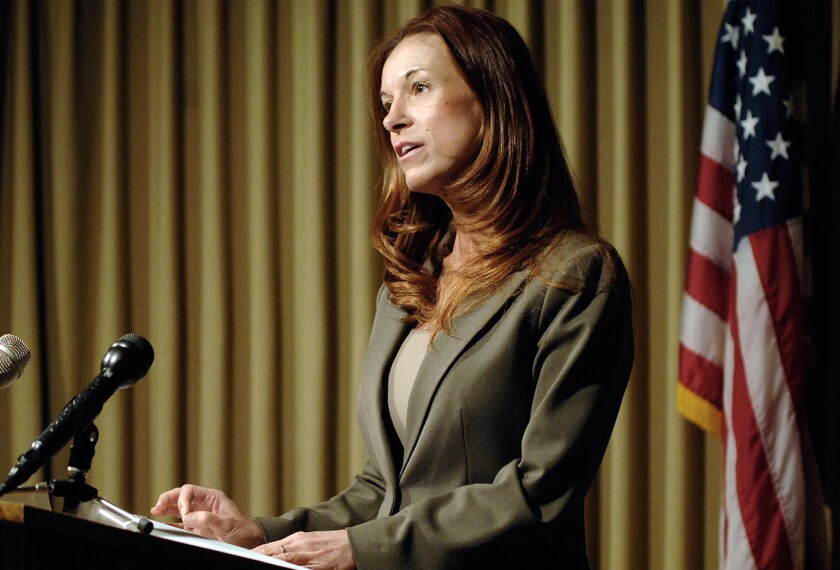
In approaching these requests, the department is trying to balance the Trump administration’s core belief that states are better positioned than Washington to lead the way on K-12, with an imperative to boost student achievement and the legal requirements in ESSA, said Kirsten Baesler, the assistant secretary of elementary and secondary education.
Furthering student academic progress and bolstering state flexibility aren’t “binary goals,” Baesler said in a recent interview. “It’s actually because we will have assessment and accountability that we will be able to return education to the states.”
Any waiver from ESSA “has to improve academic achievement,” she added. “To waive things just to waive them is not what we’re in business to do.”
Waivers bring political pressure from state chiefs, congressional Democrats
State chiefs seeking leeway see the department’s waiver invitation—and some of its early rhetoric on state authority—as a sign that outside-the-box accountability and funding proposals will receive more serious consideration than ever before.
“I am taking to heart and taking seriously what I’ve heard from our federal partners that they want states to be in control of what works for them,” said Debbie Critchfield, Idaho’s superintendent of public instruction.
Critchfield, a former state board president, has wanted students to be able to choose their own high school assessment for years.
But the “timing” was finally right, she said, when McMahon took office, began shrinking the department, and speaking extensively on state K-12 leadership.

On the other hand, Democratic education leaders in Congress—who could have significant new oversight power over the department if their party retakes one or both chambers in the upcoming midterm elections—worry that the waivers could stray from ESSA’s focus on holding states accountable for the performance of, and directing extra resources to, long-marginalized student populations.
“The federal role in education acts as an accountability measure to ensure states provide all children with high-quality education that is not limited by race, color, nationality, gender, ability, immigration status, or socioeconomic class,” the five top Democratic lawmakers on the congressional panels that oversee K-12 spending and policy wrote last May when states began to make their asks for more flexibility from federal requirements public.
“Any negligence or misuse of secretarial authority risks perpetuating disparities and failing the very students these provisions aim to support,” the lawmakers added.
That perspective is “misinformed,” said Baesler, the former North Dakota state superintendent. She doesn’t see the department’s waiver process as an attempt to allow states to obscure the performance of different student populations.
“We’re not here to let states hide schools that aren’t performing,” she said. “We’re here to elevate good practices and ensure that more students are becoming more proficient at all grade levels.”
Does a slimmed-down department have the muscle for waivers?
But some argue that a hollowed-out Education Department is in no position to keep a careful eye on implementation of complex waivers.
Last year, the Trump administration slashed the department’s staff nearly in half and started moving administration of key K-12 programs to other agencies.
The Labor Department, for instance, is slated to oversee Title I grants for disadvantaged students, career and technical education funding, and money to help districts educate English learners.
“In theory, the department is going to approve waivers for many states. There’s going to be flexibility, then, that they need to be tracking,” said Nicholas Munyan-Penney, assistant director of P-12 policy at EdTrust, an advocacy organization focused on equity in education that is working with other nonprofits to track and provide feedback on ESSA waivers. “They’re not going to have the staff capacity to do that work in any sort of meaningful way.”
Monitoring waivers was a tough proposition even during the Obama administration, when a fully staffed department offered each state the same conditional waiver from key requirements of the No Child Left Behind Act, ESSA’s predecessor, he added.

Baesler emphasized that while many career staffers in the office of elementary and secondary education overseeing the formula grants that make up the ESSA’s core—particularly Title I—are set to be detailed to the Labor Department, they still report to the secretary of education.
“The authority for policy and decisionmaking still remains with us,” she said. Career staffer in OESE “are strong and they are experienced. Our experts will continue to do the work.”
Waivers are ‘not the wild, wild West’
Iowa’s recent waiver sent a signal that while the department may be offering more flexibility than ever before, waivers aren’t a free-for-all.
The Hawkeye State initially asked for expansive authority to group together nearly all K-12 federal funding it receives under ESSA, rather than be required to break it out into the separate purposes outlined in federal law.
What Iowa ultimately secured in its waiver was the ability to merge some federal education funds and spend them on statewide initiatives—but only the state portion, typically 5% of the total, from four formula grants.

The department worked with Iowa to find a way to offer flexibility while upholding key spending restrictions in federal law, Baesler said.
“It is not the wild, wild West out there,” she said. “We showed them what parts of law we could waive and what parts we couldn’t.”
Ultimately the state arrived at a solution “where they were able to save millions of dollars and then actually pass those on to their local school districts,” she added.
Several states—including Alabama, Louisiana, and Indiana—are seeking similar flexibility to what Iowa received.
The move would “make our jobs a little bit easier, and it does help us save a little bit of money that we can further push into the classroom,” said Cade Brumley, Louisiana’s superintendent of public instruction.
But he cautioned that waivers have their limits when it comes to the broader question of recalibrating how much power the federal government has over K-12 policy.
“These waivers are not the end-all-be-all to the structure of the federal-state educational relationship,” Brumley said.
Indiana seeks even further funding flexibility. The Hoosier State wants permission to spend its $25 million in school improvement funding—which comes from a requirement in law that states set aside 7 percent of Title I money for low-performing schools—directly on the students currently attending flailing schools, not the schools themselves.
We're not here to let states hide schools that aren't performing. We're here to elevate good practices and ensure that more students are becoming more proficient at all grade levels.
The state, for example, could send the money to a charter school or neighboring district willing to serve students who would otherwise attend a poorly performing school, under its proposal.
“This shift empowers more creative and student-centered solutions in the environment that best meets each student’s needs,” the state wrote in its waiver request.
Idaho and Alabama seek testing changes
Idaho’s ask, on the other hand, relates to ESSA’s testing rules, under which states have to test students in math and reading each year in grades 3-8 and once in high school.
The state wants to sub out its current 3rd grade reading test—the Idaho Standards Achievement Test—for the Idaho Reading Screener, which is used in part to identify students with learning differences such as dyslexia, but which Critchfield said is aligned to tests Idaho schools use for younger students.
The Gem State also wants to allow high schoolers to choose their own assessment from a menu of state-approved tests that could include the state’s current test for 11th graders, the SAT, the ACT, the Classic Learning Test, ACT’s WorkKeys (a career readiness test), and the Armed Services Vocational Aptitude Battery (ASVAB).

Because the high school exam is offered just once, it can’t be used to provide a meaningful picture of student growth, Critchfield argued. A student can flunk the test and still graduate on time, she added, so there’s little motivation for students to try their best.
By contrast, the waiver proposal would give students “skin in the game,” Critchfield said.
An analysis from Ed Trust, All4Ed, the National Parents Union, and other organizations, however, said the plan would “effectively hold some students to dramatically lower academic standards than others.”
Do waivers broaden accountability or lower standards?
Alabama, meanwhile, wants all students to take both the ACT and ACT WorkKeys, measuring college and career readiness, respectively.
“We want to make certain we’re doing what’s right for the boys and girls of Alabama, to make certain that there are options there that get them ready for life after K-12,” said Eric Mackey, Alabama’s state schools chief. “And I think there’s no better way to do it than realizing that they need all of these components married together in order to be an effective part of our workforce.”

Munyan-Penney, however, sees the proposed move as “lowering standards.”
“Their argument is, ‘we’re just assessing different skills,’ with each test,” Munyan-Penney said. “But really [WorkKeys] is not as rigorous.”
Mackey disagreed. “It’s not about raising or lowering expectations,” he said. “It’s about expanding opportunity.”
Baesler declined to comment on specific waiver requests.
The Ed. Dept. want to get to ‘yes’ on waivers
Baesler has a regular, monthly call with state chiefs to discuss topics like ESSA waivers, and she’s urged them to talk to her and her team before pursuing them.
“We are their partners in this, we’re their team,” she said. “We are going to try to find a way to get to yes within the allowability of the law and keeping accountability and transparency at the forefront.”
In some cases, states don’t need the federal stamp of approval to try something new. ESSA already has a lot of leeway on testing and funding written into it, the department reminded state leaders in a letter last summer.
Mackey said he was originally skeptical that the department would really allow states to try new approaches. He remembers thinking, “I don’t know if I want to put my hand into this black box, because I’m not sure [if] something will snap my hand.”
Some of his colleagues around the country still feel that way, in states both blue and red, he said.
“I think if the administration shows, with our waiver and others, that they are willing to do some creative and different things, I think you’ll see more states stepping into it.”