

The tech backlash in schools has entered the courthouse.
Seven Pennsylvania families have sued their Philadelphia-area school district seeking to be able to opt their children out of required use of school computers, such as take-home Google Chromebooks and Apple iPads.
In addition to arguing the internet-connected devices expose their children to distractions and dangerous content, they say that officials in the 8,600-student Lower Merion school district declined to honor an opt-out policy and “contrived” to withdraw it.

The suit in Lev v. Lower Merion School District, filed Aug. 26 in federal district court in Philadelphia, appears to be one of the first broad legal challenges to school technology programs amid the recent rise of an ed-tech backlash against screen time in the classroom.
The plaintiffs, backed by the EdTech Law Center, an Austin, Texas-based legal group that has sued tech giants such as Google and education platforms such as PowerSchool and Renaissance Learning, are raising a broad 14th Amendment claim of parental rights to oversee the upbringing and education of their children.
“The right of parents to make decisions regarding the care, custody and control of their children and to direct their education and upbringing is one of the oldest substantive due process rights that is recognized under the Constitution,” Andrew Liddell, a lawyer with the EdTech Law Center, said in an interview.
Substantive due process refers to unenumerated rights that have been recognized by the courts, and the U.S. Supreme Court has interpreted the 14th Amendment to guarantee a substantive due process right of parents to direct the upbringing, education, and religious training of their children in cases going back to the 1920s.
“It’s been recognized for over a century,” Liddell said. “The world has changed significantly, obviously, in the last century. But the fundamental principle remains, which is that what your children are exposed to at school and what they’re required to do at school—there are limits to what that can do to undermine your life at home.”
Amy Buckman, a spokeswoman for the Lower Merion district, said in a statement that the district was “aware of a lawsuit filed by some parents, not all of whom have students enrolled in LMSD schools, alleging the school board’s decision to repeal a school board policy represents a violation of their civil rights. The district denies the allegations and will respond further through the judicial process.”

Computers and other ed tech portrayed as ‘thieves of precious time’
Some of those parents whose children are not enrolled in the district had sent them to Lower Merion schools but removed them after recent clashes over the former opt-out policy.
James Hausman, the parent of a current 7th grader, removed his son from the district after last school year and enrolled him in private school, the suit says.
Hausman does not permit his child to have a smartphone or use social media or YouTube. But having a school-issued computer led his son to use those services excessively for entertainment and engage in other non-educational uses, such as online poker and horror games, the suit says. His son became agitated and aggressive when Hausman tried to cut off his access to the school computer at the end of the day, the lawsuit says.
Other parents in the suit do have children who continue to attend Lower Merion schools.
Yair Lev, a professor of cardiology and the lead plaintiff in the case, is the parent of a 1st grader and 3rd grader in the district. His younger child started kindergarten last year using a district-issued iPad for a few weeks, but Lev opted the child out of the technology under the district’s former policy.
“To me, computers, smartphones, tablets, and unnecessary digital technology are thieves of precious time,” Lev said in a court declaration in August. “Beyond my well-founded concerns about health, safety, privacy, and education, these devices rob children of time playing, imagining, reading, talking, being outside, interacting with other people, and simply experiencing the real world.”

After Lev’s son was given alternative assignments under the opt-out policy, he told his parents he felt lucky not to have to use the tech device.
“After several months of not having an iPad while his classmates did, [the son] told my wife and me that the time that he was not on the iPad was his favorite part of the day because he was given complicated math problems to do by hand,” Lev said in the declaration.
The son “observed that his classmates are glued to their individual iPads, that they do not respond to anything around them while they’re using them, and that they tend to become frustrated or upset when the iPad is taken away from them,” Lev added.
By the 2025-26 school year, concern over school technology led some parents in Lower Merion to form a group called Pencils Over Pixels, which made recommendations such as banning student cellphones and other devices during the school day and requiring parental opt-in to use school tech.
The suit alleges that as the grassroots group gained momentum, Lower Merion Superintendent Frank Ranelli decided by this past March or April to begin work on repealing the opt-out policy, and that he began denying opt-outs even when the policy was still in place.
The suit cites a comment Ranelli made at an April school board policy committee meeting. “Is there an opportunity for my kids to opt out?” the superintendent said at the session. “We do not have an opportunity for you to do that.”
At a June meeting where the school board repealed the opt-out policy, one board member said the former policy was never meant to give families a broad option to refuse to use school-issued technology devices. And in August, the board adopted a new policy that some proponents asserted gave the anti-tech parents much of what they wanted, such as new language that all use of school devices be “supervised.”
The suit says the district has never been able to provide adequate supervision of tech devices and the new policy seeks to shift the burden to parents.
Recent U.S. Supreme Court decisions defer to parental rights
In raising their parental rights claims, the plaintiffs stress they are challenging a school methodology and not what is taught.
“This case is not about curriculum,” the suit says. “The plaintiffs do not seek to usurp the district’s role in adopting and promulgating curriculum, nor do they seek to exercise veto power over the academic content taught to their children. Rather, Plaintiffs seek only to safeguard their children’s health, safety, and privacy, help them learn and develop skills, and ensure that what their children do all day at school does not undermine their family values.”
The curriculum point may be driven by the fact that federal courts have generally been inhospitable to parental challenges to public school teaching materials, at least to the degree such suits sought to remove books or courses such as sex education.
But the U.S. Supreme Court recently has been more receptive to arguments that certain school policies and classroom materials violate parents’ rights. Republican politicians have also accelerated a push for parents’ rights in recent years. The U.S. House of Representatives, for example, passed the Parental Bill of Rights Act in 2023, spelling out that parents have the right to a list of contents in school library collections and to inspect curriculum materials. (The bill never advanced to the U.S. Senate.) Several Republican candidates for governor this year are including similar pledges in their campaign platforms.
The Supreme Court addressed parental rights last year in Mahmoud v. Taylor, when it ruled parents have a First Amendment religious free exercise right to have their children excused from the use of LGBTQ+-themed storybooks in schools.
Writing in dissent in that case, Justice Sonia Sotomayor said that “requiring schools to provide advance notice and the chance to opt out of every lesson plan or story time that might implicate a parent’s religious beliefs will impose impossible administrative burdens on schools.”
In March, in a decision on its emergency docket, the court reinstated a federal district court decision that said California parents have federal constitutional rights to be informed when their children socially transition or express gender nonconformity at school.
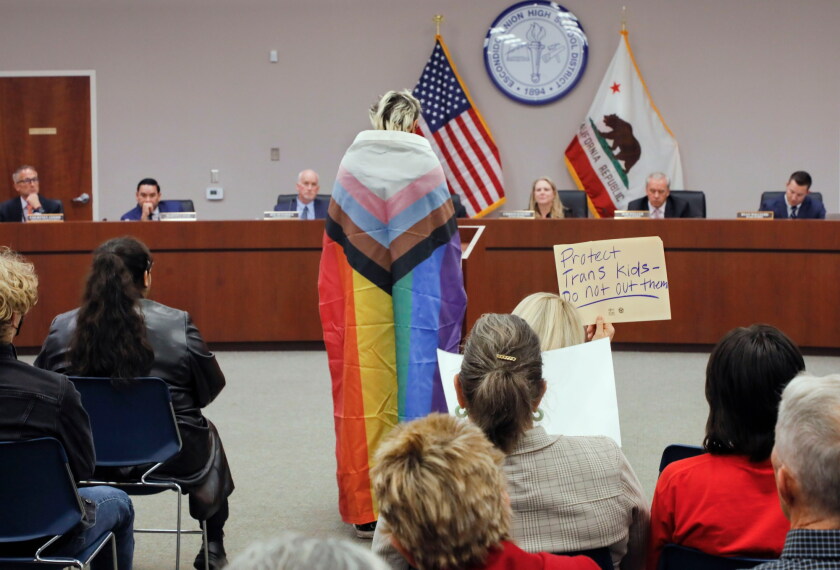
In Mirabelli v. Bonta, the challengers included some parents who were basing their objections on a First Amendment religious exercise claim, and others who based their claims on the 14th Amendment’s due process clause, which is where the Supreme Court has recognized the right of parents to direct their children’s upbringing and education.
“Under long-established precedent, parents—not the state—have primary authority with respect to ‘the upbringing and education of children,’” the court said in the unsigned majority opinion.
Liddell, the EdTech Law Center lawyer representing the plaintiffs, said the Lower Merion district will have to demonstrate a compelling governmental interest to sustain its no opt-out policy against the parents’ assertion of their fundamental constitutional rights.
“We’ve amply alleged violations of parents’ 14th Amendment substantive due process rights,” he said. “What’s the compelling interest here? What good is it for the school district to have students be off task all day? And bouncing around the internet all day and looking at social media and shopping and bullying and chatting with AI chatbots?”
Rena M. Lindevaldsen, a law professor at Liberty University in Lynchburg, Va., said she was sympathetic with the Lower Merion plaintiffs’ parental rights claim, but she characterized it as novel and perhaps stretching beyond the extent of the right as defined by the Supreme Court thus far.
“I’d love to see the Supreme Court find that this would be a parental rights violation,” she said. “I think schools can accommodate this opt-out and parental rights should be a fundamental right as the court has referred to it before.”
But the claims here seem to go one or two steps beyond what the court has recognized recently, such as the religious exercise-based right to opt out of LGBTQ+ storybooks in Mahmoud, and Mirabelli, which was couched in part in parents’ concerns for their children’s mental health, she said.
“We have seen a strengthening in the court’s willingness to recognize parental rights recently,” Lindevaldsen said. “I just don’t know how far they’re ready to go.”

School boards can exercise broad discretion over policies
David B. Rubin, a Metuchen, N.J.-based lawyer whose firm represents 115 New Jersey school districts, is even more dubious of the parental rights claims in the Lower Merion suit.
“While there is an emerging body of law at the Supreme Court on recognizing parents’ rights to decide certain things affecting their kids in the public schools, I don’t think the doctrine has evolved to the point yet where I give the legal theory the plaintiffs are advancing here very high odds of success,” he said.
Rubin is well known in school law circles and will present on parental rights in education at a webinar next week for the National School Attorneys Association.

He said his firm’s clients do not offer broad opt-out policies for ed tech but may alter requirements in some circumstances, such as when a special education student’s individualized education plan calls for it.
At many of the districts he represents, Rubin said, “parents are showing up at board meetings, raising similar concerns. They’re sending emails with very detailed explanations for why they don’t want their children using ed tech. So the concerns are not new to us.”
Some of the districts “are taking these concerns to heart and rethinking what their policies are on these things, but they’re not allowing individual parents to opt out of tech, for a number of reasons,” he added.
Many districts continue to believe that their students should use tech tools and that they have educational benefits that far outweigh any harms, Rubin said. And there would be administrative challenges with offering broad opt-outs, such as giving excused students alternative assignments while trying to keep up with the curriculum, he said.
“School districts, under our system of American public education, are given a lot of discretion over decisions like this,” he said. “Elected school board representatives are held accountable at the ballot box for the policy decisions that they make.”
Unless a board policy violates a specific law, or does not rationally serve a legitimate governmental interest, it will likely be upheld, Rubin said.
The plaintiffs “are asking a court to make ultimate decisions about the safety of ed tech, on issues that are hotly debated,” he said. “I don’t think the courts are going to position themselves to do that.”


