
The U.S. Supreme Court late Monday reinstated a federal district court decision that said parents have federal constitutional rights to be informed when their children socially transition or express gender nonconformity at school.
The apparent 6-3 decision, over a sharp dissent, came after weeks of deliberation on the court’s so-called emergency docket, with the majority saying that religious parents are likely to succeed on their First Amendment free exercise of religion claims challenging California policies that restrain local school personnel from proactively informing parents about a child’s gender identity at school, unless the child consents.
“California’s policies … substantially interfere with the right of parents to guide the religious development of their children,” says the court’s unsigned majority opinion in Mirabelli v. Bonta.
“Indeed, the intrusion on parents’ free exercise rights here—unconsented facilitation of a child’s gender transition—is greater than the introduction of LGBTQ storybooks we considered sufficient to trigger strict scrutiny” in Mahmoud v. Taylor, the court said, referring to last year’s decision that blocked a Maryland school district’s policy refusing to allow parents to opt their children out of the storybooks.
The court went further and ruled for a separate subclass of parents who objected to the California policies not on religious grounds but on the basis of their parental rights under the 14th Amendment.
“Gender dysphoria is a condition that has an important bearing on a child’s mental health, but when a child exhibits symptoms of gender dysphoria at school, California’s policies conceal that information from parents and facilitate a degree of gender transitioning during school hours,” the court said. “These policies likely violate parents’ rights to direct the upbringing and education of their children.”
The court denied, without elaboration, emergency relief sought by teachers in the case, who allege the policies force them to lie to parents about students’ gender identity and to use student’s chosen names and pronouns against the teachers’ religious beliefs. Justices Clarence Thomas and Samuel A. Alito Jr. indicated they would have granted the teachers’ request.
Justice Elena Kagan, in a dissent joined by Justice Ketanji Brown Jackson, called the majority decision “a terse, tonally dismissive ruling designed to conclusively resolve the dispute” even though “the case raises tricky questions, and so cries out for reflection and explanation.”
Justice Sonia Sotomayor indicated she would have also denied the emergency application, but she did not sign the Kagan dissent.

California Education Department policies at issue
A federal appeals court in January blocked the district court decision, calling it too “sweeping” and “ambiguous” and likely wrong on the merits.
The pause by a panel of the U.S. Court of Appeals for the 9th Circuit, in San Francisco, reinstated guidance by the California Department of Education that is interpreted by the challengers, at least, as restraining teachers and district staff members from informing parents about a child’s gender identity at school, unless the child consents.
“California is requiring public schools to hide children’s expressed transgender status at school from their own parents—including religious parents—and to actively facilitate those children’s ‘social transition’ over their parents’ express objections,” the challengers said in their Jan. 13 Supreme Court filing.
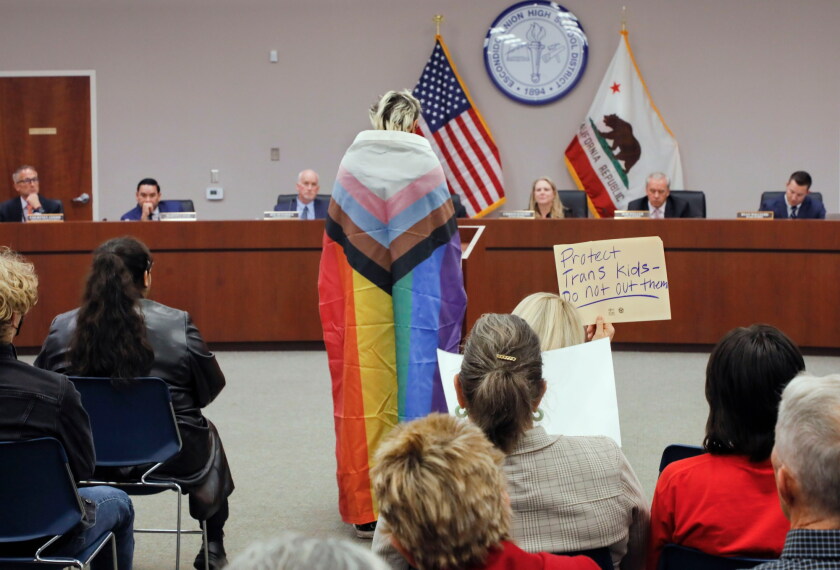
In 2023, two parents and two teachers in the Escondido Union school district challenged the then-published guidance of the state education department, which centered on a 2016 legal advisory and frequently asked questions document that said “schools must consult with a transgender student to determine who can or will be informed of the student’s transgender status, if anyone, including the student’s family.”
The guidance also said “schools are required to respect the limitations that a student places on the disclosure of their transgender status, including not sharing that information with the student’s parents,” except in the “very rare” situations where “there is a specific and compelling need to know.”
In a Dec. 22 decision, U.S. District Judge Roger T. Benitez of San Diego said that state “parental exclusion policies” and local district policies infringed on the 14th Amendment due process right of parents to direct the upbringing of their children and the First Amendment free speech and free exercise of religion rights of teachers to notify parents about their children’s gender identity.
Benitez, a President George W. Bush appointee, certified the challenge as a class action and allowed any parent or public school employee objecting to such policies on religious grounds to submit an opt-out form.
California Attorney General Rob Bonta, a Democrat, asked the 9th Circuit to block the judge’s decision, which the court did on Jan. 5. The panel said the certified class was too sweeping and that Benitez had failed to identify the specific policies he was blocking, since the state does not, in all circumstances, forbid disclosure of students’ gender-identity information to parents.
In his response to the parents’ emergency filing in the Supreme Court, Bonta said the state’s guidance on this issue has been updated in light of a law that took effect in January 2025, known as Assembly Bill 1955. That law prohibits policies that require school employees to disclose the sexual orientation or gender identity of students without their consent, unless the disclosure is required by state or federal law.

The role of California’s new law
In his Supreme Court filing, Bonta stressed that the statute “does not forbid a school district from adopting a policy that employees may elect to make such disclosures.”
The new California law was not specifically at issue in the Mirabelli case, though it is being challenged in two cases pending before the 9th Circuit.
The U.S. Department of Education on Jan. 28 announced that the California education department was in violation of the Family Educational Rights and Privacy Act (FERPA), because its policies and practices, including those stemming from AB 1955, “pressure school officials to conceal information about students’ ‘gender identity.’”
The federal department called on the state to take several actions to bring its policies into compliance with FERPA or else face a loss of federal funding. But the FERPA question is also not part of the Mirabelli case.
The California department, in a Feb. 11 letter to local school administrators, pushed back against the federal department’s statement, saying AB 1955 “does not mandate nondisclosure” to parents of student gender identity information.
A gender support plan “remains subject to a parental request for inspection and review in accordance with FERPA’s provisions,” the state agency’s letter said.
And on Feb. 13, the state sued the Education Department in federal court over the alleged FERPA violations and threat to remove federal funding.

An explanation is needed here, concurring justices say
The Mirabelli case in the Supreme Court did not directly implicate those recent developments.
Justice Amy Coney Barrett, in a concurrence joined by Chief Justice John G. Roberts Jr. and Justice Brett M. Kavanaugh, stressed that the court’s decision is not a final one on the merits, and “the parents must continue to litigate in the 9th Circuit, and if necessary, this court” as California seeks to overturn the district court injunction.

She said the parents are likely to prevail under “a straightforward application” of the court’s precedents recognizing parents’ right to direct their children’s upbringing, which is grounded in the 14th Amendment’s doctrine of “substantive due process” that involves protecting certain unenumerated rights from governmental interference.
Barrett also said that it was important for the majority to explain its decision in this emergency docket case because the 9th Circuit misconstrued last year’s Mahmoud decision, and the “general course correction will allow the case to progress efficiently.”
Kagan, in her dissent, said the decision represents a “malfunction” of the emergency docket, especially here where the court has pending on its regular docket a case that raises similar issues.
Foote v. Ludlow School Committee, about a challenge to a Massachusetts district’s policy that conformed to state guidance about when parents may be informed of their child’s gender transition at school, “is a carbon copy of this one,” Kagan said. The court has not yet decided whether to take up that case.
If the Foote case is unsuitable, Kagan said, there are some 40 other cases working their way through the judicial system that raise similar issues, and the court should have waited to grant full review of one of them to give “the careful, disciplined consideration they merit, rather than the inevitably truncated review the court affords emergency applications.”
Kagan suggested that the parents may actually be entitled to the injunction blocking the state policies.
“California’s policy, in depriving all parents of information critical to their children’s health and well-being, could have crossed the constitutional line,” she wrote. “And that would entitle the parents, at the end of the day, to relief.”
But the court should have followed its “ordinary processes” including full briefing and oral argument over the questions in this case, she said.
“If nothing else, this court owes it to a sovereign state to avoid throwing over its policies in a slapdash way, if the court can provide normal procedures,” Kagan said. “And throwing over a state’s policy is what the court does today.”


