States

Reporter’s Notebook

July 10, 2002 4 min read
  • Save to favorites
  • Print

Southern States Warned New Federal Law Could Bring Bad News

If the South wants to lead the nation in education, as leaders repeatedly declared here during the Southern Regional Education Board’s annual meeting June 22-25, much work needs to be done.

The encouraging sign for lawmakers, governors, and other policy-pushers who gathered here was that everyone seems focused on making Southern schools much better than they’ve ever been.

The roughly 150 leaders at the SREB meeting are the ones who will “take the actions and set the policy that determines how well we do” in meeting an ambitious new set of education goals, said Floyd Coppedge, Oklahoma’s secretary of education and the SREB’s vice chairman last year.

“How well we do does not depend on fate,” he added.

As a first new step, the SREB approved a set of goals that aim to elevate its 16 member states into national leaders in education improvement. The goals include: making sure every child is well-prepared for the 1st grade; providing better-quality teachers and principals in each school; and achieving 100 percent graduation rates, with more options for those who don’t finish high school. (“Southern States Poised to Set Lofty New Education Goals,” June 19, 2002.)

Much discussion was held here, as well, on the coming impact of the revised federal education law. The “No Child Left Behind” Act of 2001, championed by President Bush, will likely cause some twists for Southern political leaders who may find it difficult to push changes in their states’ education systems when the federal law starts labeling many of the nation’s schools as low- performing.

Susan K. Sclafani, a chief aide to U.S. Secretary of Education Rod Paige, warned the SREB conference that state accountability systems label too few schools as “low-performing,” and will not match up with the tougher new federal requirements. (“Frustration Grows as States Await ‘Adequate Yearly Progress’ Advice.”)

The law, a retooling of the flagship Elementary and Secondary Education Act, will require schools to break down student-achievement data by race and other groups, and will require marked improvement within every group.

“Political leadership is going to be in a quandary,” said Mark Musick, the president of the SREB, who joined a panel discussion on the new law with Ms. Sclafani.

In recognition of a pioneering drive for school reform 20 years ago, the SREB awarded its highest honor, the Lamar R. Plunkett Award—named after the late Georgia lawmaker who helped lead the organization for decades—to former Gov. William F. Winter of Mississippi.

Mr. Winter was one of the first Southern governors of his era to push for major statewide school improvement. His reforms were controversial when he proposed them after his election in 1980; some white Mississippians were deeply suspicious of his support for equity and increased spending on public schools.

The former governor said that he used a 1981 SREB report called “The Need for Quality” as the blueprint for the Mississippi Education Reform Act, which passed in 1982. He used the occasion here to press for expanded early-childhood programs in the South. Preschool must be expanded, and new efforts aimed at even younger children “will enable all children, particularly from culturally and economically deprived households, to enter school” prepared to succeed, he said.

While one Mississippi governor received an award, another was handed the symbolic gavel.
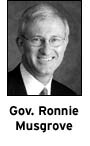
Gov. Ronnie Musgrove

Gov. Ronnie Musgrove took over for a fellow Democrat, Gov. Roy E. Barnes of Georgia, as the chairman of the SREB for the next year. A son of two high school dropouts and the first person to graduate from college in his family, Mr. Musgrove declared “the emergence of the South as the leading region of the nation,” even as many states deal with the “same questions we’ve been dealing with for generations.”

Virginia Gov. Mark R. Warner, who took office in January, proved the quickest study of all the governors at the conference. The Democrat confessed he had been riveted as he sat taking notes during a day of the conference.

“Governors don’t sit anywhere for two hours straight,” Mr. Warner quipped, after he had done just that, listening to a morning of discussions on education.

He thanked the SREB and the panel that developed the new education goals.

“What you’ve provided us throughout our states is a framework for how we’re going to approach these issues over the next 10 years,” Mr. Warner said.

Mr. Warner also announced that he would be “laying out a major initiative in a couple of weeks” on how Virginia will work to improve its lowest-performing schools. He declined to give details, but suggested the program would link struggling schools with more successful ones, and with businesses that might provide expertise, manpower, and resources.

State Sen. Lloyd G. Jackson II of West Virginia reminded everyone at the meeting—even those who might doubt that the Southern states can’t overcome their education problems—that the organization’s expertise and the exchange of ideas among leaders sent them home with the power to make schools substantially better for the children in the South.

“We don’t face these challenges alone,” Mr. Jackson said.

—Alan Richard

A version of this article appeared in the July 10, 2002 edition of Education Week as Reporter’s Notebook

Events

This content is provided by our sponsor. It is not written by and does not necessarily reflect the views of Education Week's editorial staff.
Sponsor
School & District Management Webinar
Stop the Drop: Turn Communication Into an Enrollment Booster
Turn everyday communication with families into powerful PR that builds trust, boosts reputation, and drives enrollment.
Content provided by TalkingPoints
This content is provided by our sponsor. It is not written by and does not necessarily reflect the views of Education Week's editorial staff.
Sponsor
Special Education Webinar
Integrating and Interpreting MTSS Data: How Districts Are Designing Systems That Identify Student Needs
Discover practical ways to organize MTSS data that enable timely, confident MTSS decisions, ensuring every student is seen and supported.
Content provided by Panorama Education
Artificial Intelligence Live Online Discussion A Seat at the Table: AI Could Be Your Thought Partner
How can educators prepare young people for an AI-powered workplace? Join our discussion on using AI as a cognitive companion.

EdWeek Top School Jobs

Teacher Jobs
Search over ten thousand teaching jobs nationwide — elementary, middle, high school and more.
View Jobs
Principal Jobs
Find hundreds of jobs for principals, assistant principals, and other school leadership roles.
View Jobs
Administrator Jobs
Over a thousand district-level jobs: superintendents, directors, more.
View Jobs
Support Staff Jobs
Search thousands of jobs, from paraprofessionals to counselors and more.
View Jobs

Read Next

States States Are Banning Book Bans. Will It Work?
Approved legislation aims to stop school libraries from removing books for partisan reasons.
5 min read
Amanda Darrow, director of youth, family and education programs at the Utah Pride Center, poses with books that have been the subject of complaints from parents in Salt Lake City on Dec. 16, 2021. The wave of attempted book banning and restrictions continues to intensify, the American Library Association reported Friday. Numbers for 2022 already approach last year's totals, which were the highest in decades.
Eight states have passed legislation restricting school officials from pulling books out of school libraries for partisan or ideological reasons. In the past five years, many such challenges have focused on books about race or LGBTQ+ people. Amanda Darrow, the director of youth, family and education programs at the Utah Pride Center, poses with books that have been the subject of complaints from parents in Salt Lake City on Dec. 16, 2021. (Utah is not one of the eight states.)
Rick Bowmer/AP
States McMahon Touts Funding Flexibility for Iowa That Falls Short of Trump Admin. Goal
The Ed. Dept. is allowing the state education agency to consolidate small sets of funds from four grants.
6 min read
U.S. Secretary of Education Linda McMahon is interviewed by Indiana’s Secretary of Education Katie Jenner during the 2025 Reagan Institute Summit on Education in Washington, D.C., on Sept. 18, 2025.
U.S. Secretary of Education Linda McMahon, pictured here in Washington on Sept. 18, 2025, has granted Iowa a partial waiver from provisions of the Every Student Succeeds Act, saying the move is a step toward the Trump administration's goal of "returning education to the states." The waiver allows Iowa some additional flexibility in how it spends the limited portion of federal education funds used by the state department of education.
Leah Millis for Education Week
States Zohran Mamdani Picks Manhattan Superintendent as NYC Schools Chancellor
Kamar Samuels is a veteran educator of the nation's largest school system.
Cayla Bamberger & Chris Sommerfeldt, New York Daily News
2 min read
Zohran Mamdani speaks during a victory speech at a mayoral election night watch party on Nov. 4, 2025, in New York.
Zohran Mamdani speaks during a victory speech at a mayoral election night watch party on Nov. 4, 2025, in New York. The new mayor named a former teacher and principal and current superintendent as chancellor of the city’s public schools.
Yuki Iwamura/AP
States Undocumented Students Still Have a Right to Education. Will That Change in 2026?
State-level challenges to a landmark 1982 Supreme Court ruling are on the rise.
5 min read
Demonstrators hold up signs protesting an immigration bill as it is discussed in the Senate chamber at the state Capitol Thursday in Nashville, Tenn. The bill would allow public school systems in Tennessee to require K-12 students without legal status in the country to pay tuition or face denial of enrollment, which is a challenge to the federal law requiring all children be provided a free public education regardless of legal immigration status.
Demonstrators hold up signs protesting an immigration bill as it was discussed in the Senate chamber at the state Capitol in Nashville, Tenn., on April 10, 2025. The bill, which legislators paused, would have allowed schools in the state to require undocumented students to pay tuition. It was one of six efforts taken by states in 2025 to limit undocumented students' access to free, public education.
John Amis/AP
