Opinion Blog


Rick Hess Straight Up

Education policy maven Rick Hess of the American Enterprise Institute think tank offers straight talk on matters of policy, politics, research, and reform. Read more from this blog.

Policy & Politics Opinion

What It Takes to Be an Effective Education Scholar

If those academics aren’t informing practice or policy, what’s the point?
By Rick Hess — January 05, 2026 3 min read
The United States Capitol building as a bookcase filled with red, white, and blue policy books in a Washington DC landscape.
  • Save to favorites
  • Print

On Wednesday, I’ll be publishing the 2026 RHSU Edu-Scholar Public Influence Rankings, tracking the 200 education scholars who had the largest influence on policy and practice last year.

I want to take a few moments to explain the nature of the exercise. It’s rooted in twin presumptions: First, ideas matter; second, people tend to devote more time and energy to those activities that are valued. Unfortunately, over many years, I’ve found that higher education doesn’t sufficiently value many things that it really should (including, I fear, teaching and learning).

Today, though, I want to focus on a specific shortcoming when it comes to research: Higher ed’s fixation on grants and unread academic journals has meant that it just doesn’t pay much attention to whether scholars are contributing to the real world of policy and practice. While this may not much matter when it comes to the study of physics or Renaissance poetry, it does when researchers work in education—with its immense day-to-day implications for millions of students and educators.

Now, just because education researchers are influencing policy or practice doesn’t mean their work is necessarily good or useful. Indeed, regular readers know that I’m skeptical about the value of much education research and certainly don’t think policy or practice should be driven by the whims of researchers. Why? Well, researchers inevitably bring their own biases, education research tends to be plagued by methodological complications, and even valid findings may not translate into actionable advice. So, “influential” is intended here more as a descriptor than as a compliment.

Scholars are at their best not when they’re handing down edicts from on high but when they’re asking hard questions, challenging lazy conventions, and scrutinizing the real-world impacts of yesterday’s reforms. On that count, it’s enormously healthy for education scholars to interact with the policymakers and educators they seek to persuade.

That makes it a big problem that higher education tends to reserve its professional rewards for scholars who stay in their comfort zone, producing narrow, jargon-laden papers for unread academic journals notable mostly for their unreadable prose. Consequently, there can be little incentive for responsible scholars to wade into heated, oft-unpleasant debates about policy or practice.

That’s where this exercise can help. Over the past decade-plus, dozens of deans and provosts have used these rankings to identify candidates for job openings or inform decisions about promotion and pay. I’ve heard from hundreds of scholars who’ve pointed to the results when seeking institutional support or to illustrate their impact when applying for positions, grants, fellowships, or tenure. And prominent institutions have bragged about the rankings, spotlighting activity that otherwise rarely garners much notice.

Some of this has been in the service of scholarship that I find problematic. But even when that’s the case, the rankings have helped make possible a more robust debate about which scholars are influencing policy and practice and what we should make of their work. Now, no one should overstate the precision of this exercise. It’s a data-informed conversation starter, analogous to similar rankings of ballplayers or mutual fund managers.

Finally, I want to reiterate that the rankings do not address teaching, mentoring, or service (even though I suspect that, much of the time, these are the most valuable things that professors do). For better or worse, this is an exercise in gauging public influence, not a summation of a scholar’s worldly contributions.

Related Tags:

The opinions expressed in Rick Hess Straight Up are strictly those of the author(s) and do not reflect the opinions or endorsement of Editorial Projects in Education, or any of its publications.

Events

This content is provided by our sponsor. It is not written by and does not necessarily reflect the views of Education Week's editorial staff.
Sponsor
School Climate & Safety Webinar
Belonging as a Leadership Strategy for Today’s Schools
Belonging isn’t a slogan—it’s a leadership strategy. Learn what research shows actually works to improve attendance, culture, and learning.
Content provided by Harmony Academy
This content is provided by our sponsor. It is not written by and does not necessarily reflect the views of Education Week's editorial staff.
Sponsor
School & District Management Webinar
Too Many Initiatives, Not Enough Alignment: A Change Management Playbook for Leaders
Learn how leadership teams can increase alignment and evaluate every program, practice, and purchase against a clear strategic plan.
Content provided by Otus
This content is provided by our sponsor. It is not written by and does not necessarily reflect the views of Education Week's editorial staff.
Sponsor
Artificial Intelligence Webinar
Beyond Teacher Tools: Exploring AI for Student Success
Teacher AI tools only show assigned work. See how TrekAi's student-facing approach reveals authentic learning needs and drives real success.
Content provided by TrekAi

EdWeek Top School Jobs

Teacher Jobs
Search over ten thousand teaching jobs nationwide — elementary, middle, high school and more.
View Jobs
Principal Jobs
Find hundreds of jobs for principals, assistant principals, and other school leadership roles.
View Jobs
Administrator Jobs
Over a thousand district-level jobs: superintendents, directors, more.
View Jobs
Support Staff Jobs
Search thousands of jobs, from paraprofessionals to counselors and more.
View Jobs

Read Next

Federal Opinion We Shouldn’t Have to Choose Between Federal Overreach and Abandonment in K-12
Why is federal power being used to occupy our cities but not protect our students’ civil rights?
Sally Iverson
4 min read
Large hand making pressure over group of small, silhouetted figures. Oppressions, manipulation. Contemporary art collage. Photocopy effect. Concept of world crisis, business, economy, control
Education Week + iStock
School Choice & Charters The Nation's Largest School Choice Program Excludes Muslim Schools, Lawsuit Says
The largest state to allow public funds for private schooling faces its first legal challenge.
4 min read
US NEWS TEXAS SCHOOL VOUCHERS DISCRIMINATION LAWSUIT DA
Kelly Hancock, Texas' acting state comptroller, speaks alongside Gov. Greg Abbott in Richland Hills, Texas, on May 17, 2022, when Hancock was a state senator. Hancock has excluded Islamic schools from Texas' new, $1 billion private school choice program, which he now oversees, according to a new lawsuit.
Elias Valverde II/The Dallas Morning News via TNS
Law & Courts Supreme Court Backs Parents in School Gender Disclosure Fight
The Supreme Court restored an injunction blocking California policies on student gender transitions
8 min read
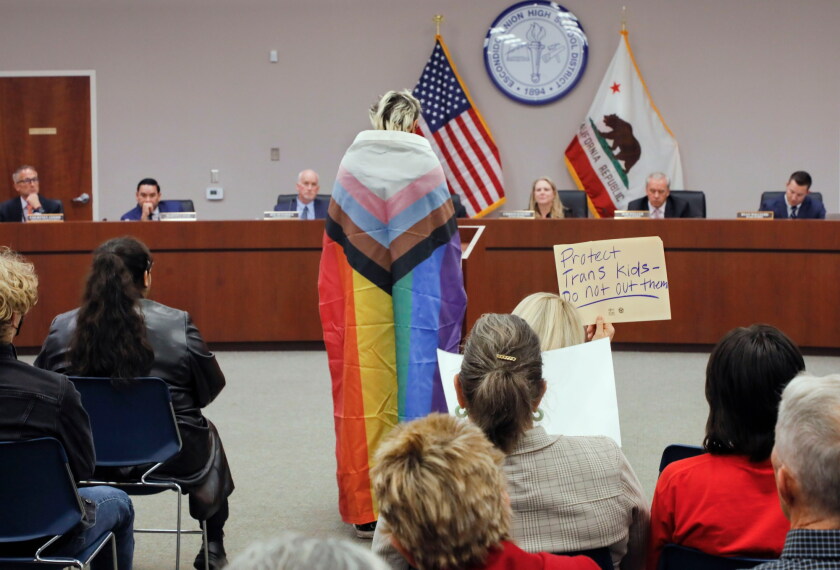
Teacher’s aide Amelia Mester, wrapped in a Pride flag, urges Escondido Union High School District not to have employees notify parents if they believe a student may be transgender in November 2025. A policy on the issue in the city’s elementary school district is the subject of a federal class-action lawsuit in which a judge just sided against the district.
Teacher’s aide Amelia Mester, wrapped in a Pride flag, urges Escondido Union High School District not to have employees notify parents if they believe a student may be transgender at a meeting in November 2025. Two parents and two teachers from the district sued in 2023, challenging California state guidance concerning student gender transitions and parental notification. The U.S. Supreme Court has now reinstated a lower-court decision overturning those state policies.
Charlie Neuman for The San Diego Union-Tribune/TNS
Federal Will the Ed. Dept. Act on Recommendations to Overhaul Its Research Arm?
An adviser's report called for more coherence and sped-up research awards at the Institute of Education Sciences.
6 min read
The U.S. Department of Education building is pictured on Oct. 24, 2025, in Washington, D.C.
The U.S. Department of Education building in Washington is pictured on Oct. 24, 2025. A new report from a department adviser calls for major overhauls to the agency's research arm to facilitate timely research and easier-to-use guides for educators and state leaders.
Maansi Srivastava for Education Week