Aaron Friedman is the president of the nonprofit Make Music Alliance.
If you teach music in your classroom, and feel squeezed by the increased time dedicated to STEM subjects, you might not realize that you have a secret educational weapon.
Only 2% of Americans (6.9 million people) work as scientists or engineers. Amateur scientists are hard to find—if your students strike up a conversation with a stranger about quadratic equations, it probably won’t help them pass their next math exam. On the other hand, an impressive 54% of Americans report that they or a member of their household play a musical instrument, and music is a classic subject for small talk (especially on first dates, or so I am told). Musicians, and music lovers, are everywhere.
Never is that more true than on Make Music Day, the annual celebration of music on June 21 that started in France in 1982 and has since spread to over 1,000 cities in 120 countries. On a single day, millions of amateur and professional musicians pour out onto porches, street corners, and parks to share their music with friends, neighbors, and strangers. Music educators around the world have taken advantage of Make Music Day to tap into their larger musical communities and create unique opportunities to learn. You can do it too—or get inspired to bring some of these ideas to your students throughout the year.
1. Go Outside: Learning to DJ in Lagos
At some point, nearly everyone has watched a DJ spin at a wedding or concert and wondered what they were doing.
So last year, Make Music Lagos organizers decided to draw upon the vibrant and growing electronic-music scene in Nigeria by offering free DJ lessons for Make Music Day. They set up a professional DJ in open spaces at the Ikeja City Mall and the University of Lagos. Along with regular music students, many curious members of the public turned out to attend the lessons, which were accessible even for those with no musical training.
Merely by taking these lessons outside, they turned what might have been a dry music-production class into a bustling public event, with the music itself attracting passersby. (In the end, they even had an unplanned DJ battle and gave away two turntables to the winner!)
When your subject is meaningful to a larger public, taking your class into the community can lead to unanticipated inspiration and surprises.
2. Learn From Each Other: Band Mash-Ups in Hannover, Germany
Since 2015, Hannover’s Make Music Day (which they call “Fête de la Musique” in honor of its French origins) has featured a “Band Mash-Up” as one of their annual highlights.
The Band Mash-Up is an international music exchange between bands from Hannover’s sister cities (including Rouen, France, and Poznan, Poland) and a local Hannover-based group. In the lead-up to June 21, these musicians spend five days together at the MusikZentrum Hannover, a musical hub with a studio, event space, and practice rooms, learning each other’s styles, techniques, and songs. At night, they stay at an arts-themed guesthouse where they have joint barbecues and other activities to get to know each other on a personal level.
When the Fête de la Musique arrives, they perform in a jam session together on stage and play cover versions of the new songs that they’ve learned from each other over the past week.
Although the Hannover project is focused on international fellowship and professional development for working bands, the same concept can work for younger musicians who write original material. Nothing sharpens skills like learning music from peers and hearing someone else’s unique interpretation of it. Paired musicians could be from different classes, schools, cities, or even countries, with the music bridging the distance between them.
3. Stream It Online: Make Music Day U.K.
Last year, Norfolk County, England’s Make Music Day U.K. included a remarkably well-attended streaming concert of amateur teenage and elementary school choral singers, broadcast live from the St. George’s Theatre Cafe in Great Yarmouth. Over 525 locations tuned in to watch the live stream of the event, including many local schools that showed the performances to entire classrooms, bringing the total viewership to several thousand people.

Students get excited to perform for thousands of people, including strangers who would never come to their school recital. But how can you achieve such high viewership?
In Norfolk, they did it in a few ways. First, they held the event in an attractive venue outside of school, to make it feel like a special occasion. Second, they promoted it to local schools, as well as nationally through the NYMAZ music charity, which works in rural areas where live music is rare and streaming is a natural alternative. Finally, they supported the concert with a live Twitter commentary, sending dozens of Tweets during the event inviting people to tune in.
All of this takes time, but with the right promotional strategy, the audience for your students’ performance may be larger than you think.
4. Find Musical Mentors: Sousapalooza in the U.S.
For eight years, Sousapalooza has been a highlight of Make Music Chicago. Each June 21, hundreds of wind band players—from amateurs to the Chicago Symphony Orchestra’s principal trumpet Chris Martin and former principal clarinet Larry Combs—have gathered in Daley Plaza, in the heart of downtown, to play the great marches of John Philip Sousa.
Sousapalooza is open for players of any age to join in and experience the awesome power of playing in a massive wind band. And it has proved so popular that nine other cities joined in with their own Sousapaloozas for Make Music Day last year.
Ultimately, Sousapalooza’s success comes from the relationships it builds between amateur and professional musicians. The amateurs love that they can play side-by-side with some of the best musicians in the city. The professionals feel the satisfaction of being mentors and elder statesmen to the next generation, without committing much time. Because John Philip Sousa’s music is straightforward and almost indestructible, the final results never sound too bad, even without prior rehearsal. And it doesn’t hurt that it has a memorable name!
5. Join a Musical Tribe: Mass Appeal in the U.S.
Since 2009, one of the most popular Make Music Day initiatives has been Mass Appeal, a series that brings together thousands of musicians of all levels and ages to make music in large, single-instrument groups.
Violinists play with each other every time they show up to orchestra rehearsal. But violinists are the exception—an oboist rarely mingles with other double-reedists, and a guitarist does not play with hundreds of other guitarists ... except on Make Music Day!
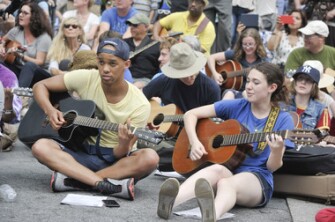
Each year for Make Music New York, where the program started, 15 to 20 different instruments have their own special events. At Mass Appeal Guitars, over 200 guitarists come to Union Square each June 21 to meet each other, jam, take lessons, hear performances from world-renowned guitar players (such as Alex Skolnick and Mark Stewart), and then play along together in an hourlong set of rock classics.
Just as popular, for an entirely different crowd, is the Mass Appeal Recorder gathering on Manhattan’s Upper West Side, welcoming all sizes of recorders (sopranino through contrabass) to play a selection of Renaissance and Baroque pieces.
Young players who come to a Mass Appeal event discover that they are not alone and find amateur musicians of all ages joyfully playing, decades after their school days have ended. By developing their skills on an instrument, they are joining a musical tribe that they can belong to their whole lives.
And when students see that music is not just an academic pursuit, but a social one, they will continue to love music and hone their abilities, long after they’ve forgotten their quadratic equations.
Connect with Make Music Day and the Center for Global Education on Twitter.
Photos, used with permission:
First photo: Credit Norfolk Music Hub. Caption: Karolina Reu sings to children from Edward Worlledge Ormiston Academy at a live-streamed performance for Make Music Day in Norfolk County, England (2018).
Second Photo: Credit: Kris Connor for Getty Images. Caption: Guitarists of all ages join Mass Appeal Guitars in New York City for Make Music Day (2015).


