
Linda McMahon’s Nomination as Trump’s Education Secretary Heads to Senate Floor
Federal

Linda McMahon’s Nomination as Trump’s Education Secretary Heads to Senate Floor

By Brooke Schultz — February 20, 2025 3 min read
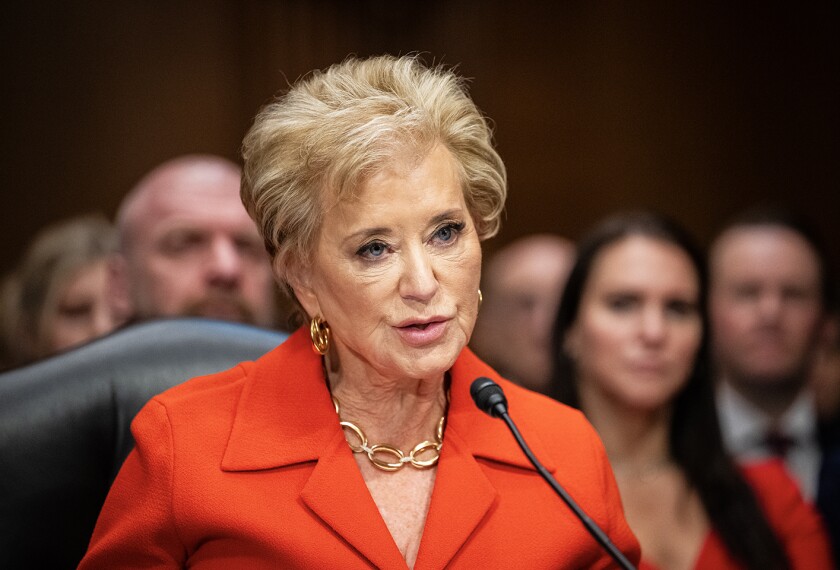
Linda McMahon, President Donald Trump’s nominee to be Secretary of Education, testifies during her Senate Health, Education, Labor, and Pensions Committee confirmation hearing, at the U.S. Capitol, in Washington, on Feb. 13, 2025.
  • Save to favorites
  • Print

Linda McMahon’s nomination to serve as secretary of education advanced through a U.S. Senate committee in a party-line vote on Thursday, paving the way for the business mogul to lead a diminished U.S. Department of Education and potentially seek its closure.

Senators on the Health, Education, Labor, and Pensions committee voted to approve McMahon’s nomination, 12-11, with all Democrats voting against her. Her nomination will now go to the full Senate for final approval.

“We need a strong leader at the department who will get our education system back on track, and Ms. McMahon is the right person for the job,” said Sen. Bill Cassidy, a Republican from Louisiana who chairs the committee. “Ms. McMahon demonstrated a strong vision for the Department of Education. She committed to empowering parents and returning powers to states and local communities, which, by the way, are best equipped to address students’ needs.”

Her nomination was contested by the nation’s largest teachers’ union, which called on senators to reject her, saying the Trump administration’s “agenda is clear and dangerous.”

McMahon testified in front of senators last week, facing questions about the department’s already aggressive agenda in the wake of President Donald Trump’s return to the White House.

The department has already been significantly diminished, with more than 100 employees placed on administrative leave or terminated and scores of contracts canceled. Meanwhile, the agency has been amping up its enforcement of the president’s social agenda, rolling back protections for transgender students and seeking to weed out any use of diversity, equity, and inclusion in its practices and in schools.

The president had previously said he hoped McMahon would “put herself out of a job.” Before lawmakers, McMahon was adamant she would see that vision through—telling them education is “best handled at the state level,” though she agreed it would take congressional action to fully dismantle the agency.

Democrats worried, however, that the erosion of the Education Department would leave behind vulnerable students.

“It is the responsibility of the federal government to see that every kid in America, whether you’re poor, middle class, or rich, gets a quality education,” said Sen. Bernie Sanders, an independent from Vermont who caucuses with Democrats and is the committee’s ranking member for the minority party. “In my view, it really is … what the Department of Education does. Is it a perfect entity? No. Is it bureaucratic? Yes. Can we reform it? Yes. Should we abolish it? No.”

Sanders also doubted that McMahon would hold true power in a Trump administration in which the president and billionaire Elon Musk’s Department of Government Efficiency team have asserted more power.

Sen. Tim Kaine, D-Va., said he found areas of agreement with McMahon. But he said he couldn’t vote for someone “who will willfully engage in the destruction of the very agency she wants to lead.”

“That is disqualifying,” he said.

But Republicans dismissed those concerns, arguing it was time to reform the agency.

“God forbid that President Trump comes in and actually wants to make changes,” said Sen. Markwayne Mullin, R-Okla. “If we really say we’re for the kids, then let’s try something drastic. Let’s actually make a change.”

Though McMahon danced around specifics of how that might look like—other than her assurances that abolishing the department would not necessarily cut funding to programs supporting students from low-income families or students with disabilities—she floated ideas that appeared in the conservative public policy agenda Project 2025, penned by many who now work in Trump’s administration.

McMahon herself has a light resume in education. Though she once aspired to be a French teacher, she went on to found and oversee a multibillion-dollar wrestling entertainment organization. She served a short stint on Connecticut’s state school board, and as a long-time trustee of Sacred Heart University, a private religious school that bears her name on its student commons building.

McMahon would be joined in leadership at the department by two long-time state education chiefs, Penny Schwinn and Kirsten Baesler, whose nominations also require Senate confirmation.

McMahon will be no stranger to Capitol Hill. She served in Trump’s first administration, leading the U.S. Small Business Association. She has been chairwoman of the board for the America First Policy Institute, an organization formed after Trump’s 2020 election loss to propel his social agenda. She was also co-leader of Trump’s transition.

Events

This content is provided by our sponsor. It is not written by and does not necessarily reflect the views of Education Week's editorial staff.
Sponsor
Student Achievement Webinar
The Relationship Advantage for Attendance, Engagement, and Achievement
Relationship-building goes beyond back-to-school. Get practical ideas from district leaders and educators to strengthen student connections.
School & District Management Webinar EdMarketer Quick Hit: Build Campaigns That Engage K-12 Leaders
We’ll share what’s resonating with Education Week’s K-12 audience based on user behavior across platforms and other proprietary data.
This content is provided by our sponsor. It is not written by and does not necessarily reflect the views of Education Week's editorial staff.
Sponsor
Assessment Webinar
Measuring What Matters: How District Leaders Are Redefining Student Assessment
In this panel discussion, district leaders and systems experts will examine the gap between the outcomes we want and the systems in place.
Content provided by Otus

EdWeek Top School Jobs

Teacher Jobs
Search over ten thousand teaching jobs nationwide — elementary, middle, high school and more.
View Jobs
Principal Jobs
Find hundreds of jobs for principals, assistant principals, and other school leadership roles.
View Jobs
Administrator Jobs
Over a thousand district-level jobs: superintendents, directors, more.
View Jobs
Support Staff Jobs
Search thousands of jobs, from paraprofessionals to counselors and more.
View Jobs

Read Next

Federal Q&A A Top Democrat Breaks Down His Party's Plans for K-12 in a House Majority
If Democrats retake the House, Rep. Bobby Scott may be in a position to set his chamber’s K-12 agenda.
5 min read
Rep. Bobby Scott, D-Va., speaks during a prayer vigil held by the Chesapeake Coalition of Black Pastors at The Mount (Mount Lebanon Baptist Church) in Chesapeake, Va., Sunday, Nov. 27, 2022, for the six people killed at a Walmart in Chesapeake, Va., when a manager opened fire with a handgun before an employee meeting Tuesday night.
Rep. Bobby Scott, D-Va., speaks during a prayer vigil in Chesapeake, Va., on Nov. 27, 2022. Scott is the ranking Democrat on the U.S. House of Representatives' education committee and will seek the panel's chairmanship if Democrats win a House majority in next month's elections.
Carolyn Kaster/AP
Federal What a Democratic Congress Could Mean for Trump's K-12 Agenda
They may try to reverse—or at least investigate—the Trump admin.'s efforts to dismantle the Ed. Dept.
9 min read
House Minority Leader Hakeem Jeffries, D-N.Y., the top Democrat in the Republican-majority House, is joined by Rep. Pete Aguilar, D-Calif., chair of the House Democratic Caucus, as they criticize President Donald Trump and his policies while talking to reporters about the approaching midterm election, at the Capitol in Washington, Thursday, Sept. 17, 2026.
House Democratic Leader Hakeem Jeffries speaks at the U.S. Capitol on Sept. 17, 2026. He's joined by Rep. Pete Aguilar, D-Calif., who chairs the House Democratic Caucus. If Democrats gain a majority of either chamber of Congress after next month's elections, they'll be able to hold oversight hearings on and launch investigations into the dismantling of the U.S. Department of Education.
J. Scott Applewhite/AP
Federal The Future of Education Research: More Partisan and Largely Left to States?
As Trump administration works to change federal grants, outside researchers try to regroup.
6 min read
Image of file folders with tabs called "funding" "grants" "projects" and a blank note paper paperclipped to the outside.
Collage by Laura Baker/Education Week + Getty
Federal Bipartisan Bill in Congress Would Help Schools Put Cellphone Bans or Restrictions in Place
The bill would establish a federal grant program to support state efforts to restrict cellphones.
5 min read
Sen. Tom Cotton, R-Ark., the chairman of the Senate Intelligence Committee, center, is joined from left by Sen. John Barrasso, R-Wyo., the GOP whip, and Senate Majority Leader John Thune, R-S.D., as he speaks to reporters ahead of a Wednesday meeting with President Donald Trump, at the Capitol in Washington, Tuesday, June 23, 2026. (AP Photo/J. Scott Applewhite) Senate Minority Leader Chuck Schumer, D-N.Y., speaks to reporters at the Capitol in Washington, Tuesday, June 23, 2026.
Sen. Tom Cotton, R-Ark., speaks to reporters ahead of a meeting with President Donald Trump at the Capitol in Washington on June 23, 2026. Cotton is one of the sponsors of a bipartisan bill that would create a grant program for states to implement school cellphone bans or restrictions.
J. Scott Applewhite/AP
