Special Report
Federal

Language Learning Twice as Hard for Mayan Student

By Lesli A. Maxwell — June 01, 2012 2 min read
Luis Mis Mis, 18, attends an English-literature class at Abraham Lincoln High School in San Francisco. A fifth-year senior, he spoke Mayan—not English or Spanish—when he arrived in the United States at age 14.
  • Save to favorites
  • Print

It’s taken less than five years for Luis Mis Mis to learn two languages—English and Spanish—since arriving in San Francisco from his birthplace in the state of Yucatán in Mexico.

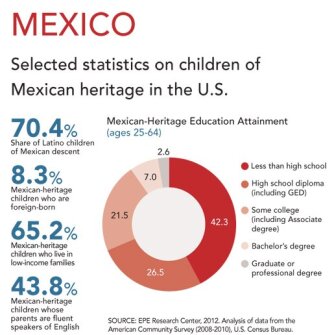
A Mayan Indian, Mis Mis, who is 18, is a bit atypical compared with most students of Mexican heritage attending school in the United States.

He was raised mostly by his grandparents, who spoke only the indigenous Mayan language. As a child, he rarely attended school and spent much of his time helping his grandfather work on the family’s small farm.

In 2008, when his mother came back to Yucatán to bring him and his siblings to join her and their father in California, he had not seen his parents for nearly 10 years.

In the United States, he landed at Newcomer High School in San Francisco, one of the nation’s oldest secondary schools for new immigrants. It has since closed down because of budget cuts. Speaking only a little Spanish at the time, Mis Mis struggled to communicate with teachers and fellow students, none of whom spoke Mayan.

After seven months at Newcomer High, where he learned Spanish from his peers and took English-as-a-second language courses, Mis Mis transferred to Abraham Lincoln High School, a large, comprehensive San Francisco high school where a majority of students are Asian-American.

He continued in ESL courses for another year and a half at Lincoln and was then reclassified as proficient in English—a remarkably short amount of time for an older immigrant student to learn the language.

Still, he needed a fifth year of high school to earn enough credits to graduate. But with the support of the administration at Lincoln High and the advocacy of Spanish teacher Suzann Baldwin and environmental science teacher Vanessa Carter, Mis Mis has been able to stay at Lincoln for an extra year. Without their assurances that he could stay another year, Mis Mis says he would have dropped out and sought a General Educational Development certificate, or GED.

Last year, he earned a 4.0 grade point average; this year, he’s enrolled in Advanced Placement Spanish with students who are all native speakers.

Mis Mis has never told his parents about his successes in school and has only shared a little with them about his ambitions: college and a career as a musician or an environmental science teacher. This spring, he’s been working with Baldwin, the Spanish teacher, to figure out how he can pay to attend a four-year college in California.

“I’m not sure they would understand,” he says of his parents. “They work really hard and probably want me to do the same thing to help out.”

Mis Mis spends all of his time outside of school “playing guitar, reading, writing, and working on my own to study and improve,” he says. “I want to have a good life.”
Events

This content is provided by our sponsor. It is not written by and does not necessarily reflect the views of Education Week's editorial staff.
Sponsor
School & District Management Webinar
Stop the Drop: Turn Communication Into an Enrollment Booster
Turn everyday communication with families into powerful PR that builds trust, boosts reputation, and drives enrollment.
Content provided by TalkingPoints
This content is provided by our sponsor. It is not written by and does not necessarily reflect the views of Education Week's editorial staff.
Sponsor
Special Education Webinar
Integrating and Interpreting MTSS Data: How Districts Are Designing Systems That Identify Student Needs
Discover practical ways to organize MTSS data that enable timely, confident MTSS decisions, ensuring every student is seen and supported.
Content provided by Panorama Education
Artificial Intelligence Live Online Discussion A Seat at the Table: AI Could Be Your Thought Partner
How can educators prepare young people for an AI-powered workplace? Join our discussion on using AI as a cognitive companion.

EdWeek Top School Jobs

Teacher Jobs
Search over ten thousand teaching jobs nationwide — elementary, middle, high school and more.
View Jobs
Principal Jobs
Find hundreds of jobs for principals, assistant principals, and other school leadership roles.
View Jobs
Administrator Jobs
Over a thousand district-level jobs: superintendents, directors, more.
View Jobs
Support Staff Jobs
Search thousands of jobs, from paraprofessionals to counselors and more.
View Jobs

Read Next

Federal The Ed. Dept.'s Research Clout Is Waning. Could a Bipartisan Bill Reinvigorate It?
Advanced education research has bipartisan support even as the federal role in it is on the wane.
5 min read
Learning helps to achieve goals and success, motivation or ambition to learn new skills, business education concept, smart businessman climbing on a stack of books to see the future.
Fahmi Ruddin Hidayat/iStock/Getty
Federal From Our Research Center Trump Shifted CTE to the Labor Dept. What Has That Meant for Schools?
What educators think of shifting CTE to another federal agency could preview how they'll view a bigger shuffle.
3 min read
Collage style illustration showing a large hand pointing to the right, while a small male pulls up an arrow filled with money and pushes with both hands to reverse it toward the right side of the frame.
DigitalVision Vectors + Getty
Federal Video Here’s What the Ed. Dept. Upheaval Will Mean for Schools
The Trump administration took significant steps this week toward eliminating the U.S. Department of Education.
1 min read
The U.S. Department of Education building is pictured in a double exposure on Oct. 24, 2025, in Washington, D.C.
Maansi Srivastava for Education Week
Federal What State Education Chiefs Think as Trump Moves Programs Out of the Ed. Dept.
The department's announcement this week represents a consequential structural change for states.
6 min read
The U.S. Department of Education building is seen behind the Dwight D. Eisenhower Memorial on Oct. 24, 2025 in Washington, D.C.
The U.S. Department of Education building is seen behind the Dwight D. Eisenhower Memorial on Oct. 24, 2025 in Washington, D.C. The department is shifting many of its functions to four other federal agencies as the Trump administration tries to downsize it. State education chiefs stand to be most directly affected.
Maansi Srivastava for Education Week
