
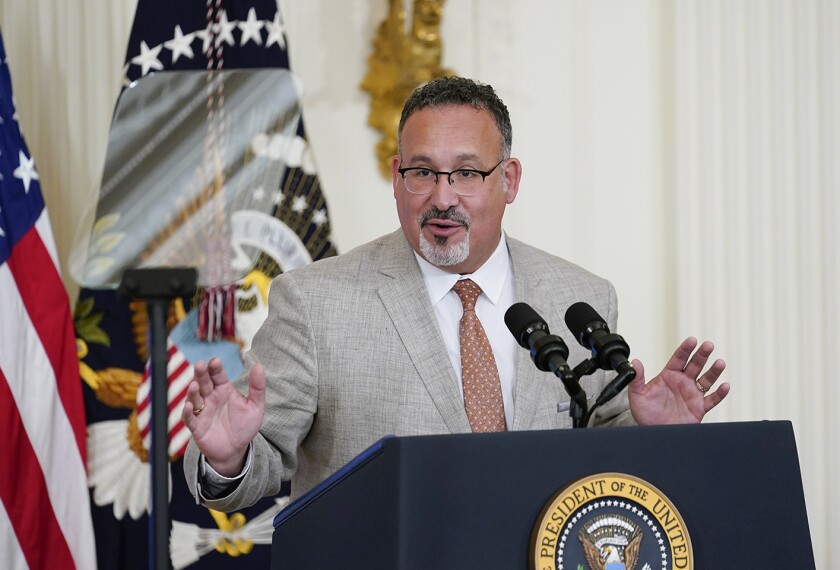
Clarification: Education Secretary Miguel Cardona’s speech was hosted by Bank Street College of Education.
It’s been a tough couple years for the teaching profession. Job satisfaction is down, attrition rates appear to be going up, and administrators and policymakers are desperate to find ways to staff classrooms with highly qualified and diverse teachers.
To address some of these issues, the U.S. Department of Education is seeking an additional $600 million to recruit, support, and retain teachers in its fiscal year 2023 budget request. Education Secretary Miguel Cardona said in a June 9 speech that policymakers—including those at the state and local levels—must make significant investments in the teacher workforce.
“Let’s transform our appreciation of teachers to action,” Cardona said at Bank Street College of Education, a teacher-preparation program in New York City. “It’s not enough to say we’ve got to lift the profession, or [focus on] teacher appreciation—we really have to start putting policy and funding behind this. That’s the bottom line. It’s time for action.”
Districts and states have received an influx of money from the federal government through the pandemic-relief packages. Cardona said there’s a sense of urgency to rebuild from the pandemic and reimagine how education can be—and that starts with putting highly qualified, diverse teachers into every classroom.
“The last two years, I’ve been fearing and fighting COVID. For the next two years, I’m going to be fearing and fighting complacency,” he said, emphasizing that districts and policymakers must take strides to elevate the beleaguered teaching profession.
During the omicron surge this winter, a subset of teachers expressed frustration with some of Cardona’s messaging to keep schools open for in-person learning, saying that his rhetoric ignored their concerns about safety and the stressors of teaching during a pandemic.
In his speech, Cardona said he values hearing from teachers and wants them at the decisionmaking tables.
“We definitely need to make sure that as we’re reopening and reimagining our schools, we’re putting teacher voice at the table before decisions are made,” he said. “Other than parents, who better to talk about what the needs of the students are than their teachers?”
Cardona’s vision for addressing teacher shortages
To start, Cardona said, valuing teachers means paying them a living wage. He added that many teachers are relying on government assistance and make less than what other college-educated workers earn.
President Joe Biden had campaigned on giving teachers a raise. His administration’s fiscal 2023 budget proposal would more than double Title I money, which could be used to pay for teacher salary increases as well as student supports. (Congress will decide whether to green-light that investment.)
It's not enough to say we've got to lift the profession ... It's time for action.
“We can talk all we want about supporting teachers, we can show up with coffee and donuts in May on Teacher Appreciation Week, but we show we value them by our wallets,” Cardona said.
Cardona also praised innovative models of preparation, including grow-your-own programs that target high school students, teacher residencies, and apprenticeships. These types of programs are generally more successful at recruiting people of color into the teaching profession than traditional undergraduate programs.
Tennessee recently became the first state to be approved by the U.S. Department of Labor to establish a permanent grow-your-own model that will allow people to become a teacher for free. The first registered apprenticeship program is a partnership between the Clarksville-Montgomery County school system and Austin Peay State University that allows school employees to get on-the-job experience—and a paycheck—while training to become a teacher. Tuition, fees, books, and required exams are all covered.
Also, Cardona said, policymakers should make it easier and more enticing for teachers to earn certification in high-demand areas, like special education and bilingual education. And there should be leadership opportunities for teachers so they can grow in their profession.
Student loan forgiveness is a key piece
Cardona touted the department’s work at fixing some of the problems with the Public Service Loan Forgiveness, which promises to forgive the federal loans of teachers and other public service workers if they make 120 on-time monthly payments toward their loan. The program has had a confusing, complicated, and poorly communicated application process that has left the vast majority of qualified borrowers unable to pursue loan forgiveness.
Last October, the Biden administration announced it would temporarily waive many requirements, including retroactively, so that more people could qualify. As of early May, more than 127,000 borrowers have qualified for forgiveness under these changes, according to the department.
Borrowers who have not yet applied for public service loan forgiveness have to do so before Oct. 31 to benefit from these changes. Advocacy groups and labor unions, including the National Education Association, have called on the Biden administration to extend the changes past October so more people can benefit.
"[B]y the time public servants figured out the new temporary rules, the program was halfway done,” said NEA President Becky Pringle, according to Forbes. “Educators and public service workers need more time to get forgiveness they deserve.”
Cardona hasn’t addressed a possible extension, but in his speech, he said the department is “trying really hard to fix a broken system.” He urged attendees to spread the word about the upcoming deadline.
‘Support the whole educator’
The pandemic has taken a toll on the mental health of students and educators, and many school districts are using their federal funding for more mental health supports. That’s a key component of reimagining schools, Cardona said.
“We can focus on literacy, numeracy, and science, and lifting up the academic expectations while also providing mental health supports for our students,” Cardona said. He added: “As we support the whole child, we must also support the whole educator.”
Only a third of district and school leaders said they have made counselors or mental health services available to staff since the start of the pandemic or added to the mental health services already offered, according to a nationally representative EdWeek Research Center survey of educators conducted in January and February.
Forty-four percent of respondents said they have offered or increased their offerings of professional development on self-care, which educators say is no substitute for the kind of broader, systemic change that would keep them from feeling that their jobs have become untenable.
On Thursday, the education department also released a list of ways states and districts can use federal funding to support the teacher workforce.


