Federal

Conservative Slate Angles for Kan. State Board Seats

By Jeanne Ponessa — October 30, 1996 3 min read
  • Save to favorites
  • Print

To hear some Kansans tell it, the upcoming state school board election is a referendum on a conservative agenda.

The intensely contested race for five of the board’s 10 seats pits five Republican candidates against four Democrats and one independent.

As it happens, the GOP candidates have all been endorsed by a grass-roots conservative organization known as the Kansas Education Watch Network, or KEW-NET, which advocates a back-to-basics curriculum as well as more local control and parental rights. In the meantime, each of their respective opponents has won the support of the Kansas NEA, which supports the state’s current school-improvement plan.

Each side is working hard to portray the other’s candidates as extremists. Yet, as some educators across the state express the fear that a victory by the Republican slate could put a decisively conservative spin on education policy, the GOP candidates deny any sort of orchestrated strategy.

“First of all, I never knew who KEW-NET was until the paper accused me of being with these people, so I had to call them and request a position paper,” said Rene Armbruster, the Republican candidate from the district that includes Topeka.

But Harold R. Hosey, a self-described moderate Republican incumbent whom Ms. Armbruster defeated in the primary, had a different perspective. “I was kind of targeted to be eliminated,” said Mr. Hosey, who is now serving as the interim superintendent of the Dodge City schools. “She and the others will destroy what had been five good years of progress in the Kansas public education system.”

Tipping the Balance

Twelve states around the country have at least some of their state school board members chosen by voters. Over the past two years, Republican victories in state board elections have given a conservative edge to the state boards in Michigan and Alabama. Observers say that this year they are watching nonpartisan races for board seats in Nebraska and Ohio, as well as partisan races in Michigan, Texas, and, of course, Kansas.

The Kansas election is so critical, Democrats and some moderate Republicans argue, because a slate of conservative candidates could politicize what had previously been a bipartisan board.

“We run on partisan tickets but we have always [operated] in the past on a nonpartisan basis,” said Mike D. Gragert, an incumbent Democrat from Wichita.

“The Democrats and the Republican moderates voted together on about all the issues,” Mr. Hosey agreed. Because there were two board members who represented the more conservative viewpoint, he said, many votes were divided 8-2.

Craig Grant, the director of political action for the Kansas NEA, the state affiliate of the National Education Association, noted that the one sitting member who tended to vote conservatively could potentially help create a six-person majority after this election. “If all five of these KEW-NET-supported candidates would win, it could tip the balance to a much more conservative leaning,” he said.

But Jim McDavitt, the executive director of the Wichita-based KEW-NET, said it was unfair to portray the Republican candidates as anything other than individuals. “My issues in deciding to endorse a candidate are, ‘Will they accept the challenge of academics?’ and ‘Will they unwaveringly demand accountability?’ The other issues are side issues,” he said. “I’d like to see [the media] quit saying that somehow a KEW-NET endorsement is more sinister or more ominous than an NEA endorsement, particularly when the NEA is so nefarious in its agenda.”

Gerald Henderson, the executive director of the United School Administrators of Kansas, said it was hard to assess the ramifications of an across-the-board Republican victory, although he said that one of his colleagues had less concern after meeting the candidates in person.

Still, he said, “there are people within those districts that say, ‘Hey don’t let that fool you--these folks are scary.’”

On the Right Track?

One recurring theme in the individual races is the Republicans’ assessment that student performance is in decline and more local control is needed.

“Basically, all these candidates sing from the same songbook, which is that our schools are bad and getting worse,” said Bill Wagnon, the Democratic candidate running against Ms. Armbruster. Mr. Wagnon, a history professor at Washburn University in Topeka, gives high marks to the state’s much-touted Quality Performance Accreditation system to evaluate school progress.

But Ms. Armbruster said that on the campaign trail she hears from employers who complain that graduates can’t read or write, and from teachers who are drowning in QPA paperwork requirements.

It’s not the fault of the teachers, she said, “just the big bureaucracy.”
Related Tags:

A version of this article appeared in the October 30, 1996 edition of Education Week as Conservative Slate Angles for Kan. State Board Seats

Events

This content is provided by our sponsor. It is not written by and does not necessarily reflect the views of Education Week's editorial staff.
Sponsor
School Climate & Safety Webinar
Belonging as a Leadership Strategy for Today’s Schools
Belonging isn’t a slogan—it’s a leadership strategy. Learn what research shows actually works to improve attendance, culture, and learning.
Content provided by Harmony Academy
This content is provided by our sponsor. It is not written by and does not necessarily reflect the views of Education Week's editorial staff.
Sponsor
School & District Management Webinar
Too Many Initiatives, Not Enough Alignment: A Change Management Playbook for Leaders
Learn how leadership teams can increase alignment and evaluate every program, practice, and purchase against a clear strategic plan.
Content provided by Otus
This content is provided by our sponsor. It is not written by and does not necessarily reflect the views of Education Week's editorial staff.
Sponsor
Artificial Intelligence Webinar
Beyond Teacher Tools: Exploring AI for Student Success
Teacher AI tools only show assigned work. See how TrekAi's student-facing approach reveals authentic learning needs and drives real success.
Content provided by TrekAi

EdWeek Top School Jobs

Teacher Jobs
Search over ten thousand teaching jobs nationwide — elementary, middle, high school and more.
View Jobs
Principal Jobs
Find hundreds of jobs for principals, assistant principals, and other school leadership roles.
View Jobs
Administrator Jobs
Over a thousand district-level jobs: superintendents, directors, more.
View Jobs
Support Staff Jobs
Search thousands of jobs, from paraprofessionals to counselors and more.
View Jobs

Read Next

Federal Ed. Dept. Wants to Revamp Assistance Program It Calls 'Duplicative,' 'Confusing'
The department's Comprehensive Centers have already been through a year of shakeups.
3 min read
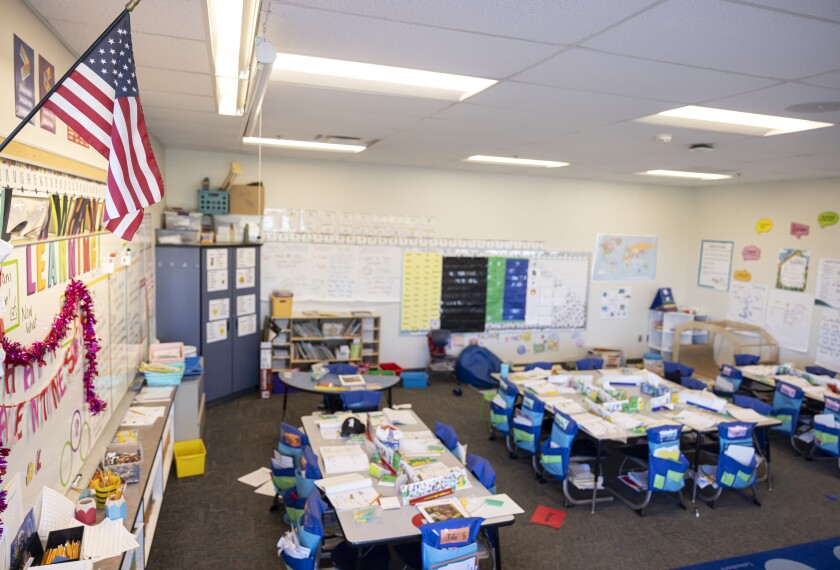
A first grade classroom at a school in Colorado Springs, on Feb. 12, 2026.
A 1st grade classroom at a school in Colorado Springs, Colo., on Feb. 12, 2026. The U.S. Department of Education released a proposal to rework a decades-old program charged with helping states and school districts problem-solve and deploy new initiatives, calling the current structure “duplicative” and “confusing.”
Kevin Mohatt for Education Week
Federal Will the Ed. Dept. Act on Recommendations to Overhaul Its Research Arm?
An adviser's report called for more coherence and sped-up research awards at the Institute of Education Sciences.
6 min read
The U.S. Department of Education building is pictured on Oct. 24, 2025, in Washington, D.C.
The U.S. Department of Education building in Washington is pictured on Oct. 24, 2025. A new report from a department adviser calls for major overhauls to the agency's research arm to facilitate timely research and easier-to-use guides for educators and state leaders.
Maansi Srivastava for Education Week
Federal Trump Talks Up AI in State of the Union, But Not Much Else About Education
The president didn't mention two of his cornerstone education policies from the past year.
4 min read
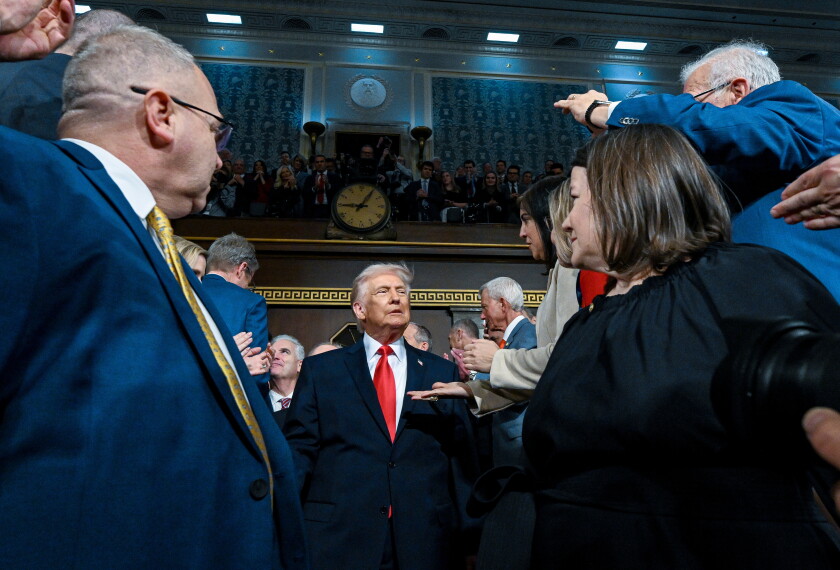
President Donald Trump enters to deliver the State of the Union address to a joint session of Congress in the House chamber at the U.S. Capitol in Washington, Tuesday, Feb. 24, 2026.
President Donald Trump enters to deliver the State of the Union address to a joint session of Congress in the House chamber at the U.S. Capitol in Washington, Tuesday, Feb. 24, 2026. The president devoted little time in the speech to discussing his education policies.
Kenny Holston/The New York Times via AP, Pool
Federal Education Department Will Send More of Its Programs to Other Agencies
Education grants for school safety, community schools, and family engagement will shift to Health and Human Services.
4 min read
Various school representatives and parent liaisons attend a family and community engagement think tank discussion at Lowery Conference Center on March 13, 2024 in Denver. One of the goals of the meeting was to discuss how schools can better integrate new students and families into the district. Denver Public Schools has six community hubs across the district that have serviced 3,000 new students since October 2023. Each community hub has different resources for families and students catering to what the community needs.
A program that helps state education departments and schools improve family engagement policies is among those the Trump administration will transfer from the U.S. Department of Education to the U.S. Department of Health and Human Services. In this photo, school representatives and parent liaisons attend a family and community engagement discussion on March 13, 2024, in Denver to discuss how schools can better integrate new students and families into the district.
Rebecca Slezak For Education Week