The following offers education-related highlights of the recent legislative sessions. The enrollment figures are based on estimated fall 2000 data reported by the National Center for Education Statistics for prekindergarten through 12th grade in public elementary and secondary schools. The figures for precollegiate education spending include money for state education administration, but not federal, flow-through dollars, unless otherwise noted.
CALIFORNIA
Fiscal Problems Color School Spending Choices
Education advocates walked away from California’s 2001 legislative session with a mixed bag of bills designed to advance student progress in meeting state standards, as Gov. Gray Davis approved more funding for the state’s low-performing schools and greenlighted staff-development programs for teachers and principals.
Still, as the governor signed a flurry of education-related measures in advance of an Oct. 15 deadline, one notable bill that did not receive approval would have given schools $250 million a year over three years to help them purchase updated, standards-based instructional materials.
“Given the rapid decline of our economy and a budget shortfall of $1.1 billion through the first three months of this fiscal year alone, I have no choice but to oppose additional general-fund spending,” the governor said in an Oct. 12 veto message.

|
Mr. Davis cited similar fiscal concerns in a message detailing his reasons for vetoing legislation that would have required the state department of education to establish a public “teacher-qualification index” designed to hold schools accountable for the qualifications of their teachers.
Despite such concerns, though, the state still hiked spending for K-12 schools by 6 percent for the 2001-02 fiscal year, approving a $45.4 billion budget for precollegiate education that includes $250 million in direct aid to help schools offset rising energy costs and implement energy-saving programs and devices. (“California Budget Pinch Leaves Schools Largely Unscathed,” Aug. 8, 2001.)
Following the governor’s veto of the instructional-materials aid, education officials said that schools would likely get by in the short term by tapping unused money, but would soon need more funding to keep pace with the state’s efforts to align classroom instruction with statewide academic standards.
“We’re not just talking about books, we’re talking about resources for the entire class,” said Doug Stone, a spokesman for the education department.
Meanwhile, school lobbyists cheered the approval of a measure that would provide $200 million in grants to help low-performing schools, with priority given to those that score in the lowest 10 percent on state tests. Schools could put the funds toward such improvement efforts as lowering class sizes, improving curriculum materials, increasing parent involvement, and boosting staff development.
Wayne Johnson, the president of the California Teachers Association, said the approval of the legislation represents a “first step” toward leveling the playing field.
“This legislation puts badly needed resources into the schools with the lowest test scores, where poverty and overcrowding are setting students up to fail,” he said.
Gov. Davis also approved a measure that allocates about $80 million for the first of what is designed to be a three-year program to provide all English/language arts and mathematics teachers in the state with intensive, standards-based training.
In addition, the governor approved a $15 million program to provide an extra five days of training each year to roughly 5,000 principals and vice principals.
The professional-development program, which would focus on instructional leadership, computers, and school management, comes six months after a report detailing the state’s shortage of qualified school leaders.
“One of the keys to high achievement is strong leadership,” California Secretary of Education Kerry Mazzoni said during a recent press briefing. “We know we have had problems with that in this state.”
Students in the class of 2004 may be spared a requirement that they pass the state’s new high school exit exam to graduate, thanks to a bill Mr. Davis signed this month that permits the state board of education to postpone the date the test will count toward graduation. The legislation calls for a formal study of how students are being taught the state’s standards, after which the state board of education can decide by next Aug. 1 whether to delay the requirement. (“Calif. to Study Whether Graduation Test Should Be Delayed,” Oct. 3, 2001.)
Gov. Davis signed a measure allowing undocumented immigrants to pay in-state tuition at California’s colleges and university, beginning in January. The governor vetoed a similar measure last year, but now says that students with California ties should not be forced to pay costly, out-of-state rates.
The governor cited his concern over childhood obesity in approving legislation that prohibits the sale of soft drinks to elementary school students and restricts the sale of carbonated beverages and vending-machine foods with limited nutritional content in middle schools.
Another health-related measure that got the governor’s go-ahead overrides dress codes prohibiting students from wearing hats on campus. His action allows students to wear hats when outside to avoid potentially cancer- causing exposure to the sun.
Lawmakers ended the legislative session without acting on a measure to place a proposed $24 billion bond issue for K-12 school construction on the statewide ballot in March.
Still, advocates of the school construction plan are hoping that legislative consensus can be reached in time to place the bond proposal on the ballot in November 2002.
In the course of budget negotiations this past summer, Gov. Davis backed away from a $65 million proposal to extend the school year by 30 days for middle school students. Though he made a prominent pitch for the measure during his State of the State Address in January, it failed to garner support from education organizations.
—Jessica L. Sandham
NORTH CAROLINA
State Targets Neediest Students and Schools
North Carolina’s most vulnerable children are intended to be the recipients of more support from the state’s $14.4 billion fiscal 2002 budget than they have under previous spending plans.
The budget, signed by the governor Sept. 26 during the longest legislative session in the state’s history, includes $5.9 billion for precollegiate education from the general fund, a 1.5 percent increase. Some education analysts believe that it takes a more strategic approach to addressing the educational needs of needy children and other students who may be at risk of failing in school.
|
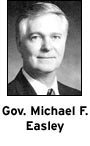
Gov. Michael F. Easley’s campaign promise to provide preschool programs for 40,000 at-risk 4-year-olds throughout the state got its start with $6.4 million for each year of the 2002-03 biennium. The money is expected to pay for programs for some 1,500 of those children.
The other major part of his education plan, reduced class sizes, will also get a boost, with $12 million to reduce kindergarten classes statewide by one student, bringing the teacher- student ratio to 1-to-19. The biennial budget continues with the reduction money in the 2003 fiscal year to achieve an average ratio of 1-to-18.
An aid package for so-called high-priority schools, or those with large numbers of children deemed at risk of academic failure, came as a pleasant surprise to some education groups. The package provides more than $8 million in fiscal 2002 to reduce class sizes in those schools, and an additional $1.7 million for even smaller classes at the state’s chronically low-performing schools.
Nearly $2 million was awarded to the high-priority schools to pay for an additional specialist position, such as a reading specialist, in each school. And $1.5 million was given for bonus pay for mathematics, science, and special education teachers who choose to work in those schools. In addition, the school year for teachers in those schools will be extended by five days to allow more time for professional development.
“That high-priority-schools package amazed me,” said John N. Dornan, the executive director of the Public School Forum of North Carolina, a nonprofit research center in Raleigh. “They seem to be following [recent recommendations] on using money more strategically, ... such as in addressing class size where it can make the biggest impact.”
The intense debate over the budget, which ran throughout the summer and into the new school year, was fueled by a projected state deficit of nearly $1 billion this year.
In the end, lawmakers agreed to raise the state sales tax as well as income taxes for the wealthiest taxpayers. (“Hard-Fought Budget in N.C. Leaves Schools Better Off Than Feared,” Oct. 3, 2001.)
After the budget was signed, however, the governor signaled to state officials that revenues would fall short of projections, and he directed them to find places to cut an additional 4 percent from their agencies’ new budgets. Mr. Easley indicated that the cuts would not affect the state’s education improvement efforts.
—Kathleen Kennedy Manzo


