Federal

Biden Admin. Warns Schools to Protect Students From Antisemitism, Islamophobia

By Libby Stanford — November 07, 2023 3 min read
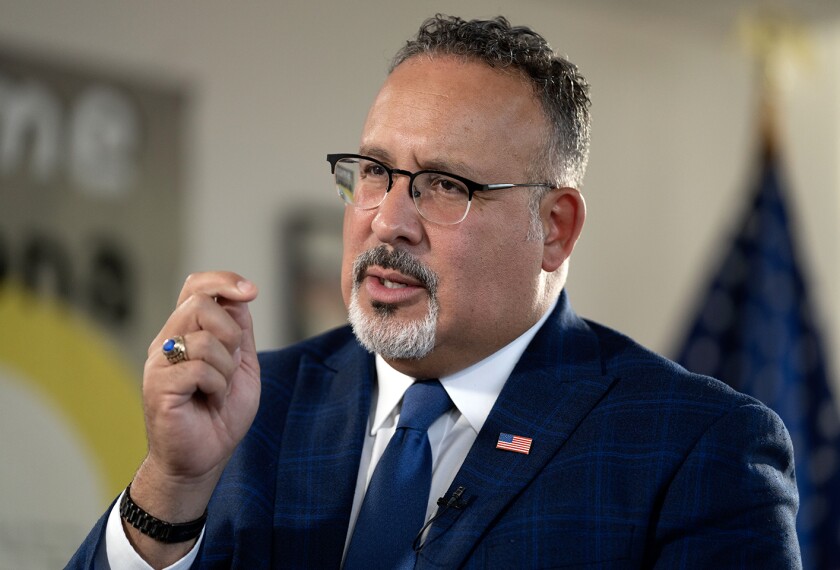
Education Secretary Miguel Cardona speaks during an interview with The Associated Press in his office at the Department of Education on Sept. 20, 2023 in Washington.
  • Save to favorites
  • Print

The U.S. Department of Education reminded schools Tuesday that they’re obligated under federal civil rights law to protect students from discrimination amid a nationwide spike in antisemitic and Islamophobic acts and threats on school campuses since the Israel-Hamas war broke out a month ago.

The Nov. 7 “Dear Colleague” letter from Catherine Lhamon, the department’s assistant secretary for civil rights, came days after the Biden administration announced the launch of a national strategy to fight Islamophobia. It also arrived as the president has come under increasing criticism from Muslim-American leaders for his support of the Israeli government as it carries out airstrikes in Gaza and blocks food, fuel, and medicine from entering the Hamas-controlled territory following the militant group’s deadly Oct. 7 attack on Israel.

The administration also launched an effort to fight antisemitism in May, when it issued another reminder to schools about their responsibilities under federal anti-discrimination law.

Schools, including K-12 campuses and colleges and universities, have seen a rise in “disturbing antisemitic incidents and threats to Jewish, Israeli, Muslim, Arab, and Palestinian students,” according to the letter from the Education Department.

The department’s office for civil rights received 12 complaints of discrimination based on shared ancestry—the category that covers antisemitic and Islamophobic incidents—between Oct. 7 and Nov. 7. Of those complaints, one stemmed from an incident at a K-12 school while the rest stemmed from situations at colleges or universities, a department spokesperson said.

In an interview with CNN Tuesday, U.S. Education Secretary Miguel Cardona said he’s asking Congress for more funding to expedite investigations into those situations.

The Education Department doesn’t receive a civil rights complaint about every alleged act of discrimination.

Schools had even seen a rise in hate crimes predating the current spike in Islamophobia and antisemitism. Some 842 hate crimes occurred at elementary or secondary schools in 2022, according to the FBI’s latest hate crimes statistics report. That’s nearly 300 more than in 2021.

“Hate-based discrimination, including based on antisemitism and Islamophobia among other bases, have no place in our nation’s schools,” Lhamon said in the “Dear Colleague” letter.

Outside of school campuses, the recent rise in Islamophia and antisemitism has been perhaps most prominently marked by the stabbing death of a 6-year-old Palestinian-American boy in Illinois and the stabbing of his mother.

See Also

Left: Protesters wave Israeli flags during a rally in support of Israel and against Hamas' attack on Oct. 9, 2023 in Beverly Hills, Calif. Right: Palestinian supporters chant as they march during a protest at Columbia University on Oct. 12, 2023, in New York.
Left: Protesters wave Israeli flags during a rally in support of Israel and against Hamas' attack on Oct. 9, 2023 in Beverly Hills, Calif. Right: Palestinian supporters march during a protest at Columbia University on Oct. 12, 2023, in New York.
Left: Ryan Sun; Right: Yuki Iwamura/AP

What the law says

Public schools are required to provide all students with an environment free from discrimination based on race, color, or national origin under Title VI of the Civil Rights Act of 1964, the letter noted.

Schools that receive federal funding must address discrimination against students of any religious group when it involves “racial, ethnic, or ancestral slurs or stereotypes,” according to the letter. They must also address discrimination based on a student’s skin color, physical features, or style of dress that reflects ethnic or religious traditions and any discrimination “based on where a student came from or is perceived to have come from.” That extends to discrimination based on a student’s accent, name, or use of a foreign language.

Schools are required to take immediate action to address any sort of harassment related to race, religion, and ethnicity that creates a hostile environment, even if the conduct isn’t directed at a specific individual, the letter said. The Education Department’s office for civil rights interprets federal law to define a hostile environment as any unwelcome conduct based on shared ancestry or ethnic characteristics that is subjectively and objectively offensive and so pervasive that it denies a student the ability to benefit from or participate in an education program or activity.

The department’s May letter reminding schools about their responsibilities to address antisemitism included a fact sheet with examples of incidents that would prompt the office for civil rights to investigate a school for a potential violation of federal civil rights law.

For example, if a student informed a teacher that classmates routinely placed notes with swastikas on their backpack, performed Nazi salutes, and made jokes about the Holocaust, and the teacher responded, “Just ignore it,” without taking any action to address or stop the harassment, that would be a violation of the law.

See Also

The U.S. Department of Education, in Washington, D.C., pictured on February 21, 2021.
The U.S. Department of Education, in Washington, D.C., pictured on February 21, 2021. The office for civil rights within the federal Education Department is responsible for resolving complaints of discrimination and enforcing civil rights laws.
Graeme Sloan/Sipa USA via AP Images

If a school failed to address reports of students telling their Muslim classmates “You started 9/11,” or calling them a “terrorist,” that would also violate Title VI, according to the fact sheet.

Events

School & District Management Webinar Squeeze More Learning Time Out of the School Day
Learn how to increase learning time for your students by identifying and minimizing classroom disruptions.
This content is provided by our sponsor. It is not written by and does not necessarily reflect the views of Education Week's editorial staff.
Sponsor
Reading & Literacy Webinar
Improve Reading Comprehension: Three Tools for Working Memory Challenges
Discover three working memory workarounds to help your students improve reading comprehension and empower them on their reading journey.
Content provided by Solution Tree
Recruitment & Retention Webinar EdRecruiter 2026 Survey Results: How School Districts are Finding and Keeping Talent
Discover the latest K-12 hiring trends from EdWeek’s nationwide survey of job seekers and district HR professionals.

EdWeek Top School Jobs

Teacher Jobs
Search over ten thousand teaching jobs nationwide — elementary, middle, high school and more.
View Jobs
Principal Jobs
Find hundreds of jobs for principals, assistant principals, and other school leadership roles.
View Jobs
Administrator Jobs
Over a thousand district-level jobs: superintendents, directors, more.
View Jobs
Support Staff Jobs
Search thousands of jobs, from paraprofessionals to counselors and more.
View Jobs

Read Next

Federal What State Education Chiefs Think as Trump Moves Programs Out of the Ed. Dept.
The department's announcement this week represents a consequential structural change for states.
6 min read
The U.S. Department of Education building is seen behind the Dwight D. Eisenhower Memorial on Oct. 24, 2025 in Washington, D.C.
The U.S. Department of Education building is seen behind the Dwight D. Eisenhower Memorial on Oct. 24, 2025 in Washington, D.C. The department is shifting many of its functions to four other federal agencies as the Trump administration tries to downsize it. State education chiefs stand to be most directly affected.
Maansi Srivastava for Education Week
Federal See Where the Ed. Dept.'s Programs Will Move as the Trump Admin. Downsizes
Programs overseen by the Ed. Dept. will move to agencies including the Department of Labor.
President Donald Trump signs an executive order regarding education in the Oval Office of the White House, Wednesday, April 23, 2025, in Washington, as Commerce Secretary Howard Lutnick, Labor Secretary Lori Chavez-DeRemer, and Education Secretary Linda McMahon watch.
President Donald Trump signs an executive order regarding education in the Oval Office of the White House on April 23, 2025, as Commerce Secretary Howard Lutnick, Labor Secretary Lori Chavez-DeRemer, and Education Secretary Linda McMahon watch. The Trump administration on Tuesday announced that it's sending many of the Department of Education's K-12 and higher education programs to other federal agencies.
Alex Brandon/AP
Federal Most K-12 Programs Will Leave Education Department in Latest Downsizing
The Trump administration announced six agreements to transfer Ed. Dept. programs elsewhere.
U.S. Secretary of Education Linda McMahon is interviewed by Indiana’s Secretary of Education Katie Jenner during the 2025 Reagan Institute Summit on Education in Washington, D.C., on Sept. 18, 2025.
U.S. Secretary of Education Linda McMahon is interviewed by Indiana Secretary of Education Katie Jenner during the 2025 Reagan Institute Summit on Education in Washington, D.C., on Sept. 18, 2025. The U.S. Department of Education on Tuesday unveiled six agreements moving administration of many of its key functions to other federal agencies.
Leah Millis for Education Week
Federal The Federal Shutdown Is Over. What Comes Next for Schools?
Some delayed funds for schools could arrive soon, but questions about future grants remain.
7 min read
USA Congress with loading icon. Shutdown, political crisis concept.
DigitalVision Vectors
