Federal

Biden Admin. Warns Schools to Protect Students From Antisemitism, Islamophobia

By Libby Stanford — November 07, 2023 3 min read
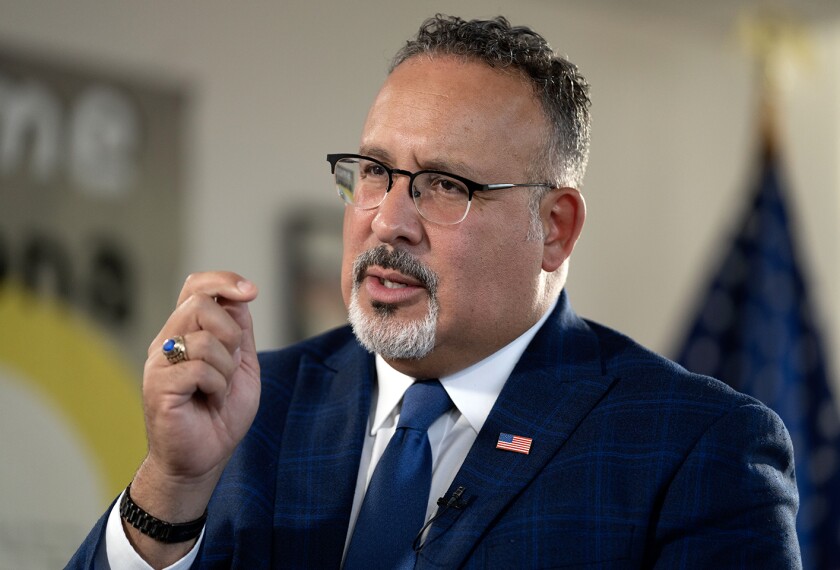
Education Secretary Miguel Cardona speaks during an interview with The Associated Press in his office at the Department of Education on Sept. 20, 2023 in Washington.
  • Save to favorites
  • Print

The U.S. Department of Education reminded schools Tuesday that they’re obligated under federal civil rights law to protect students from discrimination amid a nationwide spike in antisemitic and Islamophobic acts and threats on school campuses since the Israel-Hamas war broke out a month ago.

The Nov. 7 “Dear Colleague” letter from Catherine Lhamon, the department’s assistant secretary for civil rights, came days after the Biden administration announced the launch of a national strategy to fight Islamophobia. It also arrived as the president has come under increasing criticism from Muslim-American leaders for his support of the Israeli government as it carries out airstrikes in Gaza and blocks food, fuel, and medicine from entering the Hamas-controlled territory following the militant group’s deadly Oct. 7 attack on Israel.

The administration also launched an effort to fight antisemitism in May, when it issued another reminder to schools about their responsibilities under federal anti-discrimination law.

Schools, including K-12 campuses and colleges and universities, have seen a rise in “disturbing antisemitic incidents and threats to Jewish, Israeli, Muslim, Arab, and Palestinian students,” according to the letter from the Education Department.

The department’s office for civil rights received 12 complaints of discrimination based on shared ancestry—the category that covers antisemitic and Islamophobic incidents—between Oct. 7 and Nov. 7. Of those complaints, one stemmed from an incident at a K-12 school while the rest stemmed from situations at colleges or universities, a department spokesperson said.

In an interview with CNN Tuesday, U.S. Education Secretary Miguel Cardona said he’s asking Congress for more funding to expedite investigations into those situations.

The Education Department doesn’t receive a civil rights complaint about every alleged act of discrimination.

Schools had even seen a rise in hate crimes predating the current spike in Islamophobia and antisemitism. Some 842 hate crimes occurred at elementary or secondary schools in 2022, according to the FBI’s latest hate crimes statistics report. That’s nearly 300 more than in 2021.

“Hate-based discrimination, including based on antisemitism and Islamophobia among other bases, have no place in our nation’s schools,” Lhamon said in the “Dear Colleague” letter.

Outside of school campuses, the recent rise in Islamophia and antisemitism has been perhaps most prominently marked by the stabbing death of a 6-year-old Palestinian-American boy in Illinois and the stabbing of his mother.

See Also

Left: Protesters wave Israeli flags during a rally in support of Israel and against Hamas' attack on Oct. 9, 2023 in Beverly Hills, Calif. Right: Palestinian supporters chant as they march during a protest at Columbia University on Oct. 12, 2023, in New York.
Left: Protesters wave Israeli flags during a rally in support of Israel and against Hamas' attack on Oct. 9, 2023 in Beverly Hills, Calif. Right: Palestinian supporters march during a protest at Columbia University on Oct. 12, 2023, in New York.
Left: Ryan Sun; Right: Yuki Iwamura/AP

What the law says

Public schools are required to provide all students with an environment free from discrimination based on race, color, or national origin under Title VI of the Civil Rights Act of 1964, the letter noted.

Schools that receive federal funding must address discrimination against students of any religious group when it involves “racial, ethnic, or ancestral slurs or stereotypes,” according to the letter. They must also address discrimination based on a student’s skin color, physical features, or style of dress that reflects ethnic or religious traditions and any discrimination “based on where a student came from or is perceived to have come from.” That extends to discrimination based on a student’s accent, name, or use of a foreign language.

Schools are required to take immediate action to address any sort of harassment related to race, religion, and ethnicity that creates a hostile environment, even if the conduct isn’t directed at a specific individual, the letter said. The Education Department’s office for civil rights interprets federal law to define a hostile environment as any unwelcome conduct based on shared ancestry or ethnic characteristics that is subjectively and objectively offensive and so pervasive that it denies a student the ability to benefit from or participate in an education program or activity.

The department’s May letter reminding schools about their responsibilities to address antisemitism included a fact sheet with examples of incidents that would prompt the office for civil rights to investigate a school for a potential violation of federal civil rights law.

For example, if a student informed a teacher that classmates routinely placed notes with swastikas on their backpack, performed Nazi salutes, and made jokes about the Holocaust, and the teacher responded, “Just ignore it,” without taking any action to address or stop the harassment, that would be a violation of the law.

See Also

The U.S. Department of Education, in Washington, D.C., pictured on February 21, 2021.
The U.S. Department of Education, in Washington, D.C., pictured on February 21, 2021. The office for civil rights within the federal Education Department is responsible for resolving complaints of discrimination and enforcing civil rights laws.
Graeme Sloan/Sipa USA via AP Images

If a school failed to address reports of students telling their Muslim classmates “You started 9/11,” or calling them a “terrorist,” that would also violate Title VI, according to the fact sheet.

Events

This content is provided by our sponsor. It is not written by and does not necessarily reflect the views of Education Week's editorial staff.
Sponsor
Artificial Intelligence Webinar
Managing AI in Schools: Practical Strategies for Districts
How should districts govern AI in schools? Learn practical strategies for policies, safety, transparency, and responsible adoption.
Content provided by Lightspeed Systems
Education Funding Webinar Congress Approved Next Year’s Federal School Funding. What’s Next?
Congress passed the budget, but uncertainty remains. Experts explain what districts should expect from federal education policy next.
This content is provided by our sponsor. It is not written by and does not necessarily reflect the views of Education Week's editorial staff.
Sponsor
Student Absenteeism Webinar
Removing Transportation and Attendance Barriers for Homeless Youth
Join us to see how districts around the country are supporting vulnerable students, including those covered under the McKinney–Vento Act.
Content provided by HopSkipDrive

EdWeek Top School Jobs

Teacher Jobs
Search over ten thousand teaching jobs nationwide — elementary, middle, high school and more.
View Jobs
Principal Jobs
Find hundreds of jobs for principals, assistant principals, and other school leadership roles.
View Jobs
Administrator Jobs
Over a thousand district-level jobs: superintendents, directors, more.
View Jobs
Support Staff Jobs
Search thousands of jobs, from paraprofessionals to counselors and more.
View Jobs

Read Next

Federal The Ed. Dept. Is Sending 118 Programs to Other Agencies. See Where They're Going
The Trump administration is partnering with at least four other agencies as it tries to shutter the Education Department.
Illustration of office chairs moving into different spaces.
Laura Baker/Education Week + Getty
Federal Why K-12 Educators Are Alarmed About Proposed Student Loan Limits
They worry that the new loan limits could put a leak in the teacher and administrator pipeline.
4 min read
New graduates line up before the start of a college commencement at MetLife Stadium in East Rutherford, N.J, May 17, 2018. A proposed regulation could exclude education from a list of "professional" graduate degrees, limiting federal loans for students in the field.
Seth Wenig/AP
Federal Opinion We Shouldn’t Have to Choose Between Federal Overreach and Abandonment in K-12
Why is federal power being used to occupy our cities but not protect our students’ civil rights?
Sally Iverson
4 min read
Large hand making pressure over group of small, silhouetted figures. Oppressions, manipulation. Contemporary art collage. Photocopy effect. Concept of world crisis, business, economy, control
Education Week + iStock
Federal Ed. Dept. Hangs Banner of Charlie Kirk Alongside MLK Jr., Ben Franklin
It's part of a celebration of the nation's 250th anniversary.
1 min read
New banners of Booker T. Washington, Catharine Beecher and Charlie Kirk hang from the Department of Education, Sunday, March 1, 2026, in Washington.
New banners of Booker T. Washington, Catharine Beecher, and Charlie Kirk hang from the U.S. Department of Education on March 1, 2026, in Washington.
Allison Robbert/AP
