Federal

Bennett: Schools Fail To Prepare Blacks for College

By Robert Rothman — February 10, 1988 1 min read
  • Save to favorites
  • Print

Secretary of Education William J. Bennett last week reiterated his claim that poor precollegiate academic preparation, rather than a lack of access to higher education, is responsible for the underrepresentation of black students on college campuses.

“The most serious underlying barrier to greater black college enrollment is the insufficient size of the pool of black students who have had the right preparation,” he said here at the annual meeting of the National Association of Independent Colleges and Universities.

“This pool has been limited because too often we have not provided black students with the first-class academic elementary and secondary education they deserve,” he said.

“Indeed, the overriding civil-rights challenge for our time is this: to ensure serious reform of elemen4tary and secondary education so as to promote equal intellectual opportunity for all our young people.”

To ensure that all students receive the preparation necessary for college-level work, he added, all students should have access to the same rigorous academic curriculum, such as the one proposed in his report, James Madison High School.

“To declare that minorities are equal in theory and in law, but then to offer them ‘dummy’ courses in math, science, and English, is an offense,” he said.

Mr. Bennett’s comments were similar to those he made last month at the annual meeting of the American Council on Education, which has named a blue-ribbon commission, headed by former Presidents Gerald R. Ford and Jimmy Carter, to study the issue of minority participation in higher education and oth8er sectors of society. (See Education Week, Jan. 27, 1988.)

In his address last week, Secretary Bennett also rejected claims that minority enrollments have declined in recent years, and that “alleged” cutbacks in federal student aid have prevented many minority students from attending college.

In fact, Mr. Bennett said, higher-education enrollments of students from all minority groups rose 20 percent during the 1980’s, and black postsecondary enrollment--including enrollment in for-profit career schools--"stands at an all-time high.”

In addition, he said, need-based federal student aid has risen by 76 percent since 1980. “The American taxpayer has been generous and will continue to be generous in making college education available to all students,” he said.

A version of this article appeared in the February 10, 1988 edition of Education Week as Bennett: Schools Fail To Prepare Blacks for College

Events

This content is provided by our sponsor. It is not written by and does not necessarily reflect the views of Education Week's editorial staff.
Sponsor
Artificial Intelligence Webinar
Managing AI in Schools: Practical Strategies for Districts
How should districts govern AI in schools? Learn practical strategies for policies, safety, transparency, as well as responsible adoption.
Content provided by Lightspeed Systems
This content is provided by our sponsor. It is not written by and does not necessarily reflect the views of Education Week's editorial staff.
Sponsor
Reading & Literacy Webinar
Unlocking Success for Struggling Adolescent Readers
The Science of Reading transformed K-3 literacy. Now it's time to extend that focus to students in grades 6 through 12.
Content provided by STARI
Jobs Virtual Career Fair for Teachers and K-12 Staff
Find teaching jobs and K-12 education jubs at the EdWeek Top School Jobs virtual career fair.

EdWeek Top School Jobs

Teacher Jobs
Search over ten thousand teaching jobs nationwide — elementary, middle, high school and more.
View Jobs
Principal Jobs
Find hundreds of jobs for principals, assistant principals, and other school leadership roles.
View Jobs
Administrator Jobs
Over a thousand district-level jobs: superintendents, directors, more.
View Jobs
Support Staff Jobs
Search thousands of jobs, from paraprofessionals to counselors and more.
View Jobs

Read Next

Federal Ed. Dept. Hangs Banner of Charlie Kirk Alongside MLK Jr., Ben Franklin
It's part of a celebration of the nation's 250th anniversary.
1 min read
New banners of Booker T. Washington, Catharine Beecher and Charlie Kirk hang from the Department of Education, Sunday, March 1, 2026, in Washington.
New banners of Booker T. Washington, Catharine Beecher, and Charlie Kirk hang from the U.S. Department of Education on March 1, 2026, in Washington.
Allison Robbert/AP
Federal Ed. Dept. Wants to Revamp Assistance Program It Calls 'Duplicative,' 'Confusing'
The department's Comprehensive Centers have already been through a year of shakeups.
3 min read
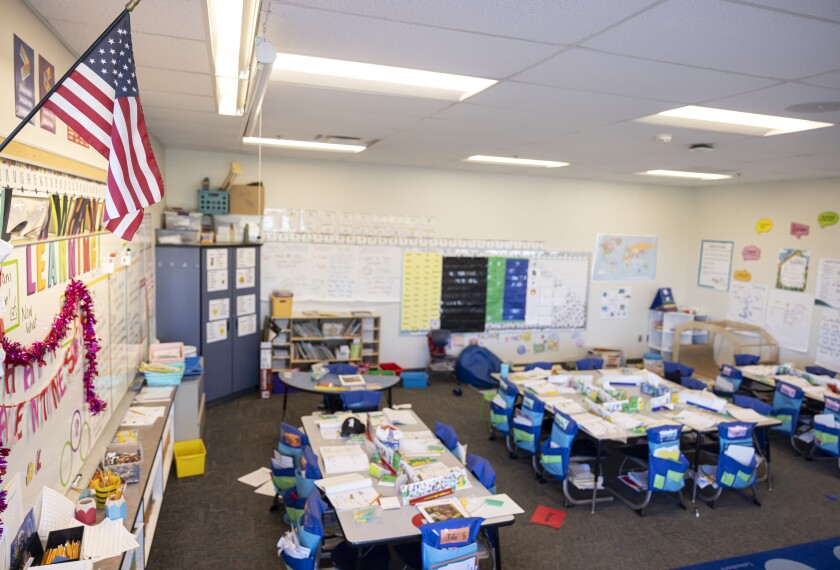
A first grade classroom at a school in Colorado Springs, on Feb. 12, 2026.
A 1st grade classroom at a school in Colorado Springs, Colo., on Feb. 12, 2026. The U.S. Department of Education released a proposal to rework a decades-old program charged with helping states and school districts problem-solve and deploy new initiatives, calling the current structure “duplicative” and “confusing.”
Kevin Mohatt for Education Week
Federal Will the Ed. Dept. Act on Recommendations to Overhaul Its Research Arm?
An adviser's report called for more coherence and sped-up research awards at the Institute of Education Sciences.
6 min read
The U.S. Department of Education building is pictured on Oct. 24, 2025, in Washington, D.C.
The U.S. Department of Education building in Washington is pictured on Oct. 24, 2025. A new report from a department adviser calls for major overhauls to the agency's research arm to facilitate timely research and easier-to-use guides for educators and state leaders.
Maansi Srivastava for Education Week
Federal Trump Talks Up AI in State of the Union, But Not Much Else About Education
The president didn't mention two of his cornerstone education policies from the past year.
4 min read
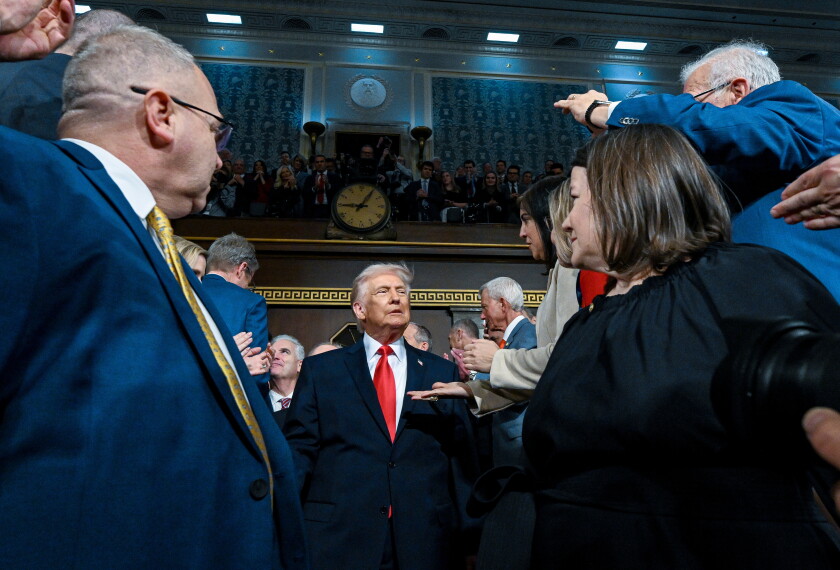
President Donald Trump enters to deliver the State of the Union address to a joint session of Congress in the House chamber at the U.S. Capitol in Washington, Tuesday, Feb. 24, 2026.
President Donald Trump enters to deliver the State of the Union address to a joint session of Congress in the House chamber at the U.S. Capitol in Washington, Tuesday, Feb. 24, 2026. The president devoted little time in the speech to discussing his education policies.
Kenny Holston/The New York Times via AP, Pool