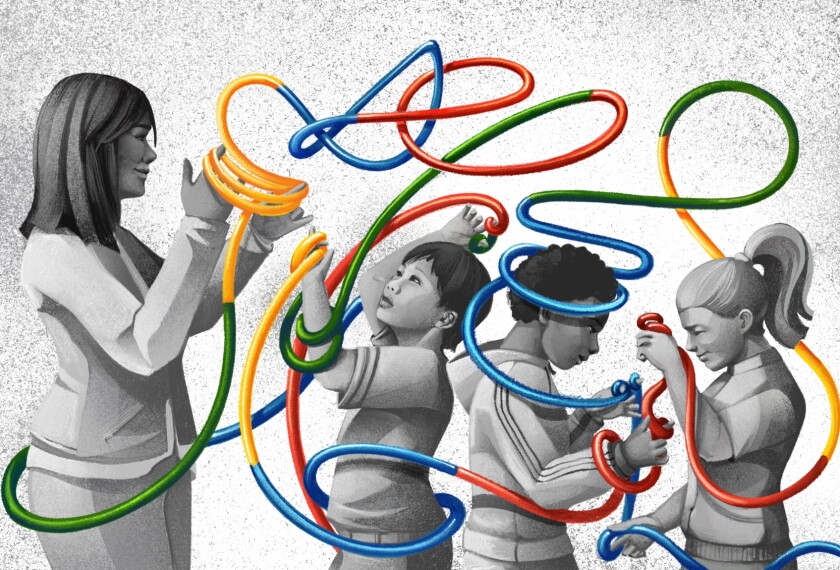
Districts have invested heavily in social-emotional learning in the past few years to help students recover from the trauma they experienced during the pandemic.
But at the same time, some of those SEL programs have run up against intense opposition from parents and politicians, who take issue with how SEL is being linked to learning about racism, sexism, and LGBTQ+ issues.
In an April 27 webinar hosted by the nonprofit Collaborative for Academic, Social, and Emotional Learning (CASEL), experts discussed the latest research that shows how integrating SEL—which teaches skills such as resilience, persistence, empathy, and patience—into academic learning can be effective, and they provided best practices for how districts can strengthen their SEL programs.
International study details the characteristics of effective SEL programs
Decades of research has provided “strong evidence” that integrating social-emotional learning into academic learning leads to better student behavior, well-being, and academic achievement, Mark T. Greenberg, the founding director of the Edna Bennett Pierce Prevention Research Center and an emeritus professor at Pennsylvania State University, said during the webinar.
And a new meta-analysis of 424 studies from 53 countries, published in February, found the most effective programs have these characteristics:
- They meet the SAFE (sequenced, active, focused, explicit) criteria;
- Classroom teachers deliver the content;
- They focus on skills and school climate;
- They use a multicomponent approach;
- They teach intrapersonal skills first;
- They integrate SEL into academic content; and
- They have high-quality implementation.
Research has also found that teachers with strong social-emotional competence build stronger relationships with their students, have fewer discipline problems, and have greater student engagement.
And yet, U.S. schools use few evidence-based educator-focused SEL programs, Greenberg said. To have an effective SEL program for students, districts should also ensure teachers have a strong SEL foundation.

Inside school walls, an effective SEL program needs strong leadership, quality professional development, effective planning and implementation, and greater support from federal and state policymakers, Greenberg said.
There are several strategies that schools are using that “really work,” according to Linda Darling-Hammond, the president and CEO of the Learning Policy Institute. Beyond explicit instruction on SEL for students and teachers, some schools are using restorative justice practices, which includes learning conflict resolution skills.
Schools are also finding ways to create advisory systems that match students with a caring adult with whom they can develop a trusting relationship, Darling-Hammond said. For example, there could be a group of 15 students with one teacher with whom they learn SEL skills while also getting support needed to put the skills into practice.
Most parents support SEL programs, but there is pushback in some communities
Beyond school walls, district leaders and principals have a lot of work to do to ensure the community is part of the conversation, according to the panelists.
“Overwhelmingly, there is parent support” for SEL, said Aaliyah Samuel, the president and CEO of CASEL. “Parents do want their kids to be happy in school and have a joy of learning and feel a sense of connectedness.”
But there has been significant pushback to the teaching of SEL in some communities over concerns that schools are teaching kids about topics such as racism and sexism that they believe would be better addressed by parents, a topic the webinar guests did address. Some political groups that oppose “critical race theory"—an academic framework that says racism is embedded in legal systems and policies—have flagged SEL as linked to the concept, though schools say it is not. Others are concerned that teaching SEL skills takes away time from important academic learning.
“We can’t let the political rhetoric overwhelm or override what we’re hearing from parents who have kids that are within the system,” Samuel said.
District and school leaders need to go out and show the community the benefits of teaching students SEL skills to ensure community support, and policymakers at every level need to bring more parents, students, and teachers into the conversation to help inform the policies affecting classrooms, the panelists said.
“We have to really understand that all learning is social and emotional,” Samuel said. “We cannot bifurcate SEL and academics when we talk about recovery. We have to be thinking about the integration of both of those together in order to really be able to address the realities right now.”