
Student Absenteeism Infographic

What CDC Safety Data Reveal About School Absenteeism, in Charts

By Sarah D. Sparks — August 14, 2024 2 min read
Illustration about warnings, with a businessman and woman each holding a with megaphone in front of a caution symbol.
  • Save to favorites
  • Print

School safety concerns may worsen ongoing absenteeism in schools, suggest new federal data.

Thirteen percent of high school students reported missing school in 2023 out of safety concerns, according to the data from the Centers for Disease Control and Prevention.

However, absenteeism varied significantly for different groups of students. Girls were 6 percentage points more likely than boys to say they had stayed home from school in the last month because they worried about their safety at or on the way to school; 16 percent of girls said that, versus 10 percent of boys.

Only 1 in 10 Asian or white students reported missing school out of fear, compared to 15 percent of Black and Native American, 17 percent of Hispanic, and 22 percent of Native Hawaiian and Pacific Islander students.

See Also

Image of teens sitting in a circle on the floor doing work and being social.
iStock/Getty

The findings are part of the CDC’s biennial Youth Risk Behavior Survey, a nationally representative study of U.S. high school students. More than 20,000 students participated in the 2023 survey.

“Considering the vital role schools play in promoting health and well-being, it is critical to address school-based violence and safety concerns,” said Kathleen Ethier, the CDC’s director of adolescent and school health, in a statement.

Nearly 1 in 5 students reported they were bullied at school in 2023, and nearly 1 in 10 said they were threatened with or injured by a weapon on campus—both increases since 2021.

Reported bullying rates, which fell in the immediate aftermath of pandemic school closures, have returned to levels about on par with those of the last decade. But the likelihood that girls would report being threatened or injured with a weapon rose from 6 percent to 9 percent from 2013 to 2023. And the share of students who avoid school out of safely concerns has nearly doubled, from 13 percent in 2013.

In particular, the CDC data show higher shares of LGBTQ+ high school students reporting violence and bullying compared to their peers. LGBTQ+ students were also 7 percentage points less likely to report feeling close to others at school than heterosexual and cisgender students.

These stressors may also help to account for higher mental health problems among LGBTQ+ students, the CDC found. Forty-one percent of LGBTQ+ students said they had seriously considered suicide in the past year—more than triple the rate of heterosexual and cisgender students—and they were twice as likely as non-LGBTQ+ peers to have been injured in a suicide attempt.

Many students also perceived the school discipline system as stacked against them. Nearly 1 in 5 students reported being unfairly disciplined at school in the last year, with students of color more likely to report disparities. LGBTQ+ students were equally likely to report unfair discipline practices as all students, but boys in that community were more likely than girls to say they had experienced unfair discipline.

Events

This content is provided by our sponsor. It is not written by and does not necessarily reflect the views of Education Week's editorial staff.
Sponsor
Professional Development Webinar
Grow Leaders, Keep Teachers: Leadership Development as a Staffing Strategy
Find out how to turn leadership development into a staffing strategy and grow your next generation of school leaders from within.
Content provided by Frontline Education
This content is provided by our sponsor. It is not written by and does not necessarily reflect the views of Education Week's editorial staff.
Sponsor
Teaching Webinar
Closing the Practice Gap: Essential Insights for Leaders
Three instructional experts will share strategies for making students’ reading and math practice more engaging and impactful this year.
Content provided by Renaissance
This content is provided by our sponsor. It is not written by and does not necessarily reflect the views of Education Week's editorial staff.
Sponsor
School & District Management Webinar
The Principal's Role in Collective Efficacy and Student Outcomes
Learn practical strategies that help principals translate their confidence into stronger collective teacher efficacy and student outcomes.
Content provided by Otus

EdWeek Top School Jobs

Teacher Jobs
Search over ten thousand teaching jobs nationwide — elementary, middle, high school and more.
View Jobs
Principal Jobs
Find hundreds of jobs for principals, assistant principals, and other school leadership roles.
View Jobs
Administrator Jobs
Over a thousand district-level jobs: superintendents, directors, more.
View Jobs
Support Staff Jobs
Search thousands of jobs, from paraprofessionals to counselors and more.
View Jobs

Read Next

Student Absenteeism Chronic Absenteeism Is Linked to Slower Academic Recovery in Math, Reading
A new study adds to the evidence base suggesting attendance is a key to raising student achievement.
3 min read
MVCS 5100
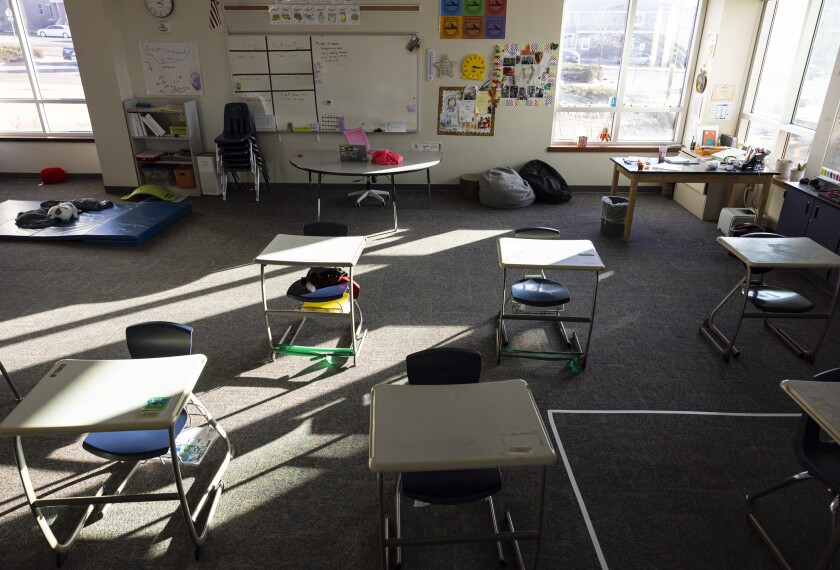
Research confirms what many educators know: chronic absenteeism undermines student academic recovery. A view of an empty classroom at a school in Colorado Springs, Colo., Feb. 12, 2026.
Kevin Mohatt for Education Week
Student Absenteeism The Data Hiding in Plain Sight That Could Help Schools Fight Chronic Absenteeism
A granular look at attendance data could help schools fight mounting absences, a new report says.
4 min read
Chronic Absenteeism Indigenous Students 24276591105046
Social worker Mary Schmauss, right, greets students as they arrive for school on Oct. 1, 2024, at Algodones Elementary School in Algodones, N.M. A new report says a deep look at attendance data could point schools toward strategies that could help them lower stubbornly high chronic absenteeism.
Roberto E. Rosales/AP Photo
Student Absenteeism What Makes Some Schools Better at Building Attendance? There's No Silver Bullet
"Deep" family engagement to boost attendance is promising, but schools must address the problem holistically.
4 min read
Shepria Johnson, lead for Concentric Educational Solutions in Michigan looks for a student absent from the Westwood Community School District near Detroit on April 11, 2024.
Shepria Johnson, lead for Concentric Educational Solutions in Michigan, looks for a student absent from the Westwood Community School District near Detroit on April 11, 2024. A new study in Michigan finds some promising practices to curb student absenteeism that rely on home visiting and family engagement. But, it says, no one strategy is likely to work all on its own.
Andy Morrison/The Detroit News via TNS<br/>
Student Absenteeism Immigrant Students Fear Enforcement and Stay Out of School
An April working paper found that immigration enforcement increased absence rates.
4 min read
Officers from the Metropolitan Police Department, FBI, and Homeland Security Investigations (HSI), are seen monitoring a football game between Bell Multicultural and Archbishop Carroll on Sept. 12, 2025, at Cardozo High School in the Columbia Heights neighborhood of Washington, D.C.
Officers from the Metropolitan Police Department, FBI and Homeland Security Investigations monitor a high school football game Sept. 12, 2025, at Cardozo High School in Washington. Heightened immigration enforcement activity has raised concerns about its impact on students’ attendance and well-being.
Pablo Martinez Monsivais/AP
