
Artificial Intelligence From Our Research Center

Teachers Desperately Need AI Training. How Many Are Getting It?

By Lauraine Langreo — March 25, 2024 2 min read
Illustration of AI and classroom tools.
  • Save to favorites
  • Print

Even though it’s been more than a year since ChatGPT made a big splash in the K-12 world, many teachers say they are still not receiving any training on using artificial intelligence tools in the classroom.

More than 7 in 10 teachers said they haven’t received any professional development on using AI in the classroom, according to a nationally representative EdWeek Research Center survey of 953 educators, including 553 teachers, conducted between Jan. 31 and March 4.

The survey data shows that teachers who are in urban districts, those in districts with free/reduced-price meal rates of more than 75 percent, and those who teach elementary grades are more likely than their peers to say they haven’t received any AI training.

A previous EdWeek Research Center survey found that one of the major reasons teachers aren’t using AI in their work is because of a lack of knowledge and support for how to use AI tools effectively and appropriately.

Some experts say that educators can’t ignore this technology that is predicted to be a huge force in the world. They say that it’s important for teachers to learn more about AI, not just so they can use it responsibly in their work, but also to help model that use for students who are already interacting with this technology and will need to become smart AI consumers.

Districts have ‘competing priorities’

For Justin Sealand, a math teacher for Woodford County High School in Versailles, Ky., getting training on AI is important because “the kids are going to be looking for” it, and “I would personally like to be able to provide that.”

While his district has provided two professional learning sessions focused on AI so far, Sealand still wants more training.
See Also

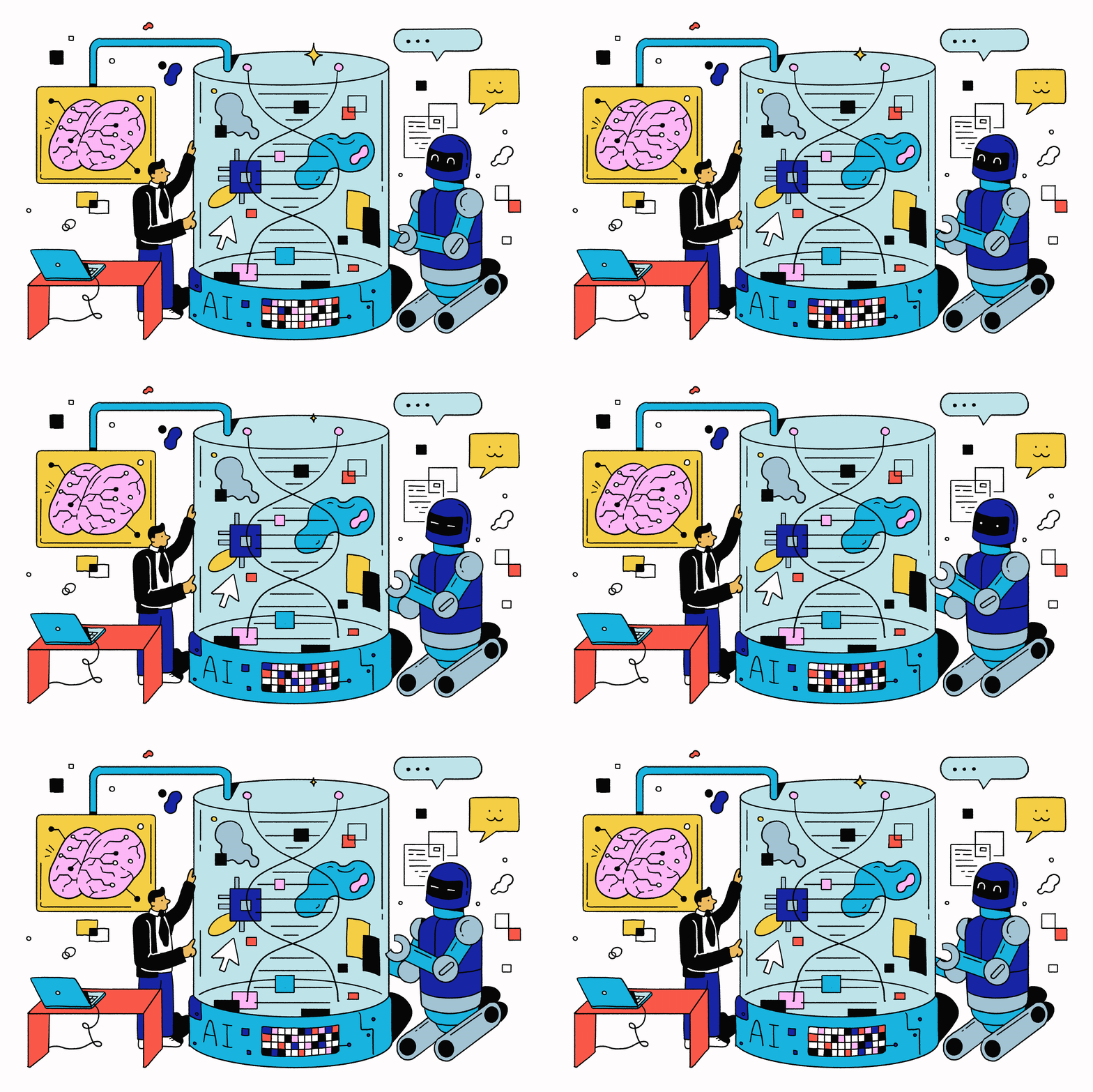
A person and a robot study a giant cylinder filled with AI elements
Kathleen Fu for Education Week

“I want it to be way more tailored to what I’m trying to accomplish,” he said.

For instance, for his class, he writes a lot of code for graphics or manipulatives and curates datasets for statistics examples, but he would like to “figure out how to better leverage AI for those content-specific things.”

But it’s not surprising that many districts have yet to provide AI-specific training, said Tara Nattrass, the managing director of innovation strategy at the International Society for Technology in Education and the Association for Supervision and Curriculum Development.

“Districts are focusing on a lot of different areas right now,” Nattrass said. “There’s a focus on the science of reading. There’s a focus on social-emotional learning. There are a lot of competing priorities when we look across school districts, and AI is one piece of that.”

Looking for PD opportunities elsewhere

Sealand said he understands why his district hasn’t had any other training on AI beyond the basics.

“I might be the only person in my entire district interested in that hyper-specific type of prompt writing,” he said. So in his own time, he’s been researching ways to leverage AI tools to create graphics, visualizations, and manipulatives to use for demonstrations with his students.

See Also

Photo collage of computer with pixelated image of girl.
F. Sheehan for Education Week / Getty

Other educators are also looking for professional development opportunities outside of the district. More than 3,500 educators have signed up for ISTE’s professional learning course on AI, according to the organization. Others are also participating in the organization’s webinar sessions on AI, Nattrass said.

This isn’t a bad thing, according to Nattrass. Teachers should have “a variety of ways” to engage in AI learning, such as district-led professional development opportunities, courses from other organizations, and networking with other educators.

Related Tags:

Events

Teaching Profession K-12 Essentials Forum Supporting the New K-12 Workforce: What Teachers Need to Stay at School
 Join this free virtual event to discover what teachers say they need to feel supported to stay in classrooms for the long haul.
College & Workforce Readiness K-12 Essentials Forum Career and Technical Education Takes Its Next Big Step
Join this free virtual event to hear creative approaches to modernize CTE programs and navigate the shift away from a near-exclusive focus on "college preparedness."

EdWeek Top School Jobs

Teacher Jobs
Search over ten thousand teaching jobs nationwide — elementary, middle, high school and more.
View Jobs
Principal Jobs
Find hundreds of jobs for principals, assistant principals, and other school leadership roles.
View Jobs
Administrator Jobs
Over a thousand district-level jobs: superintendents, directors, more.
View Jobs
Support Staff Jobs
Search thousands of jobs, from paraprofessionals to counselors and more.
View Jobs

Read Next

Artificial Intelligence Q&A Educators Offer Advice on AI's Role in Workforce Development
Teachers’ use of AI varies widely, based on how much training and guidance they’ve received.
4 min read
TeachersAI SG23
Teachers participate in a team exercise at the first training session of the National Academy for AI Instruction on March 18, 2026, at UFT headquarters in New York City. Experts say teachers need more professional development opportunities around how to use AI to improve instruction.
Salwan Georges for Education Week
Artificial Intelligence Students Are Experiencing AI in Very Different Ways. Is That a Problem?
Sharply divergent state standards, district rules, and teacher strategies result in uneven access to the technology.
5 min read
Collage of a phone showing Perplexity, Claude, and ChatGPT and a student is reflected working on a comptuer.
Collage by Laura Baker/Education Week + Canva
Artificial Intelligence What the Research Says AI Changes Its Feedback on Students' Writing When It Knows Their Race, Gender
AI makes judgments based on the writer's characteristics—a problem if teachers use it as a writing coach.
6 min read
A silhouette of a girl's profile has the quote "I love your confidence in expressing your opinion!" on top of it on torn pieces of paper. She is facing a silhouette of a boy's profile that has the quote "Try providing additional evidence or examples from the article to support this claim." on top of it, also on torn pieces of paper.
Illustrations by Emily Wright for Education Week + Getty
Artificial Intelligence Q&A Momentum Builds to Expand Coding Education to Learning About AI 'Under the Hood'
CodeAI CEO talks about artificial intelligence and the future of computer science education.
6 min read
A student uses a laptop during a science class on Aug. 28, 2024, in Aurora, Colo.
A student uses a computer during a class on Aug. 28, 2024, in Aurora, Colo. One big concern among many students who are interested in computer science careers and people already working in the field is that AI can write code on its own.
Godofredo A. Vásquez/AP
