School & District Management

Study Links CUNY’s Admissions Policy, Student Gains

By Jeanne Ponessa — May 15, 1996 2 min read
  • Save to favorites
  • Print

The practice of open admissions at the City University of New York has afforded long-term benefits to students who otherwise would not have been able to attend college, a study concludes.

Researchers David E. Lavin and David Hyllegard tracked the graduation rates and career paths of students entering through the university’s controversial open-admissions policy. That policy, which virtually guarantees admission to New York City high school graduates who meet basic requirements, was enacted in 1970 over the protests of critics who feared that it would devalue a CUNY education.

The study is to be published this month by Yale University Press in a book, Changing the Odds: Open Admissions and the Life Chances of the Disadvantaged.

Mr. Lavin, a sociology professor at CUNY’s graduate school and at Lehman College in the Bronx, said in an interview that the study should put many critics’ fears to rest.

“What we learn from looking at that long-term view is that substantial numbers of students who wouldn’t have gotten in have gone on to earn advanced degrees, which obviously suggests that CUNY credentials under open admissions continue to have value,” he said.

The study found that out of roughly 100,000 first-time freshmen between 1970 and 1972, more than 68,000 eventually graduated, and roughly 27,000 of those were students who would not have entered without open admissions. And more than 21,000 students completed a graduate program, 5,200 of them “open admissions” beneficiaries.

Mr. Lavin said the educational opportunities provided by open admissions “translated into substantial rewards in the job market in terms of salary, so that these CUNY degrees continued to have some leverage.”

The study found that in one year in the 1980s, open-admissions graduates earned roughly $67 million more than they would have had they not gone to college.

Findings Welcomed

The CUNY policy guarantees admission to the 10 four-year colleges in the 206,000-student public system for city high school graduates who have earned an 80 average or rank in the top third of their graduating classes. Before 1970, admissions requirements to these colleges varied, but generally called for high school averages in the high 80s.

In the first year the policy took effect, the freshman class was 75 percent larger than the year before. Minority enrollments in those four-year colleges, the study found, climbed from 4 percent in 1969 to an average of 16 percent between 1970 and 1972.

James P. Murphy, the chairman of the CUNY board of trustees, welcomed the findings. “This should embolden higher education generally, and particularly public education around the country--which has a broader responsibility to reach out to the poor and less prepared--to stay the course,” he said in an interview.

Related Tags:

Events

This content is provided by our sponsor. It is not written by and does not necessarily reflect the views of Education Week's editorial staff.
Sponsor
School & District Management Webinar
Stop the Drop: Turn Communication Into an Enrollment Booster
Turn everyday communication with families into powerful PR that builds trust, boosts reputation, and drives enrollment.
Content provided by TalkingPoints
This content is provided by our sponsor. It is not written by and does not necessarily reflect the views of Education Week's editorial staff.
Sponsor
Special Education Webinar
Integrating and Interpreting MTSS Data: How Districts Are Designing Systems That Identify Student Needs
Discover practical ways to organize MTSS data that enable timely, confident MTSS decisions, ensuring every student is seen and supported.
Content provided by Panorama Education
Artificial Intelligence Live Online Discussion A Seat at the Table: AI Could Be Your Thought Partner
How can educators prepare young people for an AI-powered workplace? Join our discussion on using AI as a cognitive companion.

EdWeek Top School Jobs

Teacher Jobs
Search over ten thousand teaching jobs nationwide — elementary, middle, high school and more.
View Jobs
Principal Jobs
Find hundreds of jobs for principals, assistant principals, and other school leadership roles.
View Jobs
Administrator Jobs
Over a thousand district-level jobs: superintendents, directors, more.
View Jobs
Support Staff Jobs
Search thousands of jobs, from paraprofessionals to counselors and more.
View Jobs

Read Next

School & District Management Former Iowa Superintendent Pleads Guilty to Falsely Claiming U.S. Citizenship
The former Des Moines superintendent admitted to falsely claiming to be a U.S. citizen on a federal form and illegally possessing firearms.
4 min read
Ian Roberts, superintendent of Des Moines Public Schools, delivers an annual address at North High School in Des Moines, Iowa, Feb. 11, 2025.
Jon Lemons/Des Moines Public Schools via AP
School & District Management A Cold Front Is Sweeping the Country. Can Schools' Heating Keep Up?
A spate of frigid temperatures across much of the country will present a test for schools' aging heating systems.
5 min read
20260122 AMX US NEWS CPS CANCELS CLASS FRIDAY DUE 1 TB
A crossing guard assists students as they arrive for classes at Chalmers STEAM Elementary school on Jan. 22, 2026, in Chicago. Extreme cold hitting much of the United States in the coming days could test schools' aging infrastructure and force school closures. Chicago Public Schools called off classes for Friday, Jan. 23.
Antonio Perez/ Chicago Tribune
School & District Management How Principals Are Coaching the Next Generation of School Leaders
Mentors give aspiring school leaders an unvarnished view of the principalship.
6 min read
Photo of school officials having conversation.
iStock
School & District Management How 4 Superintendents Are Bracing for Federal Funding Uncertainty Under Trump
Superintendent of the Year finalists discussed how they're preparing for potential cuts.
3 min read
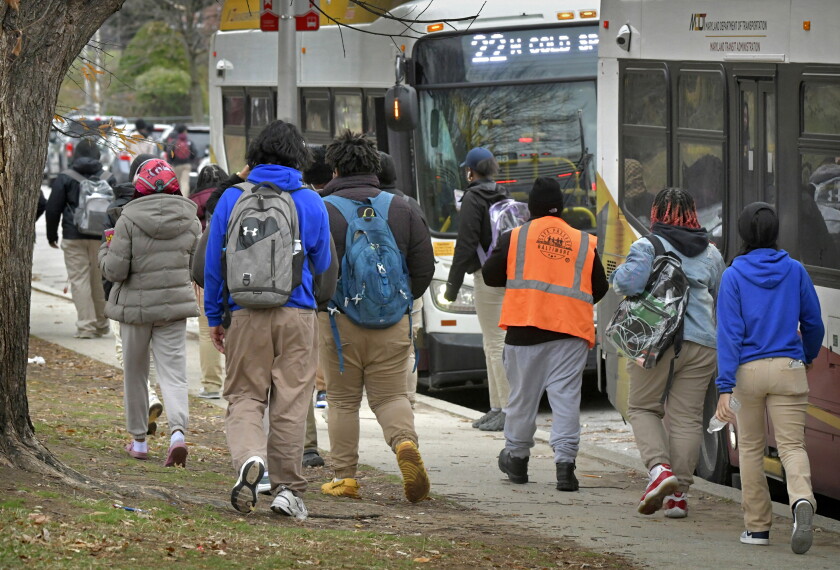
Students at Merganthaler Vocational-Technical High School board MTA buses at the end of the school day on Dec. 13, 2024 , in Baltimore. federally funded programs allows students to access resources they might otherwise not get—like tutoring and after-school programs, according to Baltimore Superintendent Sonja Santelises.
Students at Merganthaler Vocational-Technical High School board buses at the end of the school day on Dec. 13, 2024 , in Baltimore. Federally funded programs in the city's schools allow students access to services they might otherwise not get, such as tutoring and after-school programs, Baltimore Superintendent Sonja Santelises said at a recent panel discussion of the finalists for AASA's Superintendent of the Year award.
Amy Davis/Baltimore Sun/TNS