
School & District Management

How 4 Superintendents Are Bracing for Federal Funding Uncertainty Under Trump

By Caitlynn Peetz Stephens — January 16, 2026 3 min read
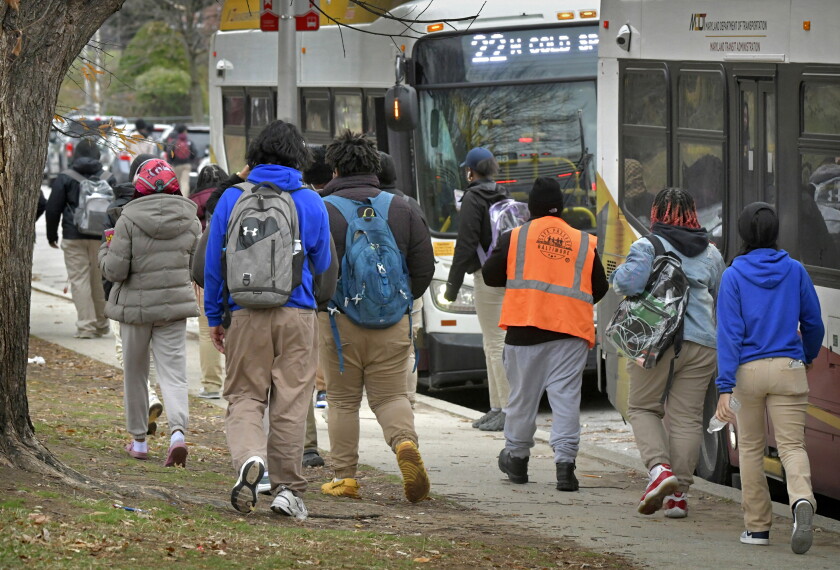
Students at Merganthaler Vocational-Technical High School board MTA buses at the end of the school day on Dec. 13, 2024 , in Baltimore. federally funded programs allows students to access resources they might otherwise not get—like tutoring and after-school programs, according to Baltimore Superintendent Sonja Santelises.
  • Save to favorites
  • Print

Education Week Staff Writer Caitlynn Peetz Stephens served as moderator of the Jan. 8 panel discussion described below among the four finalists for AASA’s National Superintendent of the Year award.

School district leaders are making contingency plans for federal funds that could be stripped by President Donald Trump’s administration in its quest to “return education to the states” and cut down on equity and race initiatives, according to the four finalists for the 2026 National Superintendent of the Year.

The contingency plans include advocating for state lawmakers to help offset any potential or anticipated funding cuts and ensuring they can prove the effect those dollars have on students, the superintendents said during a Jan. 8 panel discussion hosted by AASA, The School Superintendents Association, which runs the National Superintendent of the Year program. The discussion took place at AASA’s headquarters.

See Also

The finalists for superintendent of the year, from left: Roosevelt Nivens, Demetrus Liggins, Sonia Santelises, Heather Perry
The finalists for superintendent of the year, from left: Roosevelt Nivens, Demetrus Liggins, Sonia Santelises, and Heather Perry.
Courtesy of AASA

The winner of the National Superintendent of the Year will be announced Feb. 12 in Nashville at AASA’s National Conference on Education.

Demetrus Liggins, superintendent of Fayette County, Ky., schools, said he was just notified this month that a federal grant his district previously received would be eliminated “due to DEI.” It’s just one example of money his district will have to find ways to replenish in other ways, Liggins said, because the programs affected are ones his students have come to rely on.

Liggins plans to increase his advocacy at the state level to “ensure that we’re receiving quality state funding that will ensure we are having the services that our students still need.” The key, Liggins said, is inviting lawmakers into schools to see that the dollars are not just a line in a budget and that they benefit kids in the classroom.

“We can’t have that conversation [about the loss of federal funding] without having a very clear understanding that the majority of our funding comes from our states, and we need to ensure that they are fully aware of what is needed to educate the children each day,” Liggins said.

See Also

Upside down bluish green-colored Dollar symbol and finance graph shaped #2 pencil. On white-colored notepaper background.
Getty
Education Funding State Funding for Schools Is a Mess This Year, Too. Here's Why
Mark Lieberman, August 29, 2025
12 min read

Baltimore Superintendent Sonja Santelises agreed on the value of proving the importance and impact of federally funded programs.

In her district, a large portion of children live in poverty, and federally funded programs allow them to access resources they might otherwise not get—like tutoring and after-school programs, she said.

“It’s not just a message of, ‘We need money because we have large numbers of poor children,’” Santelises said. “It is being able to show the return on the investment.”

For the Lamar Consolidated Independent school district in Texas, “any hiccup in [federal funding] is going to hurt us,” said Superintendent Roosevelt Nivens.

Nivens said he is lucky that his district is not yet seeing budget deficits, but neighboring districts are grappling with shortfalls of millions of dollars, he said. Those same deficits “will hit us eventually,” Nivens said, and Lamar leaders are “starting to talk about how we might assign fund balances when that happens so that the deficit doesn’t impact Tier 1 instruction.”

Ultimately, it’s superintendents’ responsibility to forge new funding paths—whether from state lawmakers or community organizations—and protect students from losing access to services that will set them up for long-term success, he said.

“To me, when students walk into my district, their last name becomes Nivens, and that means whatever they need is what we’re going to give them,” Nivens said. “Regardless of what the federal government does, regardless [of] what our state government does, my kids are going to be taken care of.”

The Gorham school district in Maine likely won’t be hit as hard by federal funding cuts as some other districts because it has a smaller population of students in poverty, said Superintendent Heather Perry. But she anticipates a reduction in Title II dollars, which fund professional development. Her district is in the early stages of crafting contingency plans for PD funding and “actively planning for what happens when we see those impacts,” Perry said.

“When we talk about all the things our teachers need to learn and understand—all the transformational changes that are going to come into our school systems—professional development is going to be the key to be able to attack and move those things forward in a good way,” she said. “And if that money goes away, then that’s going to be problematic.”

Events

This content is provided by our sponsor. It is not written by and does not necessarily reflect the views of Education Week's editorial staff.
Sponsor
Special Education Webinar
Bridging the Math Gap: What’s New in Dyscalculia Identification, Instruction & State Action
Discover the latest dyscalculia research insights, state-level policy trends, and classroom strategies to make math more accessible for all.
Content provided by TouchMath
This content is provided by our sponsor. It is not written by and does not necessarily reflect the views of Education Week's editorial staff.
Sponsor
School Climate & Safety Webinar
Belonging as a Leadership Strategy for Today’s Schools
Belonging isn’t a slogan—it’s a leadership strategy. Learn what research shows actually works to improve attendance, culture, and learning.
Content provided by Harmony Academy
This content is provided by our sponsor. It is not written by and does not necessarily reflect the views of Education Week's editorial staff.
Sponsor
School & District Management Webinar
Too Many Initiatives, Not Enough Alignment: A Change Management Playbook for Leaders
Learn how leadership teams can increase alignment and evaluate every program, practice, and purchase against a clear strategic plan.
Content provided by Otus

EdWeek Top School Jobs

Teacher Jobs
Search over ten thousand teaching jobs nationwide — elementary, middle, high school and more.
View Jobs
Principal Jobs
Find hundreds of jobs for principals, assistant principals, and other school leadership roles.
View Jobs
Administrator Jobs
Over a thousand district-level jobs: superintendents, directors, more.
View Jobs
Support Staff Jobs
Search thousands of jobs, from paraprofessionals to counselors and more.
View Jobs

Read Next

School & District Management Opinion 12 Strategies Administrators Can Use to Prevent Staff Burnout (and Their Own)
Creating a healthier school culture begins with building trust, but it doesn't end there.
7 min read
Conceptual illustration of classroom conversations and fragmented education elements coming together to form a cohesive picture of a book of classroom knowledge.
Sonia Pulido for Education Week
School & District Management Video Meet the 2026 Superintendent of the Year
A Texas schools chief says his leadership is inspired by his own difficulties in school.
Superintendent Roosevelt Nivens speaks after being announced as AASA National Superintendent of the Year in Nashville, Tenn. on Feb. 12, 2026.
Kaylee Domzalski/Education Week
School & District Management Simulations Aim to Prepare Superintendents to Handle Political Controversies
The exercises, delivered virtually or in-person, can help district leaders role-play volatile discussions.
3 min read
021926 AASA NCE KD BS 1
Superintendents and attendees get ready for the start of the AASA National Conference on Education in Nashville, Tenn. on Feb. 11, 2026. A team of highlighted new scenario-based role-playing tools that district leaders can use to prep for tough conversations with school board members and other constituencies.
Kaylee Domzalski/Education Week
School & District Management What School Leaders Should Do When Parents Are Detained (DOWNLOADABLE)
School leaders are increasingly in need of guidance due to heightened immigration enforcement.
1 min read
Valley View Elementary School principal Jason Kuhlman delivers food donations to families from the school Tuesday, Feb. 3, 2026, in Columbia Heights, Minn.
Valley View Elementary School Principal Jason Kuhlman delivers food donations to school families on Feb. 3, 2026, in Columbia Heights, Minn. School leaders in the Twin Cities have been trying to assuage the fears of over immigration enforcement.
Liam James Doyle/AP

