Student Well-Being & Movement

Students’ Sense of Belonging: What the Research Says

By Evie Blad — June 20, 2017 2 min read
BRIC ARCHIVE
  • Save to favorites
  • Print

Students pick up signals from their schools and peers about whether or not they belong, perceptions that can affect their success both inside and outside the classroom, a growing body of research finds. Here’s a sample of research findings.

How does a sense of belonging change student discipline?

When students sense that their teachers respect them, they trust them more and, consequently, misbehave less, Stanford researchers found.

In a 2016 study, the researchers found that students whose teachers participated in training about the importance of empathy in the classroom were half as likely to be suspended by the end of the school year than students whose teachers had not participated.

The experiment had stronger effects for students—largely black and Latino boys—who had been suspended in the previous year.

What happens when students see unfairness at school?

Students who perceive inconsistent treatment for their racial or ethnic group may respond with defiance and misbehavior, researchers found in a study published in February.

Researchers from the University of Texas, Yale University, and Stanford University surveyed middle school students about trust and fairness at school. They found black and white students had similar responses on the trust survey at the start of 6th grade, but a “trust gap” developed by the spring of 7th grade, when black students’ average score dropped to its lowest point in middle school.

A lack of trust in school correlated with higher subsequent discipline rates and a lower likelihood of later enrollment in a four-year university.

How does belonging affect academic engagement?

Students who are underrepresented in a school setting or who are part of a group that is subject to negative stereotypes may respond differently to failure or criticism from a teacher, psychologists say.

Those students may see such experiences as confirmation that they are less capable than their peers. Schools can counteract those effects by discussing how to learn from failure and by encouraging teachers to be “warm demanders” who set high expectations for students and encourage their potential, psychologists say.

Researchers from Stanford University have found that students whose teachers attached a note to the first draft of their essays that said, “I’m giving you these comments because I have very high expectations and I know that you can reach them,” were more likely to revise that essay than students in a control group who received a note that said, “I’m giving you these comments so that you’ll have feedback on your paper.” And the effects were stronger for black students.

How does a “cultural mismatch” affect students?

Students who come from cultural backgrounds that emphasize interdependence and community may struggle in environments that view success as an individual endeavor, studies have concluded.

In a 2012 study, researchers from universities including Northwestern University, the University of Washington, and Stanford found that first-generation college students from largely working-class backgrounds performed better academically after participating in an exercise that emphasized the value of community at their college or university.

Events

This content is provided by our sponsor. It is not written by and does not necessarily reflect the views of Education Week's editorial staff.
Sponsor
Artificial Intelligence Webinar
Managing AI in Schools: Practical Strategies for Districts
How should districts govern AI in schools? Learn practical strategies for policies, safety, transparency, and responsible adoption.
Content provided by Lightspeed Systems
This content is provided by our sponsor. It is not written by and does not necessarily reflect the views of Education Week's editorial staff.
Sponsor
Student Absenteeism Webinar
Removing Transportation and Attendance Barriers for Homeless Youth
Join us to see how districts around the country are supporting vulnerable students, including those covered under the McKinney–Vento Act.
Content provided by HopSkipDrive
This content is provided by our sponsor. It is not written by and does not necessarily reflect the views of Education Week's editorial staff.
Sponsor
Reading & Literacy Webinar
Two Jobs, One Classroom: Strengthening Decoding While Teaching Grade-Level Text
Discover practical, research-informed practices that drive real reading growth without sacrificing grade-level learning.
Content provided by EPS Learning

EdWeek Top School Jobs

Teacher Jobs
Search over ten thousand teaching jobs nationwide — elementary, middle, high school and more.
View Jobs
Principal Jobs
Find hundreds of jobs for principals, assistant principals, and other school leadership roles.
View Jobs
Administrator Jobs
Over a thousand district-level jobs: superintendents, directors, more.
View Jobs
Support Staff Jobs
Search thousands of jobs, from paraprofessionals to counselors and more.
View Jobs

Read Next

Student Well-Being & Movement Millions of Students Attend Schools Near Toxic Sites, a New Study Shows
The study explores schools' proximity to hazardous sites and students' exposure to pollutants.
4 min read
The Fifth Ward Elementary School and residential neighborhoods sit near the Denka Performance Elastomer Plant, back, in Reserve, La., Friday, Sept. 23, 2022. Less than a half mile away from the elementary school, the plant makes synthetic rubber, emitting chloroprene, listed as a carcinogen in California, and a likely one by the Environmental Protection Agency.
The Fifth Ward Elementary School and nearby residential neighborhoods in Reserve, La., pictured here on Sept. 23, 2022, sit near a synthetic rubber plant that has emitted chloroprene, which California lists as a carcinogen. New research finds thousands of schools are located within a quarter mile of such environmental hazard sites.
Gerald Herbert/AP
Student Well-Being & Movement 3 Driving Questions to Create a Sense of Belonging in Schools
Students who feel they belong in their school are more likely to show up and learn.
5 min read
MVCS 1981
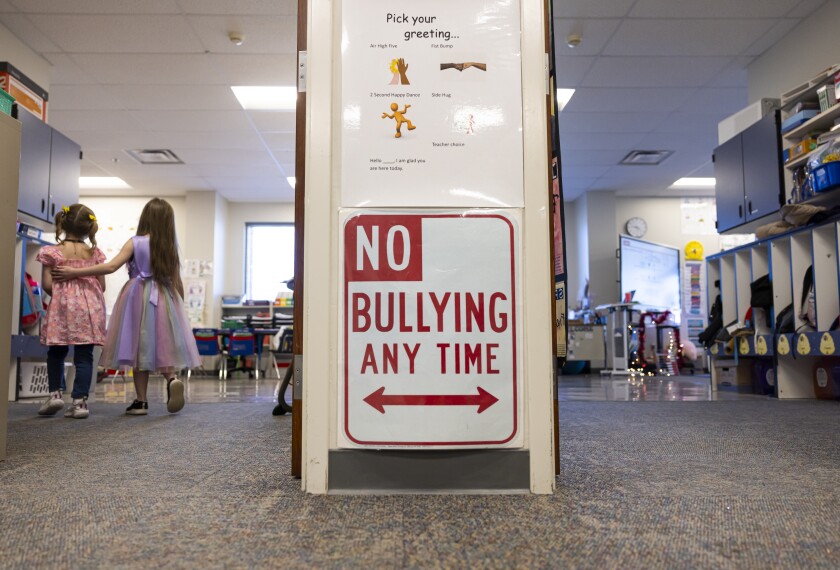
A sign discouraging bullying is seen as two students walk into a classroom at a school in Colorado Springs, Colo., on Feb. 12, 2026. Experts say creating a sense of belonging in school can help curb problems like bullying.
Kevin Mohatt for Education Week
Student Well-Being & Movement Opinion Why a Good School Needs Both Coaches and Referees
If teachers are forced into being referees, they can't fill that role properly or coach well, either.
6 min read
The United States Capitol building as a bookcase filled with red, white, and blue policy books in a Washington DC landscape.
Luca D'Urbino for Education Week
Student Well-Being & Movement Q&A Cellphones: The 'Most Formidable Adversary' Schools Have Ever Faced
The Spokane schools in Washington paired cellphone restrictions with expanded extracurricular activities.
5 min read
Students at Glover Middle School in Spokane, Wash. make bookmarks and snowflakes during Falcon Time on Dec. 3, 2025.
Students at Glover Middle School in Spokane, Wash. make bookmarks and snowflakes during Falcon Time on Dec. 3, 2025. The district has sought to encourage students to spend less time on devices.
Kaylee Domzalski/Education Week
