School & District Management Federal File

Statistical Errors?

By Debra Viadero — January 30, 2007 2 min read
  • Save to favorites
  • Print

Research advisory panel splits over NCES studies of cause and effect

The fallout over a pair of controversial studies released last year by the Department of Education’s chief statistics branch raged on last week when a national research advisory board met in Washington.

The studies—one comparing student achievement in public and private schools, and the other comparing achievement in charter schools with that of regular public schools—caused an uproar last year when they were published by the National Center for Education Statistics. That’s in part because the reports had made statistical adjustments to account for socioeconomic differences between the comparison groups.

Critics, including some top Education Department officials, said the analyses overstepped the NCES’ mission as a purely statistics-gathering agency and jeopardized its credibility.

Among the critics was the congressionally mandated National Board for Education Sciences, the panel that met last week. In September, the board approved a resolution recommending that the NCES refrain from commissioning or publishing studies that “purport” to explore the causal effects of policies. (“‘Physics First’ Is Moving Slowly Into Nation’s High Schools,” Sept. 6, 2006.)

At the board’s Jan. 23-24 meeting, though, the two board members who spearheaded the original resolution said the wording didn’t go far enough. Arguing that the earlier language failed to capture their intent, Eric A. Hanushek and Caroline M. Hoxby, both prominent economists, put forth a new proposal to delete the word “purport” and recommend instead that the NCES avoid studies “that could reasonably be interpreted” to be analyzing policy effects.

Mr. Hanushek, a senior fellow at Stanford University’s Hoover Institution, said the broader terms were needed because the reports had not purported to be cause-and-effect studies, either. They each carried disclaimers cautioning against reading too much into their findings, yet the results were widely misinterpreted to mean that charter schools, or private schools, didn’t work.

The new proposal drew a heated response from Mark S. Schneider, the NCES commissioner and a critic himself of the much-debated reports, which were commissioned before his watch. He said the new proposal was too open to interpretation and ran counter to the federal law prescribing his agency’s mission.

“We’re trying to fix something we all agree was a mistake,” he argued. The board narrowly agreed, voting 6-5 to scratch the new proposal.

Related Tags:

A version of this article appeared in the January 31, 2007 edition of Education Week

Events

Student Well-Being & Movement K-12 Essentials Forum How Schools Are Teaching Students Life Skills
Join this free virtual event to explore creative ways schools have found to seamlessly integrate teaching life skills into the school day.
This content is provided by our sponsor. It is not written by and does not necessarily reflect the views of Education Week's editorial staff.
Sponsor
Special Education Webinar
Bridging the Math Gap: What’s New in Dyscalculia Identification, Instruction & State Action
Discover the latest dyscalculia research insights, state-level policy trends, and classroom strategies to make math more accessible for all.
Content provided by TouchMath
This content is provided by our sponsor. It is not written by and does not necessarily reflect the views of Education Week's editorial staff.
Sponsor
School & District Management Webinar
Too Many Initiatives, Not Enough Alignment: A Change Management Playbook for Leaders
Learn how leadership teams can increase alignment and evaluate every program, practice, and purchase against a clear strategic plan.
Content provided by Otus

EdWeek Top School Jobs

Teacher Jobs
Search over ten thousand teaching jobs nationwide — elementary, middle, high school and more.
View Jobs
Principal Jobs
Find hundreds of jobs for principals, assistant principals, and other school leadership roles.
View Jobs
Administrator Jobs
Over a thousand district-level jobs: superintendents, directors, more.
View Jobs
Support Staff Jobs
Search thousands of jobs, from paraprofessionals to counselors and more.
View Jobs

Read Next

School & District Management On Capitol Hill, Relieved Principals Press for Even More Federal Support
With the fiscal 2026 budget maintaining level K-12 funding, principals look to the future.
7 min read
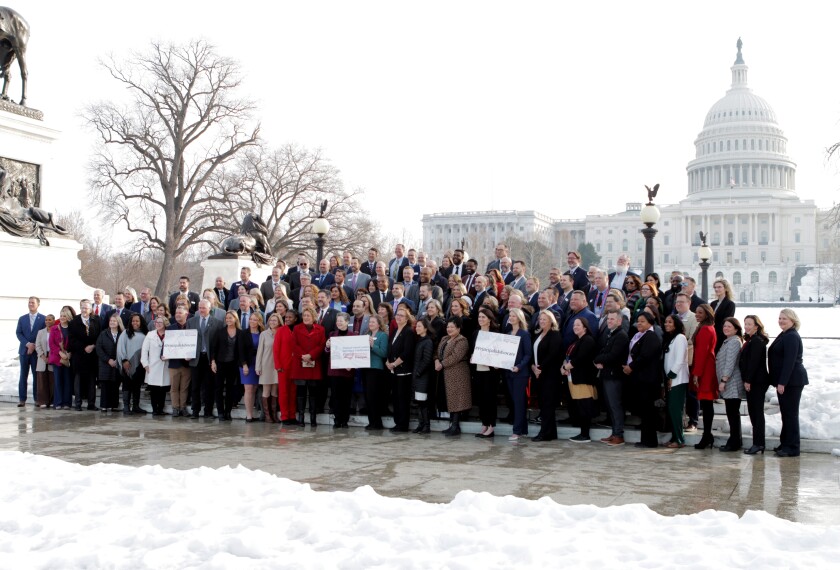
In this image provided by NAESP, elementary school principals gathered on Capitol Hill recently to meet with their state's congressional delegations in Washington
Elementary school principals gathered on Capitol Hill on Feb. 11, 2026,<ins data-user-label="Madeline Will" data-time="02/12/2026 11:53:27 AM" data-user-id="00000175-2522-d295-a175-a7366b840000" data-target-id=""> </ins>to meet with their state's congressional delegations in Washington. They advocated for lawmakers to protect federal K-12 investments.
John Simms/NAESP
School & District Management Q&A Solving Chronic Absenteeism Isn't 'One-Size-Fits-All,' This Leader Says
Proactive, sensitive communication with families can make a big difference.
7 min read
Superintendent Mary Catherine Reljac walks around the exhibition hall of the National Conference on Education in Nashville, on Feb. 12, 2026. Reljac is the superintendent for Fox Chapel Area School District in Pennsylvania.
Mary Catherine Reljac walks around the exhibition hall of the National Conference on Education in Nashville on Feb. 12, 2026. Reljac, the superintendent for Fox Chapel Area school district in Pennsylvania, is working to combat chronic absenteeism through data analysis and tailored student support.
Kaylee Domzalski/Education Week
School & District Management Opinion The News Headlines Are Draining Educators. 5 Things That Can Help
School leaders can take concrete steps to manage the impact of the political upheaval.
5 min read
Screen Shot 2026 02 01 at 8.23.47 AM
Canva
School & District Management Q&A When Should a School District Speak Out on Thorny Issues? One Leader's Approach
A superintendent created a matrix for his district to prevent rash decisions.
5 min read
Matthew Montgomery, the superintendent of Lake Forest schools in Ill., during the AASA conference in Nashville on Feb. 11, 2026.
Matthew Montgomery, the superintendent of Lake Forest schools in Illinois, is pictured at the AASA's 2026 National Conference on Education in Nashville, Tenn., on Feb. 11, 2026. The Lake Forest schools established a decisionmaking matrix that informs when the district speaks out on potentially thorny topics.
Kaylee Domzalski/Education Week
