The Senate education committee last week unanimously passed its version of the long-awaited overhaul of the Department of Education’s main research office.
Key lawmakers say they believe they can get a bill reauthorizing the department’s office of educational research and improvement, the $444 million- a-year operation that oversees most federally financed education studies, to President Bush before this Congress ends in early January.
|
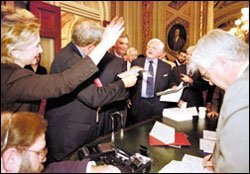
Sen. Edward M. Kennedy, in dotted tie, the chairman of the Senate education panel, is seen with colleagues Sept. 25 as the committee works on an OERI bill. |
Despite higher-profile legislative priorities, the upcoming elections, and the Thanksgiving break, a spokesman for Sen. Edward M. Kennedy, the chairman of the Health, Education, Labor, and Pensions Committee, said he believed the full Senate would vote on and pass the bill sometime next week. He said lawmakers would immediately begin trying to reconcile differences between the Senate bill and a previously passed House version even before action by the full Senate.
“We are starting to reach out to the House and ‘preconference’ the bill to get it done,” said Jim Manley, the spokesman for Sen. Kennedy. “We are optimistic about advancing the process.”
The Senate bill, approved by the education committee Sept. 25 with no amendments, would reorganize the OERI and put a focus on longer-term research. The result, lawmakers say, would be a more autonomous, streamlined “Institute for Educational Sciences.” That part of the plan is strikingly similar to the House’s vision of a new OERI, to be known as the “Academy of Education Sciences.(“Research Bill Clears House Without Fuss,” May 8, 2002.)
In both bills, the institute would be headed by a director and a board of directors, instead of an assistant secretary of education as in the current setup. The director, appointed by the president for a six-year term, would set long-term research priorities for the institute.
Gerald R. Sroufe, the government-relations director for the Washington-based American Educational Research Association, said the new structure proposed for the agency would give it some independence from politics.
“Any agency that needs to get appropriations is not going to be completely independent politically,” Mr. Sroufe said. But at least whatever you are going to do, you know you have six years to do it. It won’t matter who wins the election. It will change the whole tenor of the agency.”
Notable Distinctions
The Senate bill is in some significant ways different from the House version, research experts said. For example, they said, the Senate version would protect the autonomy of the National Center for Education Statistics, the agency within the OERI that is the primary gatherer and disseminator of basic education data.
The House bill would have the commissioner of education statistics chosen by the director of the restructured OERI. That arrangement would pose a problem in the view of Chester E. Finn Jr., the president of the Washington-based Thomas B. Fordham Foundation and a former assistant secretary for educational research in the Reagan administration. He said the House version would remove the political independence that has helped to protect past NCES commissioners from those who appointed them.
“The House bill compromised the statistics agency, by giving the new academy director quite a lot of control,” Mr. Finn said. “The Senate bill undoes that damage and preserves a measure of independence and autonomy.”
The Senate bill would maintain the current practice of having the president choose the commissioner, subject to approval by the Senate.
In addition, some observers say, the House approach would diminish the authority of the National Assessment Governing Board, a bipartisan body that supervises the National Assessment of Educational Progress, the tests that monitor how American students are doing in reading, mathematics, science, history, and other subjects.
The House bill would pass authority to the director of the new research academy to publish reports on NAEP results and conduct peer reviews of NAEP studies. The Senate bill, on the other hand, would preserve the governing board’s power.
No Deal Breakers
Those differences won’t hold up final passage of a reauthorization bill, according to a spokeswoman for Rep. Michael N. Castle, R- Del., who chairs the Education Reform Subcommittee of the House Education and the Workforce Committee. Mr. Castle sponsored the House version of the reauthorization.
“My boss wants to cooperate with the Senate and get it done this session,” said Elizabeth Wenk, a spokeswoman for Rep. Castle. “We’ve been in talks with the Senate. The White House will be committed. There are some differences in the bill, but he [Rep. Castle] feels pretty confident we can make some compromises.
“We are confident we can move forward with that sooner rather than later,” she said.
Members of Congress involved in education policy are eager to reauthorize the OERI not only because it is three years overdue, but also because the looming requirements of the “No Child Left Behind” Act of 2001 have stepped up the pressure. The act, which overhauled the primary federal K-12 law, requires school systems to rely on “scientifically based” research in choosing most of the programs and policies paid for with federal money. The OERI, in whatever new configuration emerges, will likely be central to that effort.
Some education advocates, meanwhile, say that even if the controversial items are taken out of the final bill, the new OERI will be too similar to the current agency.
“This is an extension of current law,” said Bruce Hunter, a lobbyist for the American Association of School Administrators. “Whatever the state of education research is now, it is going to be unchanged based on the work in that bill.”


