

Eye contact is a critical part of communication—in showing respect, engagement, trustworthiness, and confidence—and building relationships.
Yet kids are getting worse at it, according to a nationally representative survey of K-12 educators.
Sixty-two percent of teachers, principals, and district leaders said in a recent survey by the EdWeek Research Center that the average student’s ability to make and maintain eye contact has gotten worse compared with 10 years ago. A quarter of educators described the issue as “much worse.”
That decline is likely rooted in the isolation of the pandemic and the proliferation of cellphones and social media use, educators say, and it’s a symptom of the overall atrophying of kids’ social skills.
If eye contact is half as important as the job-interview advice columns claim, then today’s generation may struggle as they enter the workforce. And this isn’t just a future problem: Poor eye contact is already undermining students’ relationships with their teachers and their peers, say educators.
“I held the lunchroom door open one day and spoke to every student [and] counted how many kids acknowledged me and also how many made eye contact,” said a superintendent in Oklahoma in response to an open-ended question on the survey. “Eighty percent spoke back. Forty percent made eye contact.”
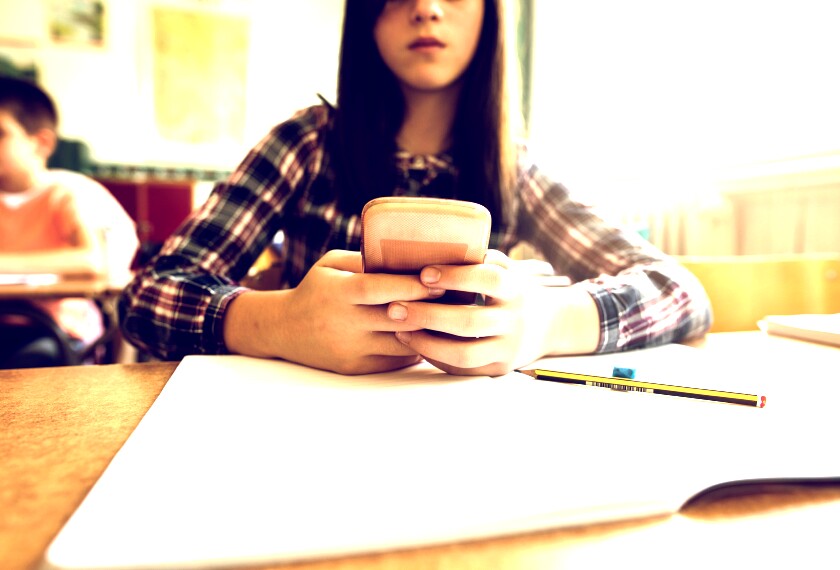
A high school teacher from Idaho said in the survey: “I teach communication, and the change of eye contact from when I started to now, it worries me, along with the ability to critically think and problem solve.”
“Students are less socially advanced than in years past. They do not look you in the eye when speaking to you,” said an elementary school teacher in North Carolina. “Students do not know how to respond to classmates in social situations either. It is concerning to see the lack of social skills in our school.”
Among their current students, 1 in 5 educators rated their ability to make eye contact as “poor.”
The EdWeek Research Center conducted the survey in May and June. The findings draw on responses from 868 teachers, principals, and district leaders.
Why are kids getting worse at making eye contact?
As researchers tell us—and many people instinctively know—eye contact is a powerful form of nonverbal communication. Where we direct our eyes signals where we’re directing our attention, and if it’s not at the person you’re speaking with, that signals disinterest or even disrespect.
In Western cultures, strong eye contact portrays confidence and even dominance, while breaking eye contact can be seen as conciliatory, conceding a point, or even a sign of submission. This is why this nearly imperceptible dance of eyeballs has spawned countless guides—including a disproportionate amount of job interview advice—on how people can improve their eye contact.
“I think that’s a very, very important skill, being able to have eye contact with adults, with staff, with teachers, with fellow students,” said 18-year-old Palash Kapoor from Cincinnati, Ohio. He is a recent graduate of Sycamore High School there and an incoming freshman at Stanford University. “Because you’re showing that you appreciate what they’re saying, that you’re listening to what they’re saying, and that you see value in what they are trying to convey to you.”
What’s causing the deterioration in kids’ ability to look adults and peers in the eyes? One culprit, according to Kapoor, a youth advocate raising awareness about tech addiction, is social media overuse.

Kids often avoid what they perceive as awkward social situations—or any interaction with strangers—by pulling out their phone and scrolling on social media, Kapoor said. The more kids avoid eye contact, he believes, the more likely they are to undervalue its importance.
Because messaging apps have come to dominate youth communication, many students simply haven’t learned how to have face-to-face conversations, said Candace Peyton Wofford, an instructional coach and, up until recently, a social-emotional learning teacher in a middle school in Corpus Christi, Texas.
Students’ inability to make and maintain eye contact is also probably a lingering effect of the pandemic, said Wofford. Many of today’s middle schoolers were in 2nd and 3rd grade during the pandemic.
“That’s when you learn a lot of social cues,” she said. “And they weren’t in the classroom to do it. They were at home on a screen. I think that as we’re back to normal, hopefully the kids who are in 2nd and 3rd grade now, when we see them in a couple years, it will be better. But I think that’s only if the parents and schools crack down on the phones and getting them out of the kids’ hands.”
Wofford said educators can help their students by giving them phone-free time in school and making a concerted effort to make eye contact with every student when greeting kids at the door to the classroom or school so that students are fully engaging with their teacher or principal for at least one brief interaction.
Without that eye contact, the much-extolled benefits of welcoming students at the door lose their potency, said Wofford.
“It’s on the teacher to set that expectation of their classroom,” Wofford said. “Like, you’re coming in my room, you’re looking me in the eye, your phone’s not around, and let’s have a great class.”

Data analysis for this article was provided by the EdWeek Research Center. Learn more about the center’s work.


