

On a crisp fall morning, 300 school leaders and students from across the nation fanned out across Capitol Hill to meet with their state representatives and senators, as part of a two-day National Advocacy Summit here organized by the National Principals Association.
On their agenda: requests to raise federal funding to expand student mental health services, curb school choice programs, and put guardrails on how schools use artificial intelligence.
After a long day of lobbying, most principals said they felt hopeful—a decided vibe shift from when they last appealed to Congress in March 2025. Then, the U.S. Department of Education, only a few blocks away from the meetings, had just begun its first round of layoffs in an effort to downsize and eventually dismantle the agency.
“That announcement came out hours before we were going to go to the Hill, and it just felt like our bubble had been burst,” said Erin Sieh, the principal of Freeman Elementary School in Adams, Neb. “It felt very defeating. It felt like education wasn’t valued. There was a lot of uncertainty, and that was very frightening.”
Sieh and her contingent of principals from Nebraska were visibly relieved this year. Even though their representatives disagreed with them on issues like school choice, Sieh said they were open to discussing their differences.
Other principals credited the shift in mood to the Democratic takeover of both houses of Congress after the midterm elections and the rise of the so-called “blue wave.”
Standing outside Sen. Elizabeth Warren’s office, Massachusetts principals Mike Rubin and Steve Wiltshire said the new political dynamics had created an opening for a discussion of school leaders’ needs.
“There’s a palpably positive feeling around the willingness to support education and to hear our messages [more] than the last two or three times that we’ve been here,” said Rubin, who leads Uxbridge High School in Uxbridge, Mass.
He added that his representatives on both sides of the aisle were focused on the real issues in school: “I feel like there’s an alignment with what are our students’ needs and actual next steps to support [these needs].”
Over the past two years, the Trump administration has gutted the Education Department and frozen several federal grants that help schools cover food and medical costs for students. There were cuts to teacher and principal training programs as well, though some grant funding has been restored.
The Trump administration has argued that in shutting down the Education Department, they are returning power to the states and to parents by giving them the right to choose the type of education they want for their children.
The principals’ top fear—of reduced Title 1 and other federal funding—has somewhat dissipated since Congress voted to maintain the existing levels of funding for public education for fiscal year 2026. A group of Republican senators has also proposed a spending package that again preserves virtually all current federal education funding for fiscal year 2027.
Still, the current funding levels are insufficient to retain high-quality educators, provide wraparound student services, and meet testing and graduation requirements, said Lucas Pugh, the principal of Connolly Middle School in Tempe, Ariz.
With the increase in student needs in recent years, “the dollars don’t go as far,” said Pugh.
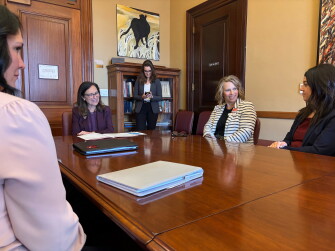
What was on the school leaders’ lobbying agenda?
Like Pugh, most principals stressed how the current funding levels aren’t enough to meet students’ increasing needs. Principals asked their representatives for:
1. An increase in Title I funding to $19 billion from $18.4 billion to help high-poverty school districts meet students’ needs.
“Schools are doing everything they can to work with what they have and find the resources to get creative]. But at the same time, we need help, and that’s why we are here today,” said Jeff Linden, the principal of the approximately 1,000-student Hastings High School in Nebraska, where 54% of students belong to low-income households and 30% require special accommodations in school.

2. An increase in Title II funding (to $2.4 billion from $2.14) and Title IV-A funding to bolster teacher and principal pipelines and support and expand access to quality mental health care for educators and students.
In meetings with their representatives and congressional aides, most principals highlighted the need for a better student-to-counselor ratio, given the rapid increase in mental health challenges and suicidal ideation in students across grades.
Rubin and Wiltshire, from Massachusetts, told an aide in Democratic Sen. Ed Markey’s office that multiple students from their schools had been hospitalized for mental health conditions.
Principals also spoke about the pressures teachers operate under. For relatively little pay, teachers work long hours, and their “grinding” jobs often go beyond just teaching to managing student behavior and dealing with mental health challenges, said Jay Dostal, the principal of Westside High School in Omaha, Neb.
Dostal stressed the importance of increasing teacher pay and mental health support to an aide in Republican Sen. Pete Rickett’s office by using an example from his own family, where several members are teachers: “My family is in generational debt trying to teach the youth of tomorrow. How do we incentivize the youth to continue teaching?”
3. Tighter curbs on artificial intelligence used in schools. School leaders weren’t alone in voicing their fears about how students are abusing AI to cheat or cyberbully others. Policymakers from both sides of the aisle were also keen to learn about AI’s impact on schools.
Principals told lawmakers and their staff that while they recognize students will need AI skills for the job market, it’s hard to balance that priority with keeping students and teachers safe from online, AI-driven harassment.
An aide for Markey said their office had written to Google about its decision to bundle AI features with the search function, a move that several prominent school districts have pushed back against. Democratic Rep. Jim McGovern indicated to the Massachusetts contingent that he intends to push to regulate AI sooner than Congress had acted on curbing social media exposure for students.
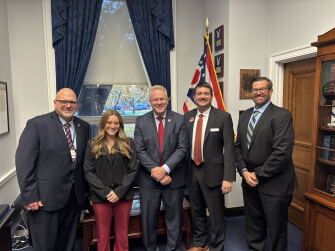
The principals and lawmakers debated school choice
School leaders were vocal about their concerns over the Federal Scholarship Tax Credit program, which will go into effect on Jan. 1, 2027. Individuals can claim a federal income tax credit up to $1,700 for qualified cash contributions to certain scholarship-granting organizations.
Scholarships can be used for students’ approved expenses such as tutoring at a public school or tuition at a private school. School districts could receive a significant amount of money from the program.
So far, governors of 31 states have opted into the program, according to Education Week reporting. Fifteen states and the District of Columbia are still undecided, while four have said they will not participate.

Virginia’s newly elected governor Abigail Spanberger, a Democrat, reversed her Republican predecessor’s decision and pulled out of the program this week.
Some of the principals in Washington said they’re hopeful that more such reversals are in the cards, especially as governorships change hands—and parties—in January. They expressed concern that the scholarship program will end up disproportionately benefiting private school students.
In their meetings with policymakers, school leaders stressed that taxpayer dollars should be directed to public schools, not away from them. In Rickett’s office, the principal contingent from Nebraska expressed their frustration with the senator’s support for school choice programs, even though the state’s voters had rejected a school voucher program last year.
“The funding is finite. School vouchers dilute the funding [for public schools],” Anna Thoma, the assistant principal of Millard High School in Millard, Neb. told Rickett’s aide.
On balance, principals agreed that students should have more choice in picking educational opportunities, but Thoma stressed that could be done within the public school system.
The principal contingent from Ohio also spoke to their representatives about school choice programs. Afterwards, Greg Johnson, the longtime principal of West Liberty-Salem High School, an hour outside Columbus, said even policymakers who supported private school choice were “open” to his view that these programs pull money away from public school students.
“For students in a low-performing school, I agree that [school choice] is equity issue, … they should have access to other school options,” said Johnson. “But in my conversation, I was able to share how [school choice] allows extra funds for students to apply to a private education in situations where that student could already afford that.”


