When Komal Bhasin heard that her New Orleans school was shutting down in preparation for a hurricane, she anticipated having an extra, leisurely day for lesson planning. Instead, the teacher fled to Huntsville, Ala., to escape the wrath of Hurricane Katrina.
Now, she has no idea when or whether she will return to New Orleans, and if her school and her job will still be there.
View an updated collection of outreach resources from state and national agencies, Hurricane Relief: Outreach From National Organizations
Thousands of displaced teachers from Louisiana and Mississippi struggled to put their lives back together last week, anxiously awaiting news of jobs and paychecks disrupted by the deadly Gulf Coast storm.
Those states offered the evacuees pay and benefits, but as of last week, administrators faced a logistical nightmare in finding the scattered teachers and retrieving payroll and employment records. Other states, facing an influx of displaced students, made arrangements to hire those teachers on a provisional basis.
Meanwhile, the two major teachers’ unions, the National Education Association and the American Federation of Teachers, set up phone lines for their members to call for information about their school districts and advice on union benefits, such as supplemental health insurance, loans, and disaster aid.
“We’ve been inundated” with teachers’ calls for information and help, said Linda Bridges, a spokeswoman for the Texas Federation of Teachers, an AFT affiliate. “There are a lot of unanswered questions, and we’re trying to fill in blanks each day.”
Pay From New Orleans
Many states have begun formulating plans for how they will handle the needs of the expected flood of students into their districts. Some expect to hire hundreds of displaced teachers to teach those students and are planning to waive requirements such as proof of certification.
“When we’re under a declaration of a disaster, there is some flexibility,” said Caron Blanton, a spokeswoman for the state education department in Mississippi, where many educators and students from coastal areas have moved elsewhere in the state.
The U.S. Department of Education has told districts that it will consider waivers on a case-by-case basis for the “highly qualified” teacher component of the No Child Left Behind Act. Although that provision is to take effect for all classroom teachers at the end of this school year, teachers hired in Title I schools since the beginning of the 2003-04 school year must already meet that standard.
No details on the waivers were available late last week.
“These are issues we are reviewing right now, and [Secretary of Education Margaret Spellings] has committed to applying common sense and flexibility to help these kids,” said Susan Aspey, a spokeswoman for the department.
On the pay front, New Orleans teachers had been instructed to call Alvarez & Marsal, the private crisis-management firm that has been handling the district’s payroll, among many of its other affairs, to leave their contact information. The firm expected to send payments—most likely cash instead of checks—to employees through a national financial-services company by Sept. 15, said Steven Alschuler, a spokesman.
He said no decision had been made on how long the employees will be paid, but they will retain health-insurance coverage for at least the next few weeks; pension plans were not affected.
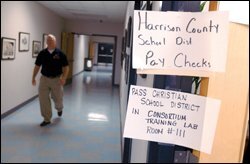
Mississippi officials announced Sept. 7 that hurricane-affected school employees who had direct-deposit accounts would get paychecks that day. Several hurricane-ravaged districts also began distributing paper checks then, too. Workers will be paid at least until the districts decide on reopening their schools, according to documents on the state education department’s Web site.
Streamlined Process
Anticipating a need for new teachers for the displaced students for an indefinite period, many states have loosened licensing requirements and waived fees for background checks.
The Texas Education Agency announced last week that it would create a one-year provisional teaching license for teachers from Louisiana and Mississippi and other affected areas. Applicants, whose fees will be waived, must provide all contact information, give details of any teaching licenses they hold in other states, and submit fingerprints for an FBI background check. The sponsoring Texas district must provide additional information about the applicant as well.
On Sept. 8, the Houston district held a job fair to hire teachers for all the new students who had enrolled in its schools, a number that was estimated at more than 6,000 last week but was expected to balloon in coming weeks. Georgia’s Professional Standards Commission also announced last week that it would offer a special one-year certificate for displaced teachers. Its Web site said the agency planned to “temporarily relax the requirements for official documentation and will work with the employing school systems to verify information in other ways.”
The Arkansas education department announced a streamlined teacher-application process on Sept. 2, enabling teachers licensed in Louisiana, Mississippi, or Alabama to apply online for jobs within the state. Fees for criminal-background checks were waived.
“We already had a shortage of teachers, and now, as our schools accept students who have been displaced by the hurricane, we anticipate an additional need for teachers across the state,” Beverly Williams, Arkansas’ assistant commissioner for human resources/licensure, said in a statement. “We also hope that, by being able to work, these displaced teachers will be able to bring home some needed income.”
Tennessee already accepts teaching licenses from most other states, according to Rachel Woods, a spokeswoman for the state education agency. With many more displaced students expected in coming weeks, she said, her department will work with districts to hire teachers as they see fit.
Last week, Oklahoma hired three displaced teachers, said state schools Superintendent Sandy Garrett. But she did not expect a further need because the state has a surplus of teachers, and its schools, some of which had declining enrollments, so far had been able to absorb the approximately 400 new students.
Meanwhile, Ms. Bhasin and a co-worker, Julie Lause, both 8th grade teachers at the KIPP Phillips Academy New Orleans, joined other colleagues last week at Houston’s Astrodome to look for their former students and make sure they were enrolling in schools in the Texas district.
But neither teacher had immediate plans. Ms. Bhasin was considering applying to teach in Houston or substitute-teach in Boston. The New Orleans public charter school, which opened just last month, is planning to reopen as soon as possible, Principal Gary Robichaux said from the Astrodome. Whether the students will return to the school is in question, but Ms. Lause said she planned to be there.
“There was something so hopeful about New Orleans,” she said, “that we can’t let go.”


