As students displaced by Hurricanes Katrina and Rita continue returning to their home school districts in Louisiana and Mississippi, tens of thousands remain scattered elsewhere in those states, in nearby states, and across the nation.
Five months after schools began rolling out the welcome mat for families fleeing New Orleans and other storm-ravaged communities, officials are still working out graduation requirements, cost reimbursements, and other questions affecting students who can’t return home yet, or who are making a new home.
According to the most recent data provided to Education Week by state education departments, Louisiana had the highest number of students—105,000—attending schools in the state that are not their home schools.
Read the accompanying story, First Lady, Spellings Tour Gulf Coast Schools
Some 10,000 displaced students were in Mississippi schools at the end of December, including Mississippi students who had left hurricane-damaged districts within the state, as well as students from Louisiana.
About 40,200 displaced students were enrolled in Texas schools, and Georgia counted 10,300 evacuees in its schools, while Alabama and Florida had more than 5,000 each, the most recent figures from those states show.
In smaller numbers, states far from the Gulf Coast continue to help meet the educational needs of displaced students. At last count, about 1,100 evacuees were enrolled in California, and 435 were attending schools in New York state.
But the numbers—some of which have not been updated since October—tell only a part of the story.
Changing Schools
Just because students return to their districts doesn’t mean they’re in the same schools they were attending before the hurricanes.
“We’ve got people scattered all over the place,” said Henry Arledge, the superintendent of the Harrison County, Miss., school district, which had about 13,300 students before Katrina and now has about 12,000.
Other students have changed school districts more than once.
School districts hit hardest by Hurricane Katrina have seen students return in varying numbers.
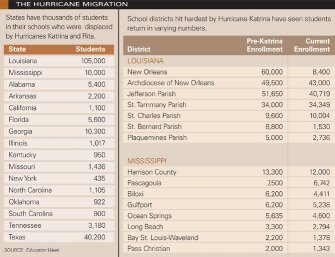
SOURCE: Education Week
Many evacuees from Louisiana who found temporary housing across the border in eastern Texas eventually dispersed throughout Texas when it became clear that they would not be able to return home any time soon, said Suzanne Marchman, a spokeswoman for the Texas Education Agency.
With the recent passage of the federal Hurricane Education Recovery Act—which allocates more than $1.4 billion to rebuild districts and help schools that took in displaced students—the states most affected by the storms might have to begin tracking those enrollment figures differently, said Caron Blanton, a spokeswoman for the Mississippi Department of Education. (“Hurricane Aid is on the Way to Districts, Private Schools,” Jan. 11, 2006.)
She said that before enactment of the federal legislation, which President Bush signed into law Dec. 30, the state education agency counted displaced students as those who had moved to another district because of a hurricane. The law, however, defines students as displaced if they are in permanent or temporary school buildings that are different from the ones they attended before the storms.
As a result, a few districts, for purposes of federal hurricane-related school aid, will be counted as having lost almost their entire enrollments because most of their students were moved into portable classrooms, even though they didn’t leave the districts.
Though the Mississippi department counted roughly 10,000 students as being displaced at the end of December, that figure will likely be much higher when it’s recounted using the federal definition, Ms. Blanton said.
In Louisiana, which used the new federal method for counting displaced students, the most recent number of evacuees in the state is 105,771.
But Meg Casper, a spokeswoman for the state education department there, said that number would likely go down when January figures are counted because “a lot of movement” has taken place in recent weeks as schools continued to reopen.
New Priorities
Even with more students returning home, the challenge of meeting the needs of thousands of other young evacuees remains.
Hurricane Katrina, which slammed into the Gulf Coast on Aug. 29, forced massive evacuations and long-term school closures in Louisiana and Mississippi. In the weeks following the disaster, the federal government estimated that 372,000 students—from preschool through college—were displaced by the storm.
States continue to provide schooling for out-of-state students displaced by hurricanes Katrina and Rita.
| State | Students |
| Texas | 40,200 |
| Georgia | 10,300 |
| Florida | 5,600 |
| Alabama | 5,400 |
| Tennessee | 3,180 |
NOTE: Excludes Louisiana and Mississippi.
The second punch came Sept. 24, in the form of Hurricane Rita. That storm missed heavily populated areas in and near Houston, but left dozens of schools along the Texas and Louisiana coasts closed in its wake.
Immediately following the disasters, state and local school officials focused on getting displaced students enrolled in school and making their transition as smooth as possible. Now, with many students likely to finish the school year in the districts that received them, other matters are taking priority. Displaced students who were initially welcomed into new schools without the usual documentation, for example, have since needed to provide records.
Marsha Pugh, an instruction and curriculum supervisor for the 5,800-student Walton County district in Florida, which received about 500 displaced students, said she helped many new high school students get credit for the courses they had taken before the hurricanes.
Barbara Cole, a counselor at South Walton High School in Walton County, was also concerned about where to send transcripts after students returned to their home schools. “Somehow, it has all worked miraculously,” she said.
Still, school records were a small worry, Ms. Cole added, “with all the trauma and the pain and the human suffering involved.”
With the school year nearly half over, education officials in Texas and other states are trying to help displaced students who are scheduled to graduate from high school this year receive diplomas from their home schools.
“We’re working with the Louisiana Department of Education so those kids can get a Louisiana diploma,” Ms. Marchman of the Texas Education Agency said. “A lot of those kids went to Louisiana schools K through 12, and now they’re in another district in another state.”
Ms. Marchman hopes that even if students walk across a different stage to receive their diplomas, they will be able to wear their home schools’ caps and gowns at graduation.
The Louisiana education department set up a “distance diploma” program in September to allow displaced students who have completed their graduation requirements to receive a Louisiana diploma from their former schools. The department is also allowing eligible students to take the state’s Graduation Exit Exam online to meet those requirements.
Hundreds of other students are calling for information on the program, Ms. Casper added.
And in California last week, state Superintendent of Public Instruction Jack O’Connell clarified growing confusion on the graduation issue there.
In a Jan. 24 letter to school districts, he explained that displaced high school students may choose between a California or Louisiana diploma, but must pass the graduation requirements for the state they pick.
“Helping [displaced] students navigate the process to obtain a high school diploma is an important way the California education community can help them rebuild their lives,” he wrote.
Financial Support
The states serving displaced students also have the continuing responsibility of providing financial support to the districts where those students attend school.
That process is becoming a bit easier now that the federal relief money is available.
“Those students came with no school textbooks, no permanent school records, in many cases no clothes, and in almost all cases with more psychological and social needs than many of us can imagine,” Alabama state schools Superintendent Joseph B. Morton said in a press release following the federal law’s passage. “Addressing these needs costs money.”
Schools directly affected by the hurricanes share up to $750 million, and those receiving displaced students will split $645 million. The law says that public and private schools should receive $6,000 per displaced student, and $7,500 for each special education student.
In Georgia, learning the process for receiving the funds is a top concern for most districts, said Dana Tofig, a spokesman for the state education department. He is also one of 17 caseworkers from the department working with districts that enrolled displaced students.
Compared with most Atlanta-area school districts, the Marietta city system—one of the 11 districts on Mr. Tofig’s case list—is small, with roughly 7,500 students. But it received about 500 displaced students, which was a major influx for a district of that size, Mr. Tofig said.
“We have found that most of the local systems have accepted these kids as their own,” he said.