School & District Management Report Roundup

Educational Attainment

By Jackie Mader — January 12, 2016 1 min read
  • Save to favorites
  • Print

The percentage of rural residents who have completed high school and some college increased between 2000 and 2014, although educational attainment levels remain lower for rural minority residents, according to a recent report.

The report by the U.S. Department of Agriculture examines rates of rural employment, poverty, and education levels. Between 2000 and 2014, the percentage of rural adults with a four-year college degree increased by 4 percentage points, to 25 percent, while the percentage of rural residents without a high school diploma or its equivalent decreased by 9 percentage points, to 15 percent. Although this rate is still higher than the rate for urban areas (13 percent), the report notes that the percentage of rural adults who have an associate degree or have completed some college (30 percent) is now greater than that in urban areas (29 percent).

The report notes, however, that educational attainment levels are lower for rural minorities, including black, Hispanic, and Native American residents. In 2014, only 13 percent of white rural residents had less than a high school diploma, compared with 40 percent of Hispanic residents and 25 percent of black residents in rural areas. These attainment levels corresponded with unemployment rates, according to the report.

The report also found higher child-poverty rates in rural areas with lower educational attainment rates. Overall, rural child poverty rose during the Great Recession and has since increased. In 2014, 25.2 percent of rural children lived in poverty compared to 22 percent in 2007.

A version of this article appeared in the January 13, 2016 edition of Education Week as Educational Attainment

Events

This content is provided by our sponsor. It is not written by and does not necessarily reflect the views of Education Week's editorial staff.
Sponsor
Special Education Webinar
Integrating and Interpreting MTSS Data: How Districts Are Designing Systems That Identify Student Needs
Discover practical ways to organize MTSS data that enable timely, confident MTSS decisions, ensuring every student is seen and supported.
Content provided by Panorama Education
Artificial Intelligence Live Online Discussion A Seat at the Table: AI Could Be Your Thought Partner
How can educators prepare young people for an AI-powered workplace? Join our discussion on using AI as a cognitive companion.
Student Well-Being & Movement K-12 Essentials Forum How Schools Are Teaching Students Life Skills
Join this free virtual event to explore creative ways schools have found to seamlessly integrate teaching life skills into the school day.

EdWeek Top School Jobs

Teacher Jobs
Search over ten thousand teaching jobs nationwide — elementary, middle, high school and more.
View Jobs
Principal Jobs
Find hundreds of jobs for principals, assistant principals, and other school leadership roles.
View Jobs
Administrator Jobs
Over a thousand district-level jobs: superintendents, directors, more.
View Jobs
Support Staff Jobs
Search thousands of jobs, from paraprofessionals to counselors and more.
View Jobs

Read Next

School & District Management How Principals Are Coaching the Next Generation of School Leaders
Mentors give aspiring school leaders an unvarnished view of the principalship.
6 min read
Photo of school officials having conversation.
iStock
School & District Management How 4 Superintendents Are Bracing for Federal Funding Uncertainty Under Trump
Superintendent of the Year finalists discussed how they're preparing for potential cuts.
3 min read
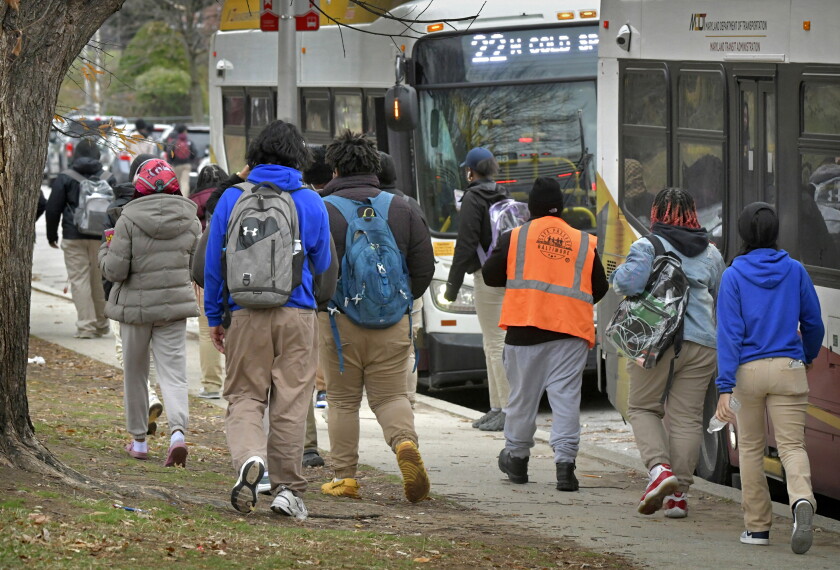
Students at Merganthaler Vocational-Technical High School board MTA buses at the end of the school day on Dec. 13, 2024 , in Baltimore. federally funded programs allows students to access resources they might otherwise not get—like tutoring and after-school programs, according to Baltimore Superintendent Sonja Santelises.
Students at Merganthaler Vocational-Technical High School board buses at the end of the school day on Dec. 13, 2024 , in Baltimore. Federally funded programs in the city's schools allow students access to services they might otherwise not get, such as tutoring and after-school programs, Baltimore Superintendent Sonja Santelises said at a recent panel discussion of the finalists for AASA's Superintendent of the Year award.
Amy Davis/Baltimore Sun/TNS
School & District Management Q&A Why This Leader Is Willing to Risk Losing His Job to Support Immigrant Students
This small Vermont district defies backlash to support immigrant families.
6 min read
A Somali flag, right, flies alongside the United States and Vermont flags outside the Winooski School District building, Wednesday, Dec. 10, 2025, in Winooski, Vt.
A Somali flag, right, flies alongside the United States and Vermont flags outside the Winooski School District building, Wednesday, Dec. 10, 2025, in Winooski, Vt. The district's effort to show support for Somali students drew intense backlash.
Amanda Swinhart/AP
School & District Management How These 3 States Are Building a Principal Pipeline
Principal apprenticeship programs aim to remove barriers to school leadership.
5 min read
Principal and apprentice having a conversation in school courtyard.
E+
