School & District Management

Competing Plans Offered To Shield Research From Political Influences

By Debra Viadero — May 10, 2000 2 min read
  • Save to favorites
  • Print

Policymakers and researchers floated ideas for ways to buffer federally funded education research from the changing whims of politics during a House education subcommittee hearing last week.

The May 4 hearing before the Early Childhood, Youth, and Families panel was held with an eye toward the upcoming reauthorization of the office of educational research and improvement, the agency that oversees much of the research financed by the Department of Education.

Hoping to improve the quality of education research, Congress in 1994 revamped the agency, which has an annual budget of about $824 million. The deadline on that reauthorization is now up, and many researchers and legislators seem to agree that the changes have had little impact.

“Most education research is not done well, is not of good quality, does not inform, and should not be trusted,” G. Reid Lyon, the chief of the child-development and -behavior branch of the National Institute of Child Health and Human Development, told the lawmakers last week.

Part of the problem, Mr. Lyon and others said, is that politics, regardless of which party is in office, plays too strong a role in what type of research is supported, how the findings are disseminated, and what gets taught in colleges and universities that prepare the nation’s teachers.

But proposals vary on ways to shield research from political influences. One strategy, reportedly favored by Republican committee aides, calls for creating an independent education research agency—possibly modeled after the Federal Reserve Board.

“While there are some drawbacks to having the educational research agency located outside the Department of Education, they are outweighed by the benefits of having the research unit being relatively free from political interference and able to institute more rigorous and scientifically sound research practices,” said Maris A. Vinovskis, a University of Michigan history professor who is studying the OERI.

C. Kent McGuire

But C. Kent McGuire, the department’s assistant secretary in charge of research, said political independence could also leave education research with fewer champions in Congress or the executive branch.

“If it were to be outside the department, I think we should worry a lot about what kind of support there is for it,” he told the subcommittee.

National ‘Institute’ Proposed

Mr. McGuire favors a more centralized national institute for education research within the department.

To create a measure of political independence, he would replace his own job as assistant secretary with an institute director who would serve a six-year term. The assistant secretary now serves at the pleasure of the president.

That idea has been echoed by the American Educational Research Association, which represents 23,000 researchers. The organization has called for a presidentially appointed commissioner of education research, who would serve a fixed term.

“None of you have preached the status quo,” said Rep. Michael N. Castle, the Delaware Republican who chairs the subcommittee. “Whether we can all agree on the same exact end, I’m not certain.”

Also unclear at last week’s hearing was the question of when the OERI reauthorization would occur.

While Mr. Castle said his own goal of passing a bill before Congress adjourns this summer was admittedly ambitious, prospects look even dimmer in the Senate.
A version of this article appeared in the May 10, 2000 edition of Education Week as Competing Plans Offered To Shield Research From Political Influences

Events

Student Well-Being & Movement K-12 Essentials Forum How Schools Are Teaching Students Life Skills
Join this free virtual event to explore creative ways schools have found to seamlessly integrate teaching life skills into the school day.
This content is provided by our sponsor. It is not written by and does not necessarily reflect the views of Education Week's editorial staff.
Sponsor
Special Education Webinar
Bridging the Math Gap: What’s New in Dyscalculia Identification, Instruction & State Action
Discover the latest dyscalculia research insights, state-level policy trends, and classroom strategies to make math more accessible for all.
Content provided by TouchMath
This content is provided by our sponsor. It is not written by and does not necessarily reflect the views of Education Week's editorial staff.
Sponsor
School & District Management Webinar
Too Many Initiatives, Not Enough Alignment: A Change Management Playbook for Leaders
Learn how leadership teams can increase alignment and evaluate every program, practice, and purchase against a clear strategic plan.
Content provided by Otus

EdWeek Top School Jobs

Teacher Jobs
Search over ten thousand teaching jobs nationwide — elementary, middle, high school and more.
View Jobs
Principal Jobs
Find hundreds of jobs for principals, assistant principals, and other school leadership roles.
View Jobs
Administrator Jobs
Over a thousand district-level jobs: superintendents, directors, more.
View Jobs
Support Staff Jobs
Search thousands of jobs, from paraprofessionals to counselors and more.
View Jobs

Read Next

School & District Management On Capitol Hill, Relieved Principals Press for Even More Federal Support
With the fiscal 2026 budget maintaining level K-12 funding, principals look to the future.
7 min read
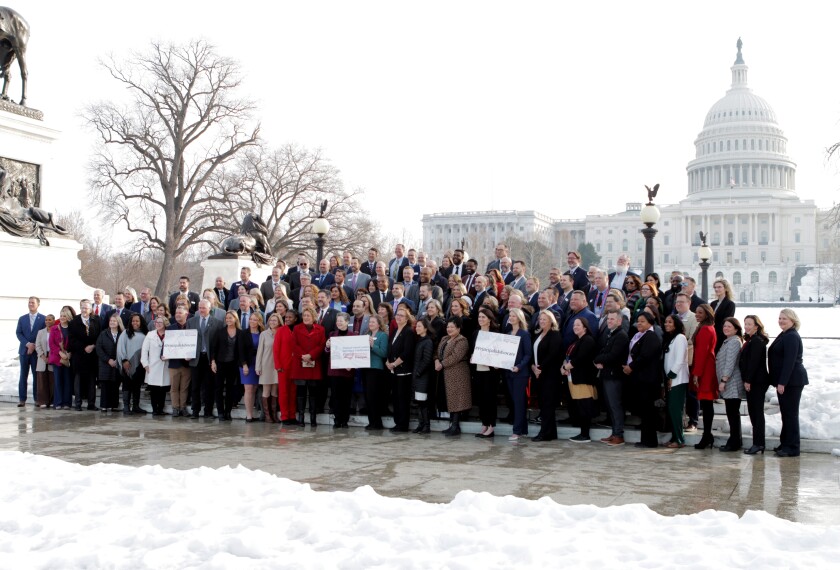
In this image provided by NAESP, elementary school principals gathered on Capitol Hill recently to meet with their state's congressional delegations in Washington
Elementary school principals gathered on Capitol Hill on Feb. 11, 2026,<ins data-user-label="Madeline Will" data-time="02/12/2026 11:53:27 AM" data-user-id="00000175-2522-d295-a175-a7366b840000" data-target-id=""> </ins>to meet with their state's congressional delegations in Washington. They advocated for lawmakers to protect federal K-12 investments.
John Simms/NAESP
School & District Management Q&A Solving Chronic Absenteeism Isn't 'One-Size-Fits-All,' This Leader Says
Proactive, sensitive communication with families can make a big difference.
7 min read
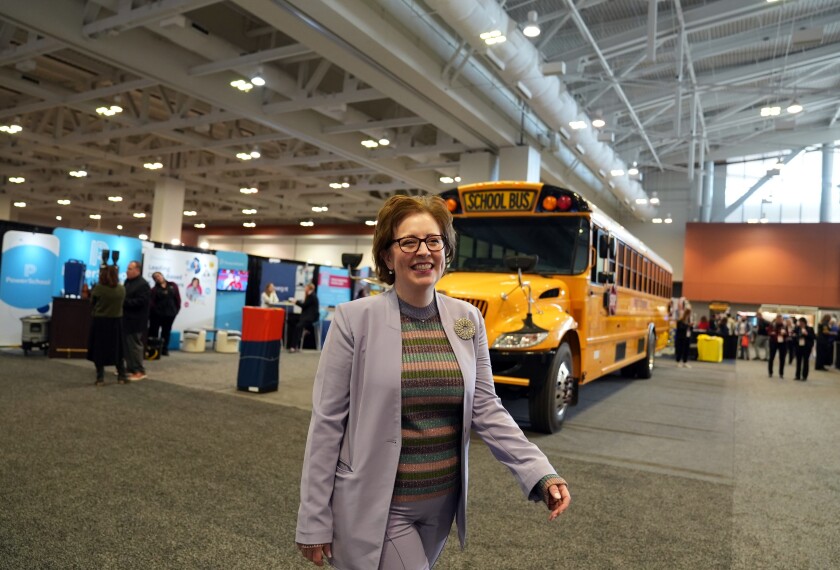
Superintendent Mary Catherine Reljac walks around the exhibition hall of the National Conference on Education in Nashville, on Feb. 12, 2026. Reljac is the superintendent for Fox Chapel Area School District in Pennsylvania.
Mary Catherine Reljac walks around the exhibition hall of the National Conference on Education in Nashville on Feb. 12, 2026. Reljac, the superintendent for Fox Chapel Area school district in Pennsylvania, is working to combat chronic absenteeism through data analysis and tailored student support.
Kaylee Domzalski/Education Week
School & District Management Opinion The News Headlines Are Draining Educators. 5 Things That Can Help
School leaders can take concrete steps to manage the impact of the political upheaval.
5 min read
Screen Shot 2026 02 01 at 8.23.47 AM
Canva
School & District Management Q&A When Should a School District Speak Out on Thorny Issues? One Leader's Approach
A superintendent created a matrix for his district to prevent rash decisions.
5 min read
Matthew Montgomery, the superintendent of Lake Forest schools in Ill., during the AASA conference in Nashville on Feb. 11, 2026.
Matthew Montgomery, the superintendent of Lake Forest schools in Illinois, is pictured at the AASA's 2026 National Conference on Education in Nashville, Tenn., on Feb. 11, 2026. The Lake Forest schools established a decisionmaking matrix that informs when the district speaks out on potentially thorny topics.
Kaylee Domzalski/Education Week
