
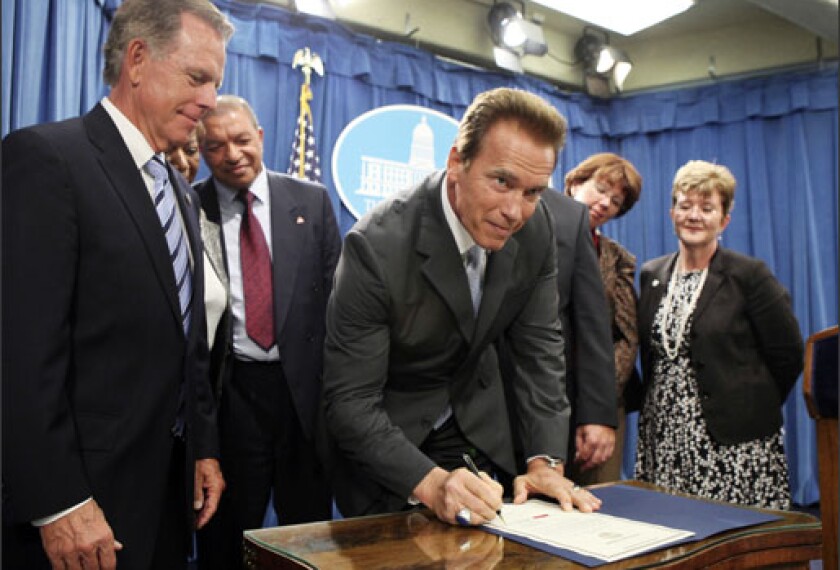
Gov. Arnold Schwarzenegger’s decision to call a special session to better position California for Race to the Top funds may be the highest-profile test yet of whether proposed federal requirements for the coveted grants are likely to significantly reshape state policy.
The Republican governor last month directed the Democratic-controlled California legislature to consider enacting a package of education redesign measures—including scrapping a law blocking the state from linking student and teacher data—in hopes of improving the state’s competitive posture.
Under draft criteria for the Race to the Top Fund, released July 23, states that have such a data “firewall” on the books would be automatically disqualified from getting a portion of the $4.35 billion fund, which was created under the American Recovery and Reinvestment Act.
California’s actions are being closely watched, particularly in states that arguably have similar data restrictions, including Nevada, New York, and Wisconsin.
At least one New York state lawmaker cited Mr. Schwarzenegger’s example in encouraging Gov. David Paterson, a Democrat, to make that state’s Race to the Top bid a priority during a possible special session set to focus on New York’s dismal budget situation.
Gov. Schwarzenegger, in announcing his decision to call for a special session with the goal of acting by October, said that, given California’s yawning $26 billion deficit, he doesn’t want to leave any federal funding on the table.
“Our laws that we have in place here in our state do not really kind of match up with what the Obama administration is looking for,” he said last month. “We are going to put together in legislation all of the things that the Obama administration is actually calling for. These are all policies that are great, actually, for the state of California and that are great for our kids.”
In addition to seeking a change in the way the state uses data to measure student, teacher, and school performance, Mr. Schwarzenegger asked lawmakers to repeal California’s charter school cap, expand public school choice, step up turnaround efforts for struggling schools, and enact alternative-pay plans for educators.
And the governor wants lawmakers to pass those measures by early October, so that California could be eligible for the first of two rounds of Race to the Top grant funding, which is slated to go out in March. The grants are intended to bolster innovative state education efforts that center on improving academic standards, teacher quality, data collection, and the lowest-performing schools.
Legislative Chances
In selling his proposals, Gov. Schwarzenegger made it clear that he’s trying to carry out the vision of President Barack Obama, who carried the Golden State overwhelmingly in the 2008 election. The governor invoked Mr. Obama’s name at least nine times during his relatively short speech.
But that tack might not work with everyone.
“Although I’m a big supporter of Obama, I feel that some of his educational focus is misplaced,” said state Assemblyman Tom Ammiano, a Democrat, who previously served on the San Francisco board of education. “This, I think, is destructive, not productive,” he said, in part because he believes the governor’s proposal would put too much emphasis on standardized-test scores in determining teacher effectiveness.
The California Teachers Association, a 340,000-member affiliate of the National Education Association, shared similar concerns during a conference call with reporters Aug. 25.
Lori Easterling, the CTA’s manager of legislative relations, pointed out that federal guidelines for Race to the Top Fund eligibility aren’t likely to be final until later this fall. Changing policy based on the proposed rules from the U.S. Department of Education is “nonsense,” she said, particularly since the NEA and other organizations are urging the Obama administration to rework the criteria.
Mr. Ammiano is also concerned that the effort may not pay off. California is already starting near the back of the pack, he said, because 15 other states are receiving money from the Seattle-based Bill & Melinda Gates Foundation to complete their Race to the Top applications.
“I think the governor and his people know about that, and they’re just trying to brush it aside so that they can play king of the mountain and make people uncomfortable—Democrats in particular,” Mr. Ammiano said.
But state Sen. Gloria Romero, a Democrat who chairs the Senate education committee, dismissed that line of thinking.
If California enacts a strong package of changes that includes a reworking of the data law, “we will be in strong standing to be very competitive” for a federal grant, she said. “We’re bigger than most states—we’d better show our clout.”
State Sen. Joe Simitian, a Democrat and an author of the data law, said he doesn’t see why the language, which was meant to ensure that teacher-evaluation methods could be collectively bargained at the local level, has become such a divisive issue.
Under current state law, school districts can still link teacher and student data, he said, so California doesn’t really have a firewall.
“This is sort of a silly little sideshow in what should be a much larger and more important discussion” of how to fix California’s most troubled schools, he said. “I’m perfectly happy to see the language removed if that will assuage anyone’s concerns.”
For his part, U.S. Secretary of Education Arne Duncan praised Gov. Schwarzenegger’s decision to seek legislative action.
“California may indeed serve as an example to other states that are facing similar challenges—this is a step in the right direction,” Mr. Duncan said.
Other States
In New York, state Assemblyman Sam Hoyt, a Democrat, sent a letter to Gov. Paterson on Aug. 21 asking that he add education legislation to the agenda for a potential special session in order to help the state qualify for Race to the Top money.
In particular, Mr. Hoyt stressed the need to eliminate the state’s cap on charter schools and revamp its data law.
“President Obama and Secretary Duncan are presenting us with a historic opportunity, and we must capitalize on it,” he wrote.
But Richard C. Iannuzzi, the president of the 600,000-member New York State United Teachers, which is affiliated with both the NEA and the American Federation of Teachers, said a special session or other legislative action isn’t necessary because, in his view, New York does not have a data firewall.
He said the state simply prohibits the linking of student data to decisions on teacher tenure, not teacher effectiveness. And that legislation will sunset in July of next year.
“There is nothing in New York state’s law that prevents looking at student test scores [as one of many factors] to determine teacher effectiveness” Mr. Iannuzzi said.
A spokesman for Gov. Paterson did not return calls seeking comment.
Meanwhile, there may be action elsewhere.
During Wisconsin’s upcoming legislative session, Gov. James E. Doyle, a Democrat, would like to see legislation making it clear that his state doesn’t prohibit the linking of student and teacher data, said Lee Sessenbrenner, a spokesman.
And Nevada schools Superintendent Keith Rheault said in an interview that he’s hoping that his state will take up the issue in a potential special session to deal with budget woes.




