
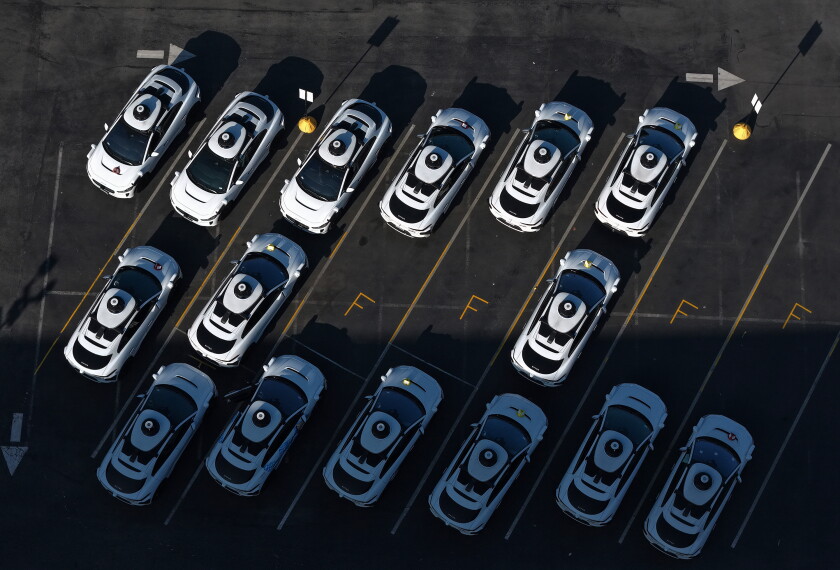
The National Highway Traffic Safety Administration launched an investigation into Waymo autonomous vehicles Thursday after one of the self-driving taxis struck a child as she ran across the street to her Santa Monica, Calif., elementary school Jan. 23, leaving her with minor injuries.
The incident is the latest example of concerns flagged by school districts that the autonomous vehicles pose potential hazards for students. In two cities where Waymo operates—Atlanta and Austin, Texas—districts have asked the company not to offer rides during school pickup and dropoff hours after repeated incidents of the vehicles failing to stop for school buses loading and unloading students.
Another federal safety agency, the National Transportation Safety Board opened an investigation Jan. 23 after the Austin district documented 23 incidents of Waymo driverless taxis illegally passing school buses. Those violations, recorded by bus-mounted video cameras and reported to police, continued after Waymo issued a voluntary December recall of 3,000 vehicles and updated their software to remedy the issue, district spokesperson JJ Maldonado said.
“Austin ISD again asks that Waymo cease operations in the mornings and afternoons during school days when our students are using our school buses,” he said in a statement. “Austin ISD continues to explore any and all legal recourse available.”
Atlanta schools have recorded nine bus passing violations involving Waymos since May 2025, spokesperson Seth Coleman said. The district has urged bus drivers to use extra caution when they see a Waymo near a scheduled stop, he said.
Autonomous vehicles raise new student safety concerns
In the Santa Monica incident, which did not appear to involve a school bus, the child was struck by a Waymo car after she ran onto the street from behind a double-parked SUV, federal regulators said. There were other children and a crossing guard in the area, NHTSA said.
“Our technology immediately detected the individual as soon as they began to emerge from behind the stopped vehicle,” Waymo said in a Jan. 28 statement on its website. “The Waymo Driver [the name of the company’s self-driving technology] braked hard, reducing speed from approximately 17 mph to under 6 mph before contact was made.
“To put this in perspective, our peer-reviewed model shows that a fully attentive human driver in this same situation would have made contact with the pedestrian at approximately 14 mph,” the statement continued. “This significant reduction in impact speed and severity is a demonstration of the material safety benefit of the Waymo Driver.”
NHTSA said its investigation will explore the vehicle’s “intended behavior in school zones and neighboring areas, especially during normal school pick up/drop off times, including but not limited to its adherence to posted speed limits” and Waymo’s post-impact response.
Buses document Waymo traffic violations
Waymo’s press office did not respond to emailed questions from Education Week about its vehicles’ failure to stop for school buses. Waymo Chief Safety Officer Mauricio Peña provided a Jan. 23 statement about the Austin school bus incidents to local news station KXAN.
“We safely navigate thousands of school bus encounters weekly across the United States, and the Waymo Driver is continuously improving,” he wrote. “There have been no collisions in the events in question, and we are confident that our safety performance around school buses is superior to human drivers.”
All 50 states and the District of Columbia require all cars traveling in either direction to stop a safe distance from a school bus stopped on a two-lane roadway without a median—whether those cars are operated by human drivers or automated technology. State laws vary on whether cars must stop for school buses on four-lane roads or roads with medians. Drivers violate those laws an estimated 42 million times per year, according to survey-based estimates from the National Association of State Directors of Pupil Transportation Services.
Austin’s automated school bus cameras have recorded various infractions, including a Dec. 19 incident when a Waymo car moved through an opposing lane of traffic as a child prepared to cross the street to get on a waiting school bus with its stop arm extended. Some security videos show human drivers passing buses alongside automated vehicles.

Both the Austin and Atlanta districts said they reported Waymo bus violations to local police departments, which issued citations to the company. The Los Angeles Unified School District said it did not have any documented incidents of traffic violations around its buses. Other districts did not respond to requests for comment.
Waymo operates in the Phoenix metropolitan area, the San Francisco Bay area, Los Angeles, and Miami. It operates in Austin and Atlanta through a partnership with the ride-sharing company Uber. Waymo plans to expand to Dallas, Houston, San Antonio, and Orlando, Fla., it announced in November. It plans to test its vehicles in additional cities, including Baltimore, Philadelphia, St. Louis, and Seattle.
Unlike the NHTSA, the NTSB is a non-regulatory agency without enforcement powers. Its investigation into the bus-passing incidents will mirror similar investigations into plane crashes, providing thorough details about factors like speed, visibility, and vehicle capabilities, said Mark MacCarthy, a senior fellow in the Center for Technology Innovation at the Brookings Institution who studies technology regulation.
Because federal laws center on safety standards for vehicles, not drivers, it’s up to state legislatures to address traffic concerns for the computerized “drivers” of autonomous vehicles, he said. In California, which places more restrictions on autonomous vehicles than Texas, the state suspended permits for a company called Cruise in 2023 after it determined its vehicles could not safely operate without a human driver.
There have been previous traffic incidents involving self-driving cars from various companies, like failures to navigate traffic stops during power outages, MacCarthy said. But the school bus reports seem to have attracted more public attention because they involve young children, he said.
“I do think the public outcry here is important,” MacCarthy said. “Waymo does not want the reputation of a company that risks the lives of schoolchildren. That’s a terrible black eye.”


