Artificial Intelligence Video

How AI Complicates Student Well-Being. What Schools Should Know

By Kevin Bushweller, Arianna Prothero & Yi-Jo Shen — May 20, 2026 1 min read
  • Save to favorites
  • Print

AI-powered products are becoming increasingly powerful. Existing education tools that incorporate AI are being developed with the intention of helping kids build better social skills and support their mental health. But mental health experts have raised alarms over adolescents’ abilities to tell the difference between the simulated empathy of an AI-driven chatbot and genuine human understanding.

Learn how to teach responsible and thoughtful use of AI tools that will help kids build valuable life skills, no matter when or where they are using technology.

Coverage of education technology is supported in part by a grant from the Chan Zuckerberg Initiative, at www.chanzuckerberg.com. Education Week retains sole editorial control over the content of this coverage.

Events

This content is provided by our sponsor. It is not written by and does not necessarily reflect the views of Education Week's editorial staff.
Sponsor
School Climate & Safety Webinar
There But Not Present: Rethinking Student Engagement
Learn how to recognize the early signs of disengagement and what the behavioral science reveals about which interventions actually work.
Content provided by Frontline Education
Teacher Preparation Webinar What Teacher Education Should Look Like in the Age of AI
Explore the current trends around the use of AI in teacher preparation and continuing education with data from the EdWeek Research Center.
English Learners Webinar How Can School Districts Better Support English Learners With Disabilities?
Join this webinar to hear recent findings from the EdWeek Research Center and discover practical strategies for improvement.

EdWeek Top School Jobs

Teacher Jobs
Search over ten thousand teaching jobs nationwide — elementary, middle, high school and more.
View Jobs
Principal Jobs
Find hundreds of jobs for principals, assistant principals, and other school leadership roles.
View Jobs
Administrator Jobs
Over a thousand district-level jobs: superintendents, directors, more.
View Jobs
Support Staff Jobs
Search thousands of jobs, from paraprofessionals to counselors and more.
View Jobs

Read Next

Artificial Intelligence A Reckoning on Social Media Addiction Came Late for Kids. Will AI Safety Be Different?
Efforts to make social media safer offer lessons for those looking to protect children using AI.
5 min read
Kristin Bride, right, mother of 16-year-old Carson Bride, who died by suicide after being cyber-bullied on an anonymous app on Snapchat, is joined by Amy Neville, left, mother of 14-year-old Alexander Neville, who died from fentanyl poisoning after being deceived by a drug dealer operating on Snapchat, during a Social Media Victims Remembrance Day memorial on Capitol Hill, June 23, 2026, in Washington.
Rod Lamkey, Jr./AP
Artificial Intelligence Opinion Think Your Students Know More About AI Than You Do? Read This
Here are four things your students don’t understand about AI—and what you can do about it.
Sam Wineburg & Nadav Ziv
•
4 min read
102026 opinion Wineburg AI media literacy
Vanessa Solis/Education Week + Getty
Artificial Intelligence ChatGPT's 'Teen Mode' Is Unsafe for Students, Report Concludes
The chatbot failed to report unsafe interactions to parents in a timely manner, researchers found.
5 min read
Young man using a smartphone to ask an AI about exercise
Vanessa Solis/Education Week + Getty
Artificial Intelligence At OpenAI Forum, Discussion Focuses on Stronger Teen Safety Measures
Panelists put forward ideas on how to incentivize industry to develop responsible products.
4 min read
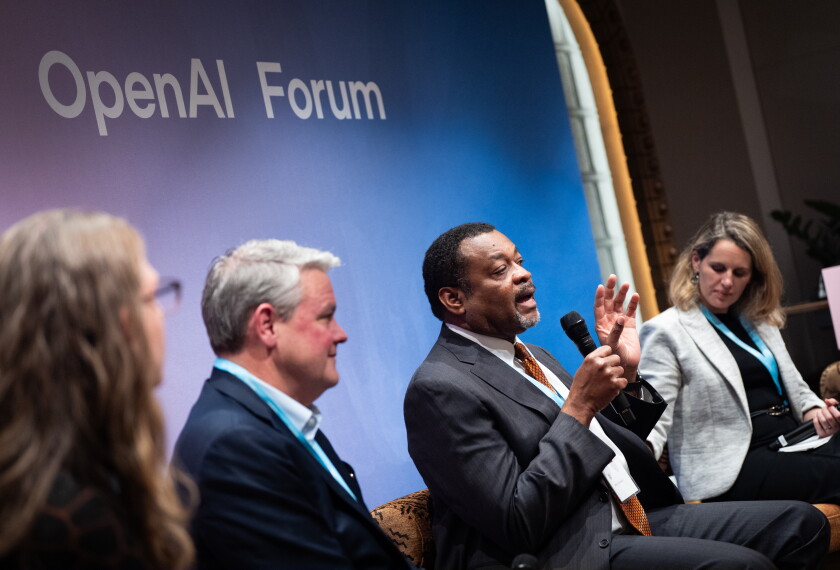
Washington, DC - October 5, 2026: Arthur C. Evans Jr., PhD, Chief Executive Officer of the American Psychological Association  speaks during the discussion. The OpenAI Forum hosted a panel on Responsible AI for Teens, how AI can support teens’ learning while promoting safe, healthy use. The program featured an OpenAI Forum panel with experts in learning, adolescent mental health, and family and online safety: Kate Ruane, Director of the Free Expression Project at the Center for Democracy & Technology, Chuck Melley, SVP of Policy, Advocacy and Communities at CodeAI, Arthur C. Evans Jr., PhD, Chief Executive Officer of the American Psychological Association and Mathilde Cerioli, Chief Scientist at everyoneAI. Chris Lehane, OpenAI’s Chief Global Affairs Officer, moderated the conversation and shared context on ChatGPT for Teens, a learning-first experience launched in August and designed to help teens think critically, deepen understanding, and use AI with confidence.
Arthur C. Evans, Jr., the CEO of the American Psychological Association, speaks on a panel at an Oct. 5, 2026, OpenAI forum on how to support responsible use of AI among teenagers.
Sarah Voisin for Education Week