

Would you rather read a book about mythical sea creatures or do a sheet of multiplication problems? Given the choice between listening to a hilarious Read Aloud featuring Elephant and Piggie or laboring through a long-division word problem, what would you choose?
Many of us teachers hated math when we were kids. It wasn’t math’s fault, exactly. It was the way we were taught.
Memorizing rules—"Whatever you do to the top of the fraction, you do to the bottom"—that got scrambled in our brains by the next day’s lesson. Inane rhymes, acronyms (remember FOIL?), and timed “math facts” drills that somehow managed to be boring and stressful at the same time.
Math instruction has gotten a little better since our time, but not much, and it varies by district, school, and even classroom to an alarming degree. In one 3rd grade classroom, students play math games, build things, and debate conjectures; right next door, the kids chant “rules” and dutifully fill in long columns of problems like underage accountants.
When it comes to national attitudes about math, I am a prime example of what’s wrong with America. The last math class I took was in 10th grade (something about triangles, I think). The closest I veered toward math in college was a “Physics for Poets” class for non-majors about mind-blowing concepts involving relativity and chaos theory. (I liked everything about it except the math.)
When I started teaching 4th grade, I had no idea what to do if the kids didn’t already understand the math concept I was teaching. I once froze up in the middle of a measurement lesson, with no idea how to go on. My mentor teacher (bless her) had to step in and finish the lesson.
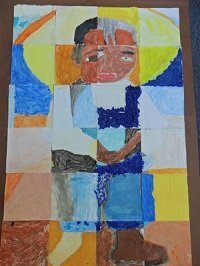
I got better at teaching math, mostly because I had to. I paid way too much money out of pocket to take a course at Bank Street College of Education on teaching math conceptually. When I came to my current district, I did several years of in-depth training on Cognitively Guided Instruction, an approach that treats arithmetic in the early grades as a foundation for algebra later on. I went to a National Council of Teachers of Mathematics conference where I attended fascinating workshops on engineering simulations and teaching ratios through giant collaborative reproductions of famous paintings.
I was never a good math student, but I have become a damn good math teacher. It wasn’t easy to get here, and I still find myself backsliding. Going whole weeks where the only thing kids touch in math class is a pencil. Trying to take shortcuts by just telling my struggling math students what to do on a particular problem, rather than doing the arduous work of getting them to true understanding. Worrying too much about the “whack-a-mole” game of hitting those dozens of surface concepts that pop up on tests, rather than building a deep foundation for mathematical thinking.
When I find myself drifting dangerously close to the kind of third-rate math instruction I experienced as a kid, I go back to a few principles that make math vibrant, creative, meaningful, and fun. Here are my top three.
1. Have kids build things.
Students can create the multiplication table rather than memorizing it, by figuring out which arrays could make products like 12 (2x6, 3x4, 1x12). They can see that a square number (4, 9, 16) is an actual square. They can get that 3x4 and 4x3 both have 12 squares, but you rotate the array when you flip the factors.
Have them fold paper to make their own fraction strips, so they get that there are two halves in a whole, or four fourths, and that the more times you cut up a piece of paper, the smaller each piece will get—which explains the dissonance they feel when 1/12 is so much smaller than 1/3, even though 12 is a bigger number than 3.
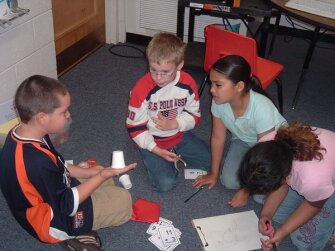
They can apply measurement and geometry to engineering simulations, through design challenges to make a parachute for a gummy bear or to build the tallest, most stable, and most symmetrical tower they can with tape and straws. Math should involve creativity, teamwork, trial and error, and absurd amounts of Scotch tape. It almost never does.
2. Play games, but include the notation.
The biggest difference I see between games that further understanding and games that don’t has less to do with the materials, or even the game itself, than the kind of mathematical notation the kids are doing.
My 1st graders play “Snap It” with rods of Unifix cubes in order to see the commutative property of addition, or to feel all the ways to decompose 10. Each time they snap the rod, they write down the equation. When we do counting collections each Friday, the kids count their shells, toy dinosaurs, or googly eyes by fives and 10s, but they also record the repeated addition involved in that counting.
3. Teach young kids to decompose numbers.
Students have to get comfortable with the idea that numbers are flexible, not fixed quantities. They have to decompose, or break apart, numbers to make them easier to work with.
Almost every week, I have the kids rotate around the room in teams of three to various whiteboards that each have a number written at the top: 10, 25, 100, and so on. In their team, the kids decompose the number as many ways as they can before it’s time to rotate to the next station.

Each board is a rich trove of mathematical concepts and properties. For example, the kids who decomposed “25" wrote equations that served as three different teaching points during our discussion afterwards.
20+5=25 and 5+20=25. We revisited the class conjecture they came up with the first week of school: You can flip the numbers when you’re adding and still get the same total (the commutative property of addition.)
2+5=25 and 10+10+5=25. We discussed the fact that 2+5 is actually 7, because the numeral 2 in 25 is really 20, the way the second equation shows.
25+0=25. This was an easy way to revisit the additive identity property, or “zero rule” in their words, and it went with that morning’s Read Aloud: Zero Is the Leaves on the Tree.
Breaking the Cycle of Bad Math
We tend to teach the way we were taught, the same way moms and dads often re-create our own childhoods when it comes to the way we raise our children. It’s OK if you weren’t good at math when you were in school. It’s OK if you have usually taught with worksheets, textbooks, and memorized rules. But we can break that bad pattern.
Let’s try to fill our students’ hours of math with as much color, construction, meaning, deep thinking, and sensory experiences as possible. They will need math their whole lives, even if they never experience the go-to examples of balancing a checkbook or making sure they don’t get cheated on the change they get back at a store.
We all use logical reasoning, spatial thinking, and concepts of number, whether we’re rearranging the furniture in our living room, grocery shopping for a dinner party, or deciding whether to pay the extra 55 cents for a venti rather than a grande mocha on a bleary-eyed Monday morning.
Our students need to see, feel, and understand math at a physical and intuitive level. Let’s try to give them that gift that so many of us were denied.
Photos taken by the author in his classroom: a 2nd grade class’s re-creation of Diego Rivera’s Retrato de Ignacio Sanchez, 2nd graders discussing their design for a mini-parachute, and a 1st grader decomposing her group’s number at their math station.


