Classroom Technology From Our Research Center

Who Pays for Repairs to Students’ School-Issued Devices?

By Lauraine Langreo — January 27, 2025 2 min read
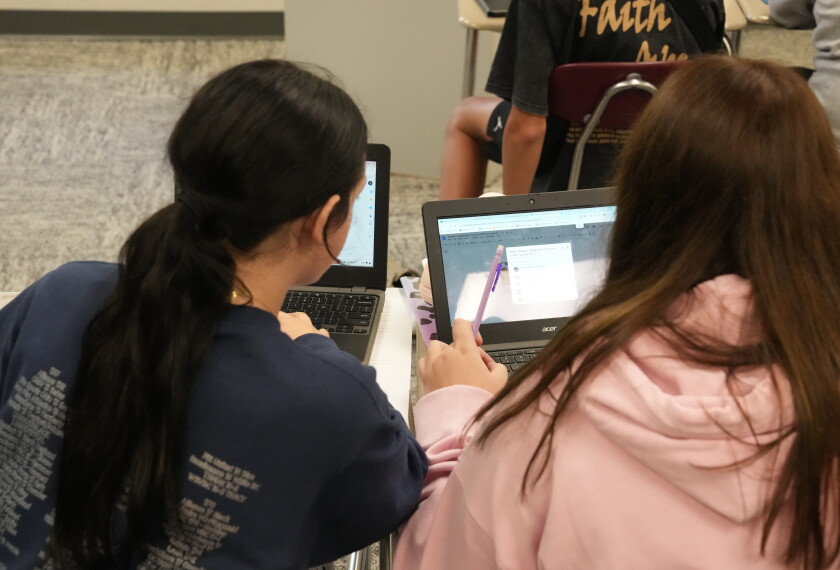
Tightly cropped photo of a group of students sitting at their desks in the classroom using laptops.
  • Save to favorites
  • Print

Nearly everything a student in most schools needs to do for their classes is now on a school-issued laptop or tablet, making these devices essential for accessing learning materials.

But maintaining these 1-to-1 computing environments in schools comes with a big hurdle: figuring out who is responsible for paying when devices need to be repaired or replaced, especially as district leaders report that one of the biggest challenges with 1-to-1 programs is students damaging or destroying devices.

Half of district and school administrators say the district or school is responsible for the cost of repairs or replacements, unless it’s the student’s fault, according to a nationally representative EdWeek Research Center survey of 1,135 educators conducted in September and October.

“A lot of that has to do with the fact that we are requiring students to have these [devices] in order to access their educational materials,” said Sarah Radcliffe, the director of future-ready learning for the Altoona school district in Wisconsin. “So we have to take on some of the burden in keeping them in good working order.”

In the 1,800-student Altoona district, if there’s intentional damage, such as if a student pokes the screen with a pen, then the district charges the student for the materials to repair the screen, Radcliffe said.

The district’s student handbook lists the costs of repairs, and families sign off on the acceptable use policy, she said. The district repairs accidental damage at no cost to families, but repeated accidental damage could lead to the family paying for some repairs, as well as a discussion with the student and family about how to better care for the device. For families who might not be able to afford repairs, the district finds other ways to pay for them.

“We want everyone to have equitable access to our 1-to-1 devices and to be able to access their educational content,” Radcliffe said. “We have to walk that fine line of trying to teach responsibility without being punitive to a child who maybe makes a mistake.”

But even if families don’t pay, the students don’t lose access to their device because it’s necessary for learning, Radcliffe said. That means districts like Altoona have to take into account those unrecovered costs when planning their technology budgets.

In fact, more than a quarter of district and school administrators say their district or school always pays the cost of repairs or replacements regardless of the nature of the damage, according to the EdWeek Research Center survey.

But the challenge of maintaining 1-to-1 programs and paying for repairs is now exacerbated by lack of funding, district technology experts say. The federal pandemic relief funds that helped districts make huge investments in technology have since expired, and districts that relied on those funds now have to find other ways to repair or replace school-issued student devices.

To make the funding challenge even harder, the replacement cycles for school-issued learning devices typically fall into 3- and 5-year cycles, according to the Consortium for School Networking, or CoSN. That means a huge number of devices that were purchased by schools in 2020 and 2021 to support remote and hybrid learning are now nearing the end of their life cycles.

Related Tags:

Events

Teaching Profession K-12 Essentials Forum Supporting the New K-12 Workforce: What Teachers Need to Stay at School
 Join this free virtual event to discover what teachers say they need to feel supported to stay in classrooms for the long haul.
College & Workforce Readiness K-12 Essentials Forum Career and Technical Education Takes Its Next Big Step
Join this free virtual event to hear creative approaches to modernize CTE programs and navigate the shift away from a near-exclusive focus on "college preparedness."

EdWeek Top School Jobs

Teacher Jobs
Search over ten thousand teaching jobs nationwide — elementary, middle, high school and more.
View Jobs
Principal Jobs
Find hundreds of jobs for principals, assistant principals, and other school leadership roles.
View Jobs
Administrator Jobs
Over a thousand district-level jobs: superintendents, directors, more.
View Jobs
Support Staff Jobs
Search thousands of jobs, from paraprofessionals to counselors and more.
View Jobs

Read Next

Classroom Technology Tech Backlash Prompts Responses From Leader of Top Ed-Tech Group
Rebuilding trust with communities on tech concerns must be a high priority, CEO says.
4 min read
Education Rural Schools 25323724091271
Students work together on a science, technology, engineering and mathematics challenge, facilitated by the Kentucky Science Center, in Simpsonville Elementary School, Nov. 18, 2025, in Simpsonville, Ky. Many schools across the country are now being asked to justify their use of technology in instruction.
Jon Cherry/AP Photo
Classroom Technology Q&A How Schools Can Limit Screen Time, But Still Use Tech Effectively
A district leader discusses how adolescent brain development and screen use affect learning.
5 min read
LuAnn Oliver's son, who is in 6th grade, demonstrates how he uses an iPad for his classes during a May 9, 2026 gathering at Oliver's house in Arlington, Va. A group of parents were there to discuss ways to encourage schools to limit screen time. Concerns about the overuse of technology in schools are rising across the country.
LuAnn Oliver's son, who is in 6th grade, demonstrates how he uses an iPad for his classes during a May 9, 2026, gathering at Oliver's house in Arlington, Va. A group of parents were there to discuss ways to encourage schools to limit screen time. Concerns about the overuse of technology in schools are rising across the country.
Kevin Wolf/AP
Classroom Technology Are Ed Tech's Academic Benefits at Odds With Its Social-Emotional Downsides?
An EdWeek Research Center survey asked educators how tech is shaping students' school experiences.
1 min read
A student types a prompt into ChatGPT on a Chromebook during Casey Cuny's English class at Valencia High School in Santa Clarita, Calif., on Aug. 27, 2025.
A student types a prompt into ChatGPT on a Chromebook during an English class at a high school in Santa Clarita, Calif., on Aug. 27, 2025.
Jae C. Hong/AP
Classroom Technology Opinion How to Run a Classroom That’s Not Screen-Dependent
Educators share tips for navigating thorny decisions about ed tech.
12 min read
Conceptual illustration of classroom conversations and fragmented education elements coming together to form a cohesive picture of a book of classroom knowledge.
Sonia Pulido for Education Week