

The role of artificial intelligence in classrooms is rapidly evolving, and educators are divided over how to handle it.
Teachers are using AI to draft lesson plans, brainstorm solutions, and identify where students are struggling. But students’ use of AI is raising new ethical and instructional questions.
Many teachers cite generative AI platforms as a common tool for students to cheat on assignments, while some critics warn about potential cognitive effects for students who rely on AI instead of developing their own skills.
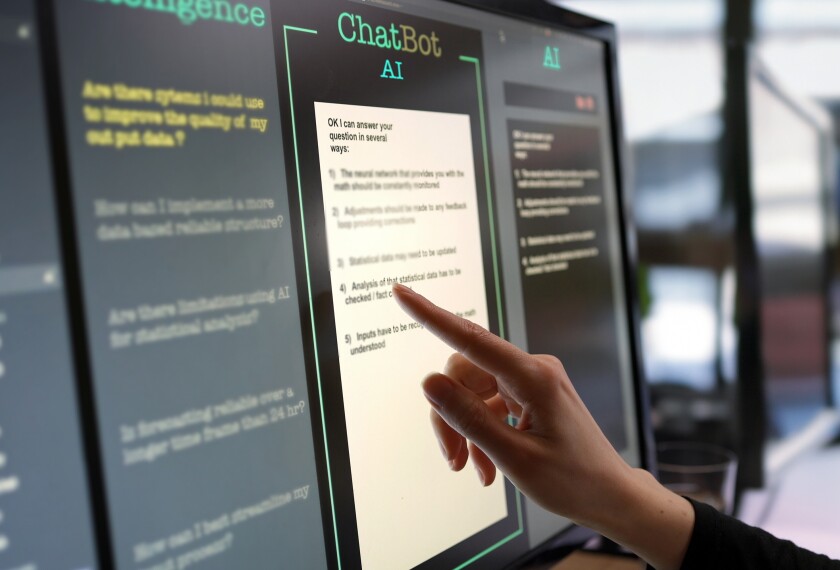
Some states and school districts have adopted AI policies, but others have not—creating a patchwork approach that leaves room for misuse. Educators’ comfort with AI varies widely. However, as Tanisca Wilson, a member of the National Council of Teachers of English, said, “AI is our friend and not our enemy.”
“We need to reimagine what we can do with such a powerful tool,” she said.
To do that, Wilson said educators must shift their mindset from seeing AI as a tool that suppresses critical thinking to viewing students as contributors who can shape how AI is used.
She added that for students to develop their creative voice, it’s important for educators to demonstrate both the benefits of generative AI—such as revising a paragraph—and its limitations.
“You can’t be equally proud of something that a computer has generated,” Wilson said.
As more generative AI technologies become available, some teachers employ AI-detection tools, whose effectiveness at accurately detecting plagiarism has been questioned. Wilson said some educators are shifting to a more in-class model of assessments instead of traditionally assigning homework because of the rise in generative AI.
In a May and June 2023 EdWeek Research Center survey about how math instruction should—if at all—change to address the existence of AI platforms that can solve math problems for students, 43% of teachers, principals, and district leaders said students should solve problems in class using pencil and paper. Thirty-seven percent said students should explain their solutions orally, while 34% said students should be taught to incorporate AI into math assignments.
Classroom strategies in action
Ana Sepulveda, a 6th grade math and dual-language teacher in the Dallas Independent school district, said she allows her students to use generative AI platforms for specific assignments, such as translanguaging their curriculum. She added that although she assigns online learning modules, students are required to show their work in a journal, which counts as a project grade.
“That journal [is] the story of how much work they’re putting in, day in and day out,” Sepulveda said.
Lisa Apau, a high school science teacher in Massachusetts’ Worcester public schools, said she encourages her students to use AI platforms, but for situations when they don’t understand course material.
“I’m not going to fight that battle. What I want to do is ... encourage kids to use it with ethics,” she said.
To discourage students from inappropriately leaning on generative AI, Apau recommends that educators design assignments creatively. In her anatomy classes, for example, Apau asks students to draw parts of the body. Although not a direct result of more AI platforms, Apau said those methods make it harder for students to cheat.
Keeping students engaged while defining responsible use
At High Tech Los Angeles, a charter school in California, teachers use a project-based learning model to limit reliance on AI and assess students’ learning skills.
“If they get involved in a project, and are super passionate about it, and there’s a lot of buy-in, they don’t need to or want to use AI,” said Bianca Batti, an English teacher at High Tech High. “A lot of it is incumbent on me, as the educator, to make sure I am engaging in the kind of praxis and curriculum development and pedagogy that speaks to students.”
Ellese Jaddou, a chemistry teacher at the school, has seen students use generative AI platforms as a “supplement to Google”—sometimes copying homework answers directly from ChatGPT. But she said a smaller portion of her students use it for project inspiration.
In Yakima, Wash., Beth Dallman, a chemistry teacher and International Baccalaureate coordinator at Davis High School, said AI is included in her school’s academic honesty policy, which allows for its use if it is cited as a source.
Before the debate on AI, educators wrestled with similar concerns about calculators on students’ math performance. Like calculators, Dallman believes generative AI should be reserved for students age 13 and older—the minimum requirement for some platforms such as Google Gemini and ChatGPT. Dallman believes educators should educate students on how to use AI as a resource—like a search engine or calculator—as she said it is “going to be part of everyone’s life.”
Regardless of one’s personal stance, Colleen Molina, the principal at High Tech High, said educators must teach students how to use AI responsibly.
“I always tell myself, no matter what, we need to educate our students on it. We as a staff need to educate them on the risks of using AI, the [benefits] of using AI, the moral background of using AI, and what you’re putting out there,” she said.


