
Classroom Technology

Video Games Could Actually Be Good for Kids’ Brains, Study Finds

By Lauraine Langreo — November 10, 2022 3 min read
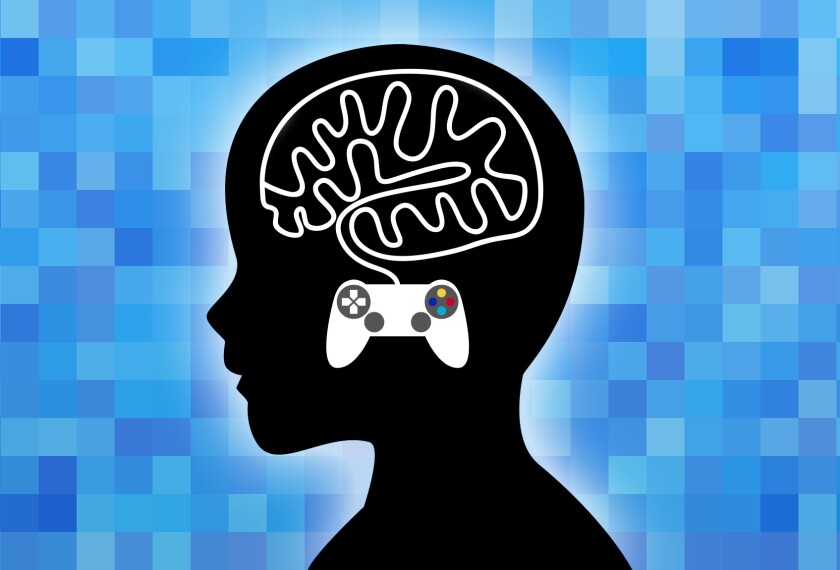
Silhouette of a boy's head with brain made from game controller and cable. Silhouette overlayed on a blue pixelated background.
  • Save to favorites
  • Print

A new scientific study suggests that video gaming may be associated with better cognitive performance in children.

Published in the JAMA Network Open journal on Oct. 24, the study of nearly 2,000 children, ages 9 and 10, found that those who reported playing video games for three hours per day or more performed better on cognitive skills tests involving impulse control and working memory compared with those who had never played video games.

The report, funded by the National Institutes of Health and the National Institute of Drug Abuse, comes as researchers have been divided on how video gaming affects the cognitive skills and brain function of children. Most of the behavioral studies on video games have linked gaming to increases in aggressive or unhealthy behavior in children.

“Many parents today are concerned about the effects of video games on their children’s health and development,” said Bader Chaarani, assistant professor of psychiatry at the University of Vermont and the lead author on the study. “As these games continue to proliferate among young people, it is crucial that we better understand both the positive and negative impact that such games may have.”

Researchers at the University of Vermont in Burlington tested two groups of children: those who played video games for at least 21 hours a week—more than the American Academy of Pediatrics’ recommended screen time guidelines—and those who didn’t play at all.

The researchers found that the gamers did better than non-gamers in tests where they had to control impulsive behavior or memorize information. The gamers’ brains also showed more activity in regions associated with attention and memory. And the researchers saw changes in gamers’ brain functions in areas that are involved with vision, attention, problem solving, and memory processing, Chaarani said in an interview.

“One of the hypotheses is that we may be seeing some sort of practice effect, where you would expect someone who is pretty familiar [with certain tasks] with faster reaction times and interpreting different sources of information at the same time,” Chaarani said about why gamers performed better on certain tasks.

Shifting the narrative about the benefits and drawbacks of video games

The research didn’t examine whether the type of video game the kids played affected their cognitive skills, but the researchers said that the genre of the game may have different effects for brain development. Chaarani said he is working on another research project that examines specific genres of video games.

See also

High school students in Coral Gables, Fla., work together on a tablet during a history class.
High school students in Coral Gables, Fla., work together on a tablet during a history class last school year.
Josh Richie for Education Week

“The results are helpful in shifting the narrative that video games are a waste of time for children and away from the knee-jerk concern that they are linked with aggression or violence,” said Mike Robb, the head of research for Common Sense Media, an organization that reviews and rates how suitable tech tools are for children.

“[But] we should exercise caution about whether children’s performance on the cognitive tasks in the study can be generalized to real-world activities and tasks,” he added.

While the study adds to the growing body of research on the links between gaming and brain development, it doesn’t establish a causal relationship. The findings were inconclusive on whether video games deliver cognitive benefits or if children who are already good at impulse control and memorization seek out video games.

The study also found that children who reported playing video games for three or more hours per day were more likely to report higher mental health and behavioral issues compared with children who played no video games. But because the study only looked at the association between gaming and cognitive skills, the researchers couldn’t conclude whether those behavioral issues “precede and drive” gaming or if gaming resulted in those benefits.

Related Tags:

Events

Jobs Regional K-12 Virtual Career Fair: DMV
Find teaching jobs and K-12 education jubs at the EdWeek Top School Jobs virtual career fair.
This content is provided by our sponsor. It is not written by and does not necessarily reflect the views of Education Week's editorial staff.
Sponsor
Artificial Intelligence Webinar
Making AI Work in Schools: From Experimentation to Purposeful Practice
AI use is expanding in schools. Learn how district leaders can move from experimentation to coordinated, systemwide impact.
Content provided by Frontline Education
This content is provided by our sponsor. It is not written by and does not necessarily reflect the views of Education Week's editorial staff.
Sponsor
Student Well-Being & Movement Webinar
Building Resilient Students: Leadership Beyond the Classroom
How can schools build resilient, confident students? Join education leaders to explore new strategies for leadership and well-being.
Content provided by IMG Academy

EdWeek Top School Jobs

Teacher Jobs
Search over ten thousand teaching jobs nationwide — elementary, middle, high school and more.
View Jobs
Principal Jobs
Find hundreds of jobs for principals, assistant principals, and other school leadership roles.
View Jobs
Administrator Jobs
Over a thousand district-level jobs: superintendents, directors, more.
View Jobs
Support Staff Jobs
Search thousands of jobs, from paraprofessionals to counselors and more.
View Jobs

Read Next

Classroom Technology Students Can Hear Questions Aloud When They Take Many Tests. Does It Help?
Text-to-speech tech helps some students answer questions correctly, but hurts others' performance.
2 min read
Young student in a school computer lab concentrates on a laptop while wearing pink headphones; classmates work nearby in a bright, collaborative learning environment focused on technology and study.
Vanessa Solis/Education Week + Getty Images
Classroom Technology Screen Time Dos and Don'ts: A Downloadable Guide to Healthier Tech Habits
This guide outlines how schools and educators can build heathier student screen habits.
1 min read
Collage of digital devices with an overlay of a clock.
Liz Yap/Education Week via Canva
Classroom Technology How to Lessen Screen Time in Schools—and Make It More Effective
Districts have tried monitoring software, tech-free days, and parent education to curb screen time.
7 min read
Open laptops, or tablets for younger students, are a common sight during class time post-Covid, as in this 6th grade class period during a "What I Need" period at Cedar Park Middle School in Beaverton, Ore., on April 3, 2026. Cedar Park is experimenting with storing Chromebooks on a classroom cart, instead of assigning them directly to each student, to try to reduce the amount of time students spend on screens during instructional time.
Sixth-graders work on laptops during a class at Cedar Park Middle School in Beaverton, Ore., on April 3, 2026. The school is experimenting with storing Chromebooks on a classroom cart, rather than assigning them directly to each student, to try to reduce the amount of time students spend on screens. Teachers and parents say the pilot program is working.
Mark Graves/The Oregonian via TNS
Classroom Technology Explainer The Good, Bad, and Ugly of Screen Time: An Explainer
Too much screen time is bad for kids. But what does that mean for schools?
9 min read
EdWeek Screen Time
Taylor Callery for Education Week
