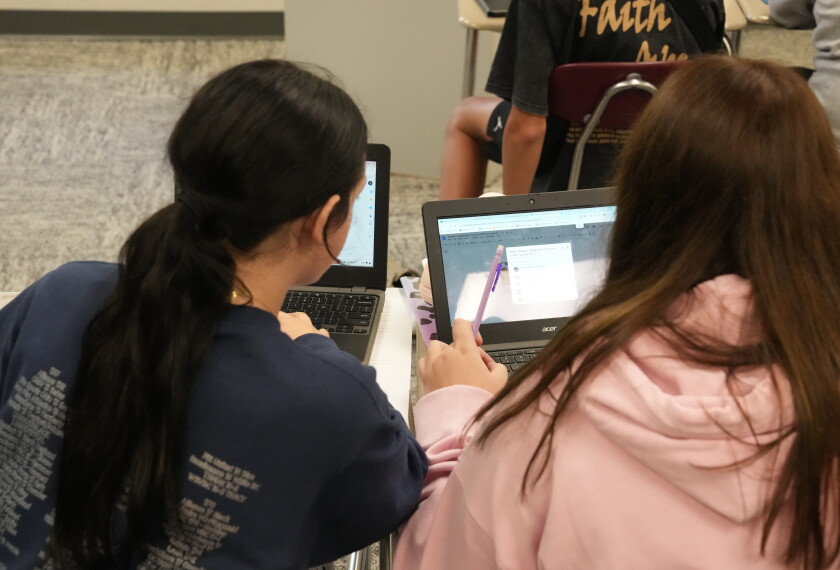
Schools across the United States have been purchasing tech tools to help students make up for the learning disrupted by the closures and other interruptions from earlier in the pandemic.
In Nebraska, the nonprofit online math platform Zearn is one product school districts are using to embrace “acceleration,” a strategy that ensures students can access grade-level content even if they haven’t mastered every concept from the previous grade. A study analyzing the impact of the Nebraska education department’s statewide partnership with Zearn found that elementary and middle school students who consistently used Zearn had 2.5 times the growth in their state assessment scores than students who did not use the platform.
In addition to Zearn, some other tech-driven accelerated learning products on the market include Amira Learning, which provides reading tutoring, oral reading fluency assessment, and dyslexia risk screening; Great Minds’ Eureka Math, an online math curriculum and learning platform; Amplify CKLA, an online English language arts curriculum; and ReadWorks, which provides differentiated reading instruction.

In a video interview with Education Week, Nicole Guth, a 1st grade teacher at South Elementary in Sidney, Neb., discussed how she uses technology to accelerate learning for her students. This interview has been edited for brevity and clarity.
How do you use Zearn in your classroom?

Zearn is broken into different parts: There is a whole group aspect, there’s a small group component, as well as a technology online lesson. In my classroom, students roughly complete three to four lessons each week using Zearn. We start every lesson with a whole group fluency activity. From there, we break up into rotations and small groups. My class is divided in half. Half of the class works with me in a small group to work on our on-level content for that day. The other half of the class works on their online component, which is composed of an adaptive learning path, as well as usually a math chat, a math lesson, notes, a Tower of Power—which is their exit ticket—and then they also have a paper and pencil exit ticket [an assignment students have to do when they finish a lesson to gauge how well they understood it]. In my class, students are allowed to either stay on-level with me or they work up to two lessons ahead or two lessons behind me.
How is it working for your students?
For students who are really excelling in math, I feel like it gives them a good challenge that they’re ready for. I feel like Zearn teaches multiple strategies to use when learning math concepts. So those kiddos are able to really apply some of those math skills that they know before I’ve even taught them, which is amazing. Then we can really talk about different ways to solve the same problem, instead of, “math has to be solved this way and this is definitely the answer.” Math has a definite answer, but there’s so many ways to get to that same answer.
Has it helped improve students’ academic outcomes?
Looking at my student data, this school year for our [winter] MAP testing, I had 100 percent of my class make growth in math, which is phenomenal to see the data improve.
How is it helping you as a teacher?
I enjoy Zearn because I can adapt [students’] path. If they need additional practice, I can go back and bookmark a specific lesson for them to go back and do again on their iPad. If they’re ready to keep going, I love the idea that kids can work at their level and keep working ahead and I’m not holding them back.
Is there anything about Zearn that you think can be improved?
The only thing I wish it had was more data, like more feedback to the teacher. The teacher does get some data about if [students are] struggling or if they’re completing [lessons], if they’re getting bonuses, but I would like more feedback as a teacher about, what specifically are they having trouble with within that piece?
What improvements do ed-tech products in general need in order to help accelerate learning?
Just thinking of what students need and keeping what kids need in mind. When it comes to math, is there an audio button so my kiddos who are struggling readers are able to still do math without struggling to read? Am I able to differentiate so that my kiddos who are ready for a challenge are able to get that challenge and really excel and students that are needing some extra practice are able to go back and have that extra practice? Does it give me data that I can use to improve my instruction or teach to students on their level where they’re at?
What should tech-enhanced accelerated learning look like?
I think it should look like you’re using some type of technology, but you’re also keeping that teacher component. I think that part is important. I think that building those relationships with students and giving them on-level grade material is really important. But [with tech] students can work at their own pace, at their level, at what is appropriate for them.