Jessica B. Heppen is a managing researcher at the Washington-based American Institutes for Research, where she serves as the principal investigator of the AIR’s evaluation of the Los Angeles Unified School District’s massive—and deeply troubled—digital learning initiative. While most of the public attention on the LAUSD’s since-aborted effort to give every student an iPad has focused on a rocky deployment and a procurement process that led to a federal investigation, the AIR also found big challenges inside classrooms. In a September 2014 report, Ms. Heppen and her team wrote that fewer than half the schools visited by researchers were even using the iPads. In those classrooms where the tablets were in play, the most common use by teachers was for whole-class instruction (26 percent of classrooms observed), followed by Internet research (16 percent), and math or reading practice (12 percent). In just two of the 245 classrooms the AIR researchers observed were teachers using the technology to support collaborative student learning.
Staff Writer Benjamin Herold conducted a telephone interview with Ms. Heppen.

What was your approach to learning how new technology was actually being used in LAUSD classrooms?
HEPPEN: We interviewed principals and assistant principals. We did interviews or focus groups with teachers, instructional leaders, and tech coordinators—the people who were formally or informally tasked with supporting technology integration in their schools. Those are perspectives that are often hard to get in large districts. We went into 15 schools and did classroom observations. We also collected back-system usage statistics from the district.
What did you expect to find, based on existing research?
HEPPEN: There aren’t that many studies. What’s often reported is wide variation both in the extent of [technology] use and how it is being used. Clearly, access to technology has increased. But it seems the degree to which teachers integrate technology into their instruction varies according to factors that influence the success or failure of almost any other kind of school reform: leadership, teacher buy-in, professional development, supports for teachers to collaborate. The evidence says that [a technology-driven transformation to student-centered teaching] is rare, but that it can happen.
What did you actually see in classrooms?
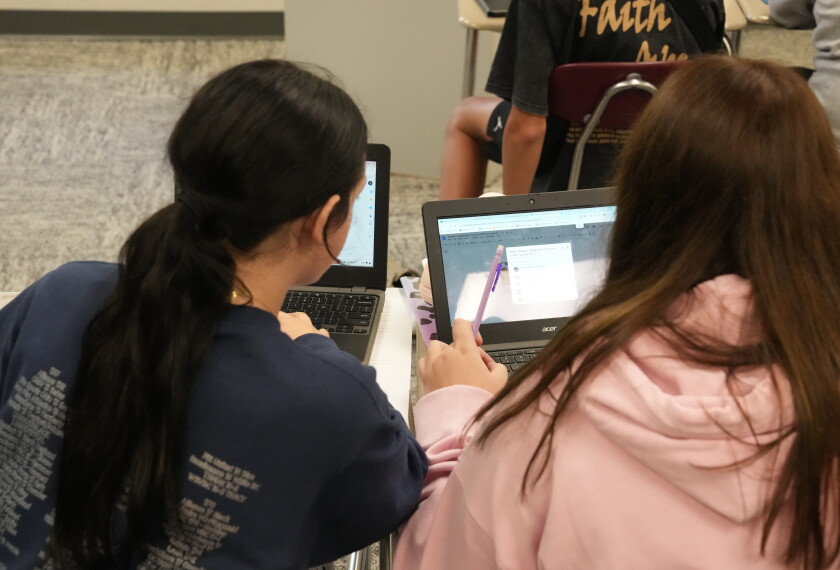
HEPPEN: We saw a couple different kinds of whole-class delivery. There were some promising uses, where teachers created interactive lessons. But it was more widespread to see students using [iPads] to look something up or take notes. At the elementary level, there was a fair amount of using [software or apps] to let students practice English or math.
What did you make of your finding that students in just 10 percent of classrooms you observed were using the new technology to create products and complete projects?
HEPPEN: Is 10 percent rare? I don’t know. As researchers, it stood out to us as a feasible way that teachers and students could move toward integrating technology into their learning experiences. I think we saw it as promising.
Overall, did you think the technology was being used effectively?
HEPPEN: The level of use was perhaps higher than we expected, but the extent and types of uses were not yet close to fulfilling [the technology’s] potential. That is really consistent with almost any study of any school reform in its early stages, and certainly with studies of technology implementation. And remember, this study was done at the end of the school year, during the first year implementing a technology initiative that had lots of challenges in terms of deployment.
“Why Ed Tech Is Not Transforming How Teachers Teach”
What did you find to be the biggest obstacles?
HEPPEN: One significant barrier was the limited level of instructional support [educators] received at the school and classroom level. The staff that was tasked with providing support for technology integration spent a lot of time on deployment and providing technical support.
The [Pearson curriculum that came preloaded on the iPads, for which the LAUSD originally paid millions, but is now seeking a refund] wasn’t functioning properly.
Schools were selected to meet goals related to access and equity. But the readiness [for new technology] sometimes wasn’t there in terms of infrastructure.
What is the takeaway for other school districts?
HEPPEN: There needs to be a coherent vision for how technology should be used in the classroom, and that has to be articulated clearly and reinforced, with a chance for it to evolve with input from folks at the school level.
You need to coordinate with other initiatives. You need high-quality materials. There needs to be support for professional development and [teacher] collaboration.
You can’t just drop the technology off at the door. If that’s what happens, some educators will find promising ways to transform their practice, but it won’t happen at scale.