In Southern California’s Cajon Valley Union school district, puzzling through what artificial intelligence should mean for teaching and learning is an all-hands-on-deck affair.
The district’s school board will consider an AI policy this month that was crafted collaboratively by students, teachers, and school leaders, with cooperation from the district’s parent-teacher association and employee union, said David Miyashiro, the superintendent of the 18,000-student district. The proposed policy emphasizes responsible use of the technology and the importance of maintaining a human connection with students.
Miyashiro acknowledges that Cajon Valley wasn’t the first out of the gate on crafting and approving an AI policy.
In fact, the district is about where many school systems are across the nation.
Nearly half—45%—of teachers, principals, and district leaders say their district or school does not have an AI policy, according to a nationally representative survey conducted this summer by the EdWeek Research Center. Another 16% said their current policy does not establish meaningful guardrails about how to use the technology for instructional purposes.
Cajon Valley’s collaborative approach wasn’t the fastest way to create a policy, Miyashiro said. Drafting took place over the course of 10 weeks, though the district worked to educate staff about AI for more than a year before that. But he believes it will result in AI guidelines that parents, teachers, and students feel ownership of.
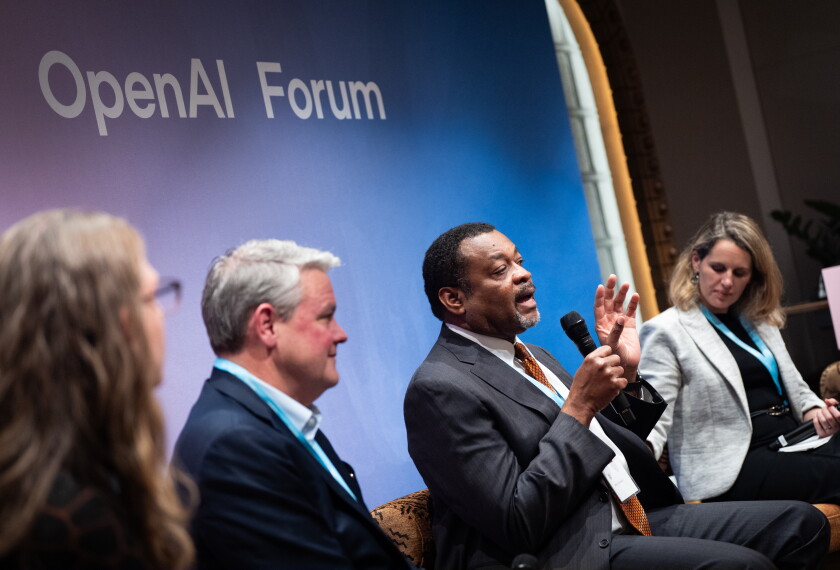
Miyashiro shared more about his district’s approach to AI at an event hosted by AASA, the School Superintendents Association, in November. He also spoke with Education Week last month. This interview has been edited for clarity and brevity.
Why was it so important to reach out to so many different stakeholders in crafting an AI policy?
One of the things I think that makes us strong is that anything we do as a district involves humans. The humans that make decisions for us are our school board and our labor unions, along with our principals. We want to make sure as we adopt and embark on new initiatives that they’re the ones who are driving the decisionmaking.
It’s more time-intensive, but in terms of ability to move a system, that’s what’s necessary: relationships, communication, ultimate trust between the different layers of the organization.
Districts that try to implement these things from a top-down structure, which education tends to do—it’s just not going to work.
How did you educate teachers and other school staff about AI so they could be informed decisionmakers in crafting a policy?
For the last two years, the ASU+GSV conference had an Air Show [teaching educators about AI].
It’s 20 minutes from us. So we invited all of our employees to go. Anybody could go—our custodians, our office managers, anyone interested in AI. That gave us several hundred employees really getting curious about what’s happening [on AI]. And we took their input.
That’s the critical step: involving and including stakeholders in hearing and seeing all the things that are happening [on AI] so that they can be part of the decisionmaking process.
AI is constantly changing. How are you going to make sure your policies or guidelines keep up?
We’ll continue to iterate. It’s going to be a moving target, so we have to be constantly be thinking and talking and considering, how is this going?
What do you think is going to be the biggest challenge of implementing AI?
Change management.
When we went from print to digital, you could actually see it, right? You could observe that. You could go to a school and say, “oh, OK, they’re using blended learning. They’re using these software tools.”
This time, there’s no hardware change. The change is really hearts and minds and deep practices, philosophical practices. It’s a different kind of change. So the change management of this process is going to need a lot more time and stickiness with our relationships, and a lot of listening to hear where people are feeling uncomfortable.
It’s going to be a hard process.
What would be your advice to other district leaders as they approach AI?
Study what’s happening in AI in other industries. Don’t just look at, “what is this [nearby school] district doing?” ... We’re looking at how companies like Nvidia and Uber are transforming their business model utilizing AI, how Fortune 50 companies are looking at it.
What education fails to do is recognize that these advances of technology are a cross sector. Health care is benefiting, engineering is benefiting, automotive is benefiting.
If we try to make this an education-only solution, we’re going to miss the opportunity of what’s really possible.