Artificial Intelligence

3 Ways Teachers Can Help Students Think Critically About AI

By Jennifer Vilcarino — July 08, 2026 3 min read
Illustration of four shrinking human brains with a circuit board texture and binary code in the background.
  • Save to favorites
  • Print

There are increasing concerns that students’ critical thinking skills are weakening due to the use of artificial intelligence. Media literacy has become central to the conversation about how to address those concerns.

The problem is that in the age of AI, schools are playing a game of media literacy catch-up to help their students apply a more critical eye to online content. They need to speed up efforts to build the skills needed to examine AI-generated content to help students protect themselves from being misled or harmed by inaccurate or inappropriate online material.

According to a RAND Corp. report on AI and homework use from February 2025, 48% of middle school students reported being concerned that AI is harming their critical thinking skills. This number increased by 20 percentage points to 68% by December 2025. In addition, high school students reported a similar concern about the effect of AI, starting at 55% and increasing to 65% over the same time period.

See Also

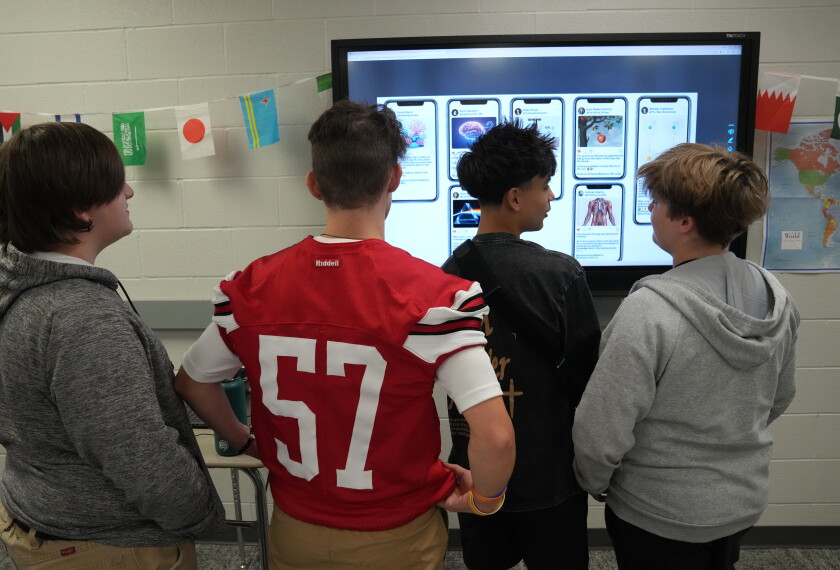
Students present their AI powered-projects designed to help boost agricultural gains in Calla Bartschi’s Introduction to AI class at Riverside High School in Greer, S.C., on Nov. 11, 2025.
Students present their AI-powered projects designed to help boost agricultural gains during an introduction to AI class at a high school in Greer, S.C., on Nov. 11, 2025. A new RAND Corp. survey of middle, high school, and college students shows nearly 7 in 10 middle and high school students say they are concerned that using AI for schoolwork is eroding their critical thinking skills.
Thomas Hammond for Education Week

School principals are especially worried about the use of AI by students, according to a 2025 College Board report. Eighty-seven percent of principals say AI could make it less likely that students will develop critical thinking skills and 82% worry that the use of the technology could get in the way of students engaging deeply with course material.

The challenges created by AI are making media literacy education a higher priority across the country. At least half of U.S. states have enacted laws to advance media literacy education, with 11 passing new legislation since January 2024, according to a report published earlier this year by Media Literacy Now, a nonprofit organization that teaches media literacy to K-12 students.

Based on conversations Education Week has had with educators, below are questions teachers can encourage students to ask when using AI:

1. Am I using AI within the bounds of the assignment?

Teachers can outline for students what is acceptable and not acceptable when using AI for help with an assignment. Students can ask if they have any questions about those guardrails.

For example, in New Jersey’s Passaic school district, students are given an AI acceptable-use rubric. This has been used by some teachers as conversation starters with students about AI, including discussions about responsible use and expectations for assignments.

This exercise can get students thinking about how they want to use AI in their school work.

2. Would I ask my teacher to do this work for me?

Kelly Guilfoil, an English teacher and multilingual specialist at Lake Stevens High School in Washington state, is addressing ethics and AI at the school. Guilfoil created a PowerPoint guide about AI use to help students reflect on the tasks they are asking AI to do and compare those to that of a teacher.

Would a student ask a teacher to write their essay for them? No. Therefore, they should not ask AI to write their essay. Would a student ask a teacher for help with brainstorming for an essay? Yes—which means AI can help with brainstorming ideas for an essay.

3. Are the sources AI provides credible?

The last tip is designed to help students decipher false information from reliable sources. AI has made this challenge much more difficult. One teacher has suggested: if students use AI, then they should begin with a human prompt and end with human reflection.

Students can check the information by comparing AI-generated responses against other online sources. If the information is an image, students can reverse search it, which is looking up an image without using text or keywords, to get more information on the image, according to previous Education Week reporting.

Bottom line: Most experts recommend that students use AI with a healthy level of skepticism and always fact-check the answers it generates. Teachers should encourage them to always take that approach.

Events

Teaching Profession K-12 Essentials Forum Supporting the New K-12 Workforce: What Teachers Need to Stay at School
 Join this free virtual event to discover what teachers say they need to feel supported to stay in classrooms for the long haul.
College & Workforce Readiness K-12 Essentials Forum Career and Technical Education Takes Its Next Big Step
Join this free virtual event to hear creative approaches to modernize CTE programs and navigate the shift away from a near-exclusive focus on "college preparedness."

EdWeek Top School Jobs

Teacher Jobs
Search over ten thousand teaching jobs nationwide — elementary, middle, high school and more.
View Jobs
Principal Jobs
Find hundreds of jobs for principals, assistant principals, and other school leadership roles.
View Jobs
Administrator Jobs
Over a thousand district-level jobs: superintendents, directors, more.
View Jobs
Support Staff Jobs
Search thousands of jobs, from paraprofessionals to counselors and more.
View Jobs

Read Next

Artificial Intelligence How Educators Can Encourage AI Skill-Building Without Being Tech Cheerleaders
State education leaders outline how they've tried to ease anxieties about the fast-evolving technology.
3 min read
ISTEDay3E
Attendees at the ISTELive 26 + ASCD annual conference listen as Kate Meyer, left, an English teacher and instructional innovation coach for the Mount Desert Island, Maine, school district, discusses how she and other Maine educators are addressing teachers' concerns about AI use. Meyer and colleagues presented at the conference, held at the Orange County Convention Center in Orlando, Fla., on July 1, 2026.
Marvin Joseph/Education Week
Artificial Intelligence Q&A How to Use Paper to Teach About AI and Cutting-Edge Tech
Low-tech activities can help students develop a richer understanding of implications and mechanics of AI.
3 min read
ISTEJune29A
Roberta Freitas presents at the ISTELive 26 + ASCD Annual Conference in Orlando, Fla., on June 29. Freitas spoke about the concept of unplugged AI, in which educators teach students about the fundamentals of the tech without immersing them in it.
Marvin Joseph/Education Week
Artificial Intelligence 'Building AI Apps is Not Easy': Stretch, ISTE's Chatbot, Is Finally Ready to Go
ISTE spent the past three years testing and refining the tool, which is now ready for a wider audience.
2 min read
STRETCHai01
StretchAI is unveiled today at ISTELive 26 + ASCD Annual Conference at the Orange County Convention Center in Orlando, Florida on June 30, 2026. This chatbot is aimed at providing educators with carefully vetted instructional resources.
Marvin Joseph/Education Week
Artificial Intelligence Q&A How an English Teacher Helps Students Find Their Voices in the Age of AI
Students' voices are lost when AI does most of the thinking, a teacher says.
3 min read
Timothy Rimke reads during Casey Cuny's English class at Valencia High School in Santa Clarita, Calif., on Aug. 27, 2025.
Timothy Rimke reads during Casey Cuny's English class at Valencia High School in Santa Clarita, Calif., on Aug. 27, 2025. Teachers face the challenge of helping students become writers with their own voices in the presence of generative AI tools.
Jae C. Hong/AP