Why Printed Books Are Better Than Screens for Learning to Read: Q&A
Special Report
Special Report
Reading & Literacy Q&A

Why Printed Books Are Better Than Screens for Learning to Read: Q&A

By Alyson Klein — March 15, 2023 3 min read
ed tech survey march 2023 klein q&a
  • Save to favorites
  • Print

Students who want to read about dinosaurs, delve into English literature classics, or just immerse themselves in a good story have plenty of options: Traditional paper books, e-readers, audio books, tablets, computer screens, even their phones or smart watches.

When it comes to learning, however, are all these mediums created equal? Which are best for comprehension, and which are best for younger students? And how will the increasing digitization of books reshape reading instruction?

To unpack those questions, Education Week spoke with Maryanne Wolf, the director of the Center for Dyslexia, Diverse Learners, and Social Justice at the UCLA Graduate School of Education and Information Studies. Wolf is also the author of Reader, Come Home: The Reading Brain in a Digital World, published in 2018 by Harper Collins.

This conversation—which took place on Zoom—has been edited for clarity and brevity.

Is it a good or a bad idea to have students read on a screen versus on a real piece of paper?

The reality is more complex than a nice, neat, tidy binary. If only it were that simple.

Maryann Wolf

The reality is that we have very interesting data that stretches from 3-year-olds all the way through young adulthood, which suggests there are advantages and disadvantages of each medium, depending on the purpose or intention.
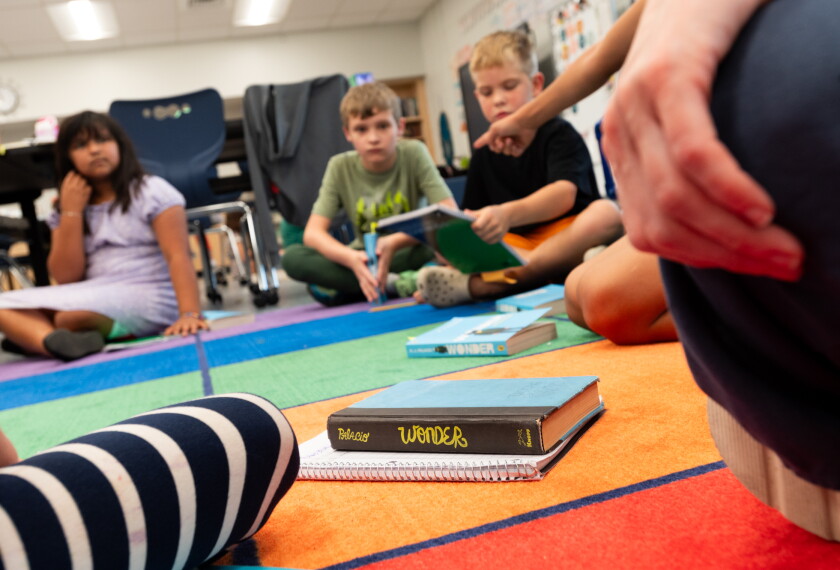
Reading development begins well before any teaching. For young children, physical books are best, audio is second best, and tablet is a clear third. And the reason is that there is a certain double-edged sword here. On the one hand, the tabletis more engaging. On the other hand, it’s a passivity of engagement. It is over-utilizing what we call the novelty reflex that human beings have. This is the last thing we want for child development because we’re wanting them to learn to focus. Instead, they are learning to be distracted.

The most common two words after the child goes off the screen: ‘I’m bored.’ Why? Because they are overstimulated. So between zero and five, the evidence has become quite clear that children’s use of the screen is helping to develop the opposite of what we want in focusing of attention.

Books are really one of the greatest tools for the mind and should never be lost until we are assured that the same processes that were advantaged there are not being diminished by the other mediums.

When are screens helpful?

You heard me say from the start, this is not a binary, right? And I really am very serious about that.

Print has more advantages for children’s learning than screens. However, children who are struggling, like those with dyslexia or those who have a really limited background knowledge on a subject, you can use digital complementary programs for giving that child practice.

The brain never had a single gene or a single region that was specific for reading. Reading is an invention. And what the brain has is the capacity to make new connections among its genetically programmed parts, like vision and language and aspects and cognition. So what reading does, and that’s why the 0-to-5 period is important, is it takes those regions that had been developing for five years, and it connects them.

We can use digital screeners [diagnostic tests that can be paper or digital] to see what [a student’s] development is like. So we want to see: Do they know their letters? Do they know the sounds? Do they have any idea that the sounds are spelled by letters? What is the vocabulary like? We also want to take a look at processing speed.

So even from the start, digital can be used in excellent ways, as a screener [to get an initial handle on a student’s skill level] and as a form of practice for children.

There are fewer people reading physical books these days. What are the implications of that trend?

The perception of the students is that they’re better readers on the screen. They believe that they’re better on the screen because they’re faster. They are faster, but they are faster because they [are] basically scrolling, word spotting, skimming, scanning. That means we have a need to really hone these deep reading skills in print, and then teach their use on digital screens.

We know that print has advantages because it encourages the time-consuming deep reading processes. But in the future, we’re not going to have people like me. We’re going to have most people who are just digital natives. The question is: how do we get the brain to be a deep, empathic, critical, insightful thinker?

Books are really one of the greatest tools for the mind and should never be lost until we are assured that the same processes that were advantaged there are not being diminished by the other mediums.

Events

This content is provided by our sponsor. It is not written by and does not necessarily reflect the views of Education Week's editorial staff.
Sponsor
Teaching Webinar
Closing the Practice Gap: Essential Insights for Leaders
Three instructional experts will share strategies for making students’ reading and math practice more engaging and impactful this year.
Content provided by Renaissance
This content is provided by our sponsor. It is not written by and does not necessarily reflect the views of Education Week's editorial staff.
Sponsor
Student Absenteeism Webinar
Attendance Isn't an Attendance Problem
Boost attendance by strengthening relationships, belonging, and support with practical strategies from Doug Fisher & Nancy Frey.
Content provided by Corwin
This content is provided by our sponsor. It is not written by and does not necessarily reflect the views of Education Week's editorial staff.
Sponsor
School & District Management Webinar
The Principal's Role in Collective Efficacy and Student Outcomes
Learn practical strategies that help principals translate their confidence into stronger collective teacher efficacy and student outcomes.
Content provided by Otus

EdWeek Top School Jobs

Teacher Jobs
Search over ten thousand teaching jobs nationwide — elementary, middle, high school and more.
View Jobs
Principal Jobs
Find hundreds of jobs for principals, assistant principals, and other school leadership roles.
View Jobs
Administrator Jobs
Over a thousand district-level jobs: superintendents, directors, more.
View Jobs
Support Staff Jobs
Search thousands of jobs, from paraprofessionals to counselors and more.
View Jobs

Read Next

Reading & Literacy What is 'Linguistic' Phonics and Why Are Some Schools Adopting It?
A new question is emerging in the "science of reading": Is one type of phonics instruction better than another?
8 min read
Julie Celestial, center, teaches her kindergarten class a literacy lesson at Mark Twain Elementary School in Long Beach, California on Tuesday, May 6, 2025 . A new bill could change how literacy is taught in elementary schools by providing transitional kindergarten through fifth-grade teachers with training and textbooks that stress what's known as science of reading, an approach to literacy that focuses heavily on phonics and foundational reading skills to combat California's literacy crisis. Though other states have shifted to this evidence-based reading, California's reading instruction has largely been left to the control of school districts, many of which have not made the switch. The school has begun their shift to a science of reading approach and are seen as an example for other California districts.
Julie Celestial, center, teaches her kindergarten class a literacy lesson at Mark Twain Elementary School in Long Beach, Calif. on Tuesday, May 6, 2025. Proponents of a "speech-to-print" phonics approach say it works more efficiently than other methods. But research evidence is inconclusive.
Allen J. Schaben/Los Angeles Times via TNS
Reading & Literacy Middle Schoolers' Reading Scores Are Still Stuck at Post-Pandemic Lows
New data shows that the lowest-performing students are falling the furthest behind.
4 min read
Sixth graders read a passage and give constructive feedback to their partners during Nancy Barajas' class at Fairview Elementary School on May 6, 2026, in Modesto, Calif.
Sixth graders read a passage and give constructive feedback to their partners during Nancy Barajas' class at Fairview Elementary School on May 6, 2026, in Modesto, Calif. New research shows the nation's 6th graders' reading scores have flatlined, and the lowest-performing students are losing ground.
Annie Barker/AP
Reading & Literacy Federal 'Science of Reading' Bill Advances
A Senate committee also passed a proposal to classify dyslexia separately under federal disability law.
5 min read
AT LEFT, US Senator Maggie Hassan (D-NH) listens as US Senator Tim Kane (D-VA) speaks regarding the Special Education Administration Act (S. 5038), and the profit the transfer of certain offices to other Federal Agency (S.5046) Act during a Health, Education, Labor and Pension Executive Session at the Dirksen Senate Office Building on Capitol Hill, Washington, DC on Thursday, July 30, 2026.
U.S. Sen. Maggie Hassan, D-N.H., left, listens as U.S. Sen. Tim Kaine, D-Va., speaks during a Senate Health, Education, Labor, and Pensions committee meeting at the Dirksen Senate Office Building on Capitol Hill in Washington on July 30, 2026. The committee advanced two bills related to reading, as well as another opposing the transfer of certain U.S. Department of Education offices to other agencies.
Demetrius Freeman for Education Week
Reading & Literacy Is Required Summer Reading a Good Idea? What the Research Says
Studies show benefits for summer reading in general. But little evidence supports assigning specific books.
4 min read
The desktop of a student at the Wells Preparatory Elementary School reflects the literature they are studying in Charlotte Owens' fifth grade class on Friday, March 8, 2024, in Chicago. In Chicago Public Schools, the average reading score went up by the equivalent of 70% of a grade level from 2022 to 2023. Math gains were less dramatic, with students still behind almost half a grade level compared to 2019. Chicago officials credit the improvement to changes made possible with nearly $3 billion in federal relief.
The desktop of a student at the Wells Preparatory Elementary School reflects the literature they're studying in Charlotte Owens' fifth grade class on Friday, March 8, 2024, in Chicago. Research supports children reading over the summer—but not specifically assigning reading lists or holding kids accountable for completing them.
Charles Rex Arbogast/AP Photo